
国潮手办

Search documents
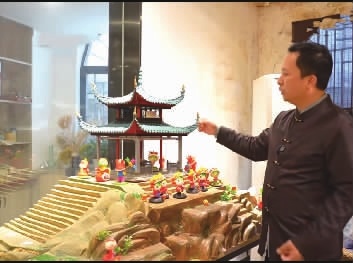
长沙匠人捏出微缩版“爱晚亭”“天心阁”
Xin Lang Cai Jing· 2026-01-06 19:29
Core Viewpoint - The article highlights the transformation of traditional Chinese dough sculpture (面塑) by Chen Jincheng, a representative inheritor of this provincial intangible cultural heritage, who innovatively integrates modern elements to attract younger audiences and elevate the art form to new heights [2][3][4]. Group 1: Artistic Innovation - Chen Jincheng has been creating dough sculptures since 2003 and became a formal apprentice in 2010, aiming to elevate the perception of dough sculptures from mere toys to recognized art pieces [2]. - By using steel wire as a framework, Chen has expanded the scale and durability of his works, with his largest piece reaching 4 meters in height, showcasing intricate details in his work "Love Late Pavilion" [2]. - His dedication led to the recognition of dough sculpture as a district-level intangible cultural heritage in 2016 and its inclusion in the provincial-level list in 2023, marking a significant milestone for this art form [3]. Group 2: Cultural Transmission and Modern Appeal - Chen has focused on engaging younger demographics by incorporating elements of "Guochao" (national trend) into his creations, producing series like national trend figurines and gradient lion sculptures that resonate with contemporary audiences [4]. - Together with his wife, who is also a representative inheritor of the craft, they actively promote the art of dough sculpture, aiming to enhance public awareness of Hunan culture and the artistic value of this traditional craft [4]. - The couple's efforts reflect a commitment to ensuring the longevity and relevance of dough sculpture, aspiring to make this traditional skill more widely recognized and appreciated [4].

洋洋大观丨古韵酿新趣 时尚中国芯——国货渐成年轻人消费首选
Xin Hua Wang· 2025-12-19 03:32
Core Viewpoint - Cultural confidence is driving domestic brands to become the preferred choice for young consumers in China, supported by traditional culture, fashion creativity, and cutting-edge technology [1] Group 1 - Traditional culture is the foundation for the rise of domestic brands, which are increasingly favored by young consumers [1] - The integration of fashion creativity and modern technology is breaking boundaries and enhancing the appeal of these brands [1] - The report highlights a day in the life of "Guochao" (national trend) through the experiences of a Syrian reporter, showcasing the cultural phenomenon [1]
促进轻制造与新消费同频共振
Jing Ji Ri Bao· 2025-11-03 22:37
Core Viewpoint - The urban development is transitioning from large-scale expansion to enhancing existing resources, focusing on "light manufacturing" that integrates production and consumption, responding to new consumer trends and improving quality of life [1] Group 1: Light Manufacturing and New Consumption - Cities are revitalizing old industrial sites and underperforming commercial areas to attract service-oriented and customized manufacturing enterprises, utilizing advanced technologies for a flexible manufacturing model [1][2] - The integration of light manufacturing with new consumption trends effectively meets the demand for personalized, immediate, experiential, and social consumption [1][2] Group 2: Urban Resource Optimization - Cities like Xi'an are actively optimizing the supply of new products and services, transforming old industrial bases and commercial districts to promote the integration of light manufacturing and new consumption [2] - The revitalization of urban resources involves innovative business models and the transformation of low-efficiency spaces to enhance urban functionality [2][3] Group 3: Consumer Experience and Emotional Consumption - Consumers are increasingly valuing the shopping experience, seeking participation and interaction beyond just the products [3] - Emotional consumption is emerging as a significant trend, with products designed to evoke emotional responses, such as unique transportation cards inspired by historical elements [3] Group 4: Challenges and Opportunities - Despite the progress, there are still challenges in innovation supply, resource activation, market expansion, and improving expectations that need to be addressed [4][5] - The local industries, particularly in handicrafts and textiles, show a lack of responsiveness to market trends and innovation capabilities [5] Group 5: Future Development Strategies - Emphasis on developing service-oriented light manufacturing that aligns with consumer demands for deep experiences and personalization [7] - Urban space management should focus on optimizing functional layouts and revitalizing underutilized areas to create diverse consumption environments [8] - New consumption scenarios should be developed by integrating cultural and industrial elements, promoting immersive experiences and innovative consumption models [9][10]