
圆环阵太阳射电成像望远镜

Search documents
【新华社】“观天逐日”——探秘四川稻城大科学装置
Xin Hua She· 2025-11-19 02:04
Core Insights - The article highlights the significant advancements in cosmic ray observation and solar monitoring technologies in China, particularly through the establishment of the LHAASO (High Altitude Cosmic Ray Observatory) and the Ring Array Solar Radio Telescope [9][10][12][14]. Group 1: LHAASO Developments - LHAASO, located at an altitude of over 4,400 meters, covers an area of 1.36 square kilometers and has made a groundbreaking discovery regarding the formation of cosmic ray "knee," providing key observational evidence [9][10]. - The observatory is equipped with nearly 10,000 detectors utilizing four advanced detection technologies, enabling it to capture cosmic ray particles effectively [12][13]. - LHAASO has achieved significant milestones, including the observation of the highest energy gamma photons and the identification of the first super cosmic ray source, marking a leap in China's cosmic ray research capabilities [18][21]. Group 2: Ring Array Solar Radio Telescope - The Ring Array Solar Radio Telescope, consisting of 313 six-meter antennas, is designed to monitor solar activities that impact space weather, providing critical forecasting capabilities [14][15]. - In September 2023, the telescope successfully predicted a solar eruption event, demonstrating its ability to provide timely warnings with an error margin of less than 1.16 hours [14]. - The telescope's construction reflects significant technological advancements, including real-time monitoring of thousands of optical fiber interfaces to ensure precise alignment of antennas [18][21]. Group 3: Research Environment and Infrastructure - The high-altitude location of Daocheng County offers optimal conditions for astronomical observations, attracting numerous scientists and researchers to the area [10][12]. - The construction of these large scientific facilities has faced challenges due to harsh environmental conditions, but the rapid development has showcased China's commitment to advancing scientific research [20][21]. - The collaborative efforts among various research institutions and universities have led to significant technological innovations, enhancing the capabilities of both LHAASO and the Ring Array [21].

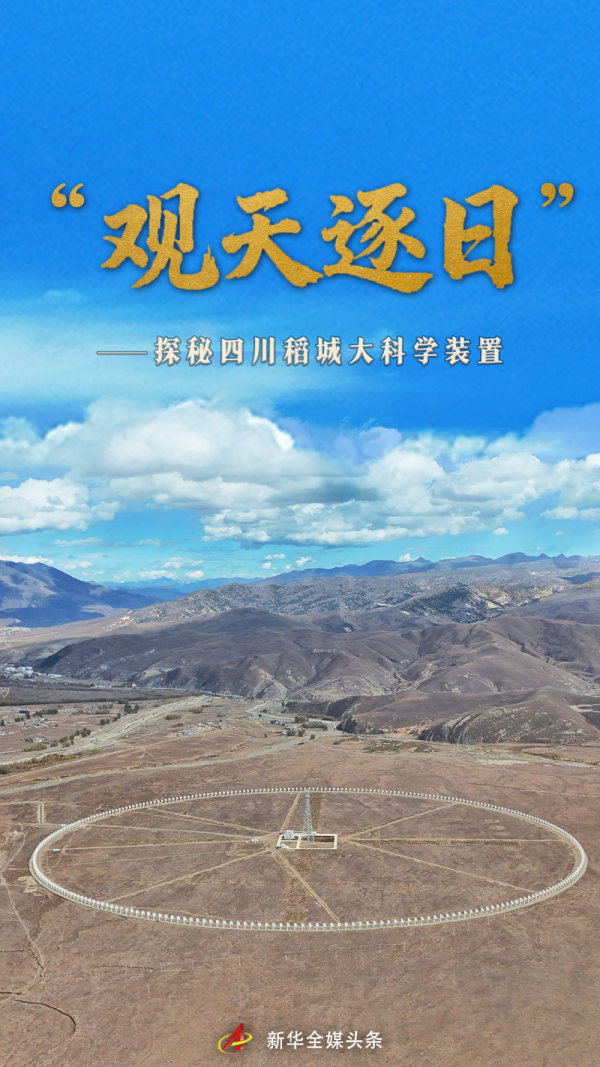
“观天逐日”——探秘四川稻城大科学装置
Xin Hua She· 2025-11-18 18:54
Core Viewpoint - The high-altitude cosmic ray observatory in Daocheng, Sichuan, has made significant advancements in understanding cosmic rays, particularly the "knee" phenomenon, providing crucial observational evidence for a long-standing mystery in the field of astrophysics [3][8][19]. Group 1: Cosmic Ray Observatory - The observatory, known as LHAASO, spans an area of 1.36 square kilometers and is designed to capture cosmic rays, which are high-energy particles from outer space [3][8]. - Since its establishment in 2016, LHAASO has become the world's highest and largest gamma-ray detection facility, achieving national acceptance in 2023 after 14 years of development [8][26]. - The observatory employs advanced detection technologies, including over 10,000 detectors, to analyze cosmic ray interactions and gather data on their origins and acceleration mechanisms [8][12][26]. Group 2: Solar Radio Imaging Telescope - The "Ring Array" solar radio imaging telescope, consisting of 313 antennas, is located near the Daocheng city and is designed to monitor solar activities that affect space weather [15][19]. - This telescope has successfully predicted solar eruption events, improving the accuracy of space weather forecasts significantly [16][19]. - The construction of the Ring Array was completed five months ahead of schedule, showcasing the efficiency of the research teams involved [32]. Group 3: Scientific Advancements and Collaborations - The observatory has led to breakthroughs in cosmic ray research, including the observation of the highest energy gamma photons and the identification of a super cosmic ray source [26][27]. - International collaborations have been established, with 32 astrophysical research institutions from various countries joining the LHAASO international cooperation group [32]. - The advancements in detection technology and the establishment of these facilities reflect China's commitment to becoming a leader in cosmic ray and astrophysics research [28][30].
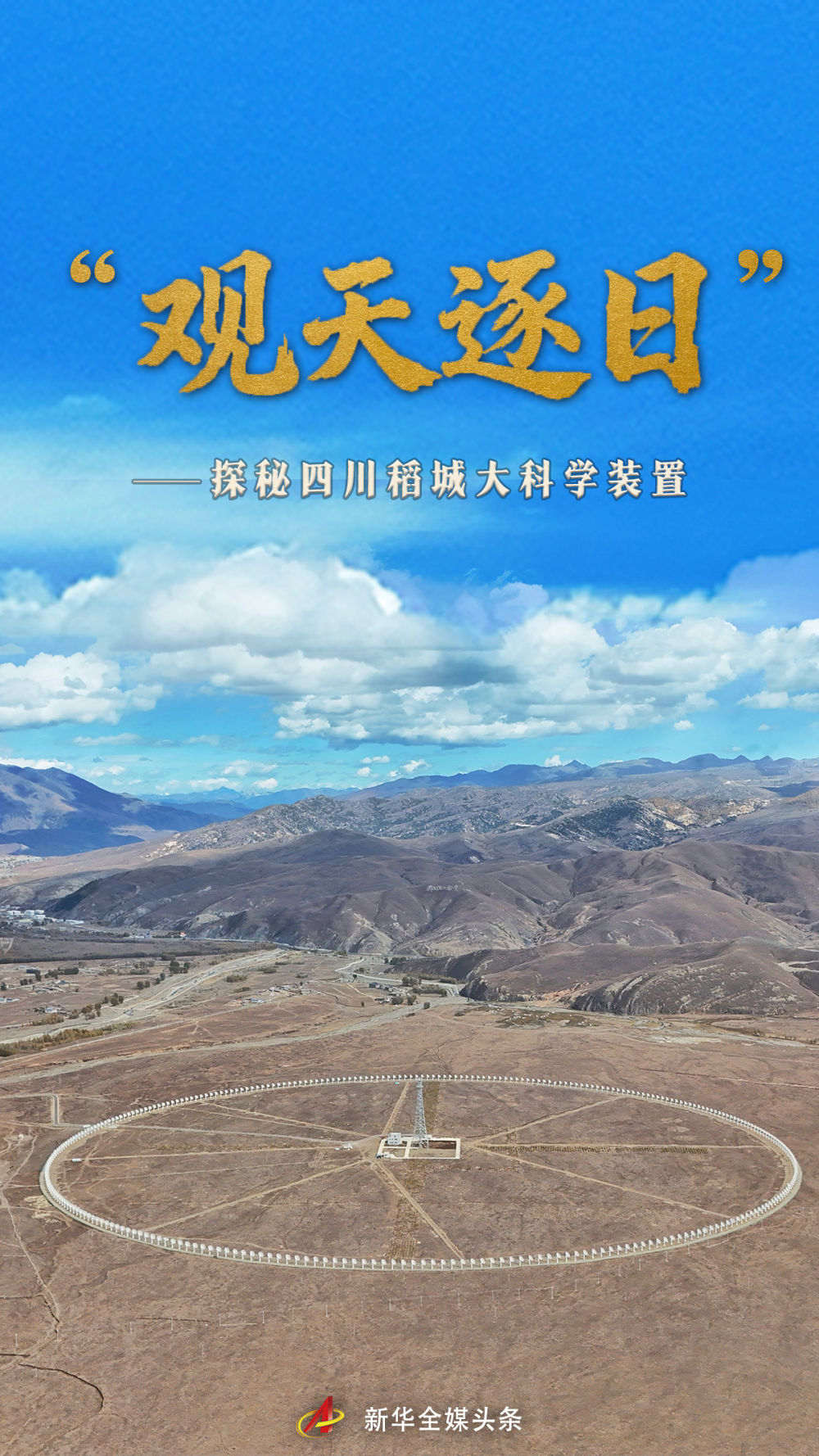
新华全媒头条|“观天逐日”——探秘四川稻城大科学装置
Xin Hua She· 2025-11-18 14:11
Core Insights - The article highlights the significant advancements in cosmic ray research facilitated by the LHAASO (Large High Altitude Air Shower Observatory) located in Daocheng, Sichuan, which has made key discoveries regarding cosmic ray origins and acceleration mechanisms [1][2][8] Group 1: LHAASO Overview - LHAASO is the world's highest and largest gamma-ray detection facility, built to address the long-standing mystery of cosmic ray "knee" formation [2][3] - The observatory covers an area of 1.36 square kilometers and employs nearly 10,000 advanced detectors using four different detection technologies [3][6] - The facility has successfully captured the highest energy gamma photons and confirmed the first super cosmic ray source, marking a leap in China's cosmic ray research capabilities [7][10] Group 2: Technological Innovations - The observatory's design and construction involved collaboration among over 50 research institutes, universities, and enterprises, overcoming numerous technical challenges [10] - The addition of 32 new large-scale imaging atmospheric Cherenkov telescopes is expected to enhance the observatory's spatial resolution by over five times [3][5] - The Ring Array Solar Radio Telescope, another major scientific installation in the region, has demonstrated its capability to predict solar events with high accuracy [5][10] Group 3: Research Impact - LHAASO's findings have revolutionized the understanding of cosmic rays and challenged traditional theories regarding their origins [8][9] - The observatory has recorded significant cosmic events, including the brightest gamma-ray burst to date, GRB 221009A, leading to new insights into gamma-ray bursts [7][8] - The advancements in cosmic ray research are part of China's broader strategy to enhance its scientific capabilities and achieve technological self-reliance [9][10] Group 4: Future Prospects - Daocheng is becoming a hub for major scientific installations, attracting more research projects and enhancing its capacity for sustainable development in scientific research [11] - The ongoing developments in the region are expected to further elevate China's position in deep space exploration and scientific research [11]
徐寄遥:编织“观天巨网”,守望日地空间
Ke Ji Ri Bao· 2025-10-22 06:19
Core Insights - The core focus of the article is on the successful completion and significance of the Meridian Project Phase II, which enhances China's capabilities in monitoring space weather and understanding the solar-terrestrial environment [5][10]. Project Overview - The Meridian Project, officially known as the Ground-based Comprehensive Monitoring Network for Space Environment, is a major national scientific infrastructure aimed at monitoring space weather events that primarily propagate along the meridian direction [5]. - The project aims to provide real-time support for space weather forecasting by monitoring changes in the solar-terrestrial environment with high temporal and spatial resolution [5][10]. Technical Advancements - Phase II of the Meridian Project has achieved a significant leap from "having" to "being strong," establishing a complete monitoring chain from the sun to various layers of the Earth's space environment [10]. - The project has deployed 282 sets of advanced monitoring equipment, including globally unique devices such as the largest integrated aperture radio telescope and the most powerful incoherent scatter radar [11][10]. Network Structure - The monitoring network is structured around a "one chain, three networks, and four focuses" framework, which includes a comprehensive monitoring chain and a grid-like network covering key geographical areas [6][10]. - The project utilizes a unified management and collaborative operation system to ensure continuous and comprehensive monitoring across all stations [8]. Challenges and Solutions - The construction faced significant challenges, including harsh environmental conditions and the need for new technology integration between Phase I and Phase II [7][12]. - Solutions included upgrading existing equipment, standardizing data output, and integrating historical data into a new database [12]. Future Directions - The Meridian Project aims to expand its reach globally and develop a joint monitoring system that combines satellite and ground-based observations for more accurate space weather forecasting [13]. Team Composition - The project team consists of nearly 800 researchers from 16 different institutions, with a diverse range of expertise in various fields of space science [14]. - The team emphasizes nurturing young talent and fostering a collaborative environment to drive innovation and scientific breakthroughs [15][18].

电磁波,看见宇宙的“眼睛”
Huan Qiu Wang Zi Xun· 2025-07-10 02:03
Core Points - The article discusses the advancements in electromagnetic wave detection technology and its applications in understanding both the universe and Earth's environment [10][12] - It highlights the significance of the "Meridian Project," a major scientific infrastructure initiative in China aimed at enhancing electromagnetic wave observation capabilities [10][11] Group 1: Electromagnetic Wave Detection - Electromagnetic waves are crucial for human perception and understanding of the world, extending beyond visible light to encompass the entire electromagnetic spectrum [3][5] - The evolution of technology has allowed humans to utilize various electromagnetic wave frequencies for observation, leading to significant discoveries in astronomy and environmental science [8][9] Group 2: Meridian Project - The Meridian Project, led by the Chinese Academy of Sciences, includes the DART (Dacheng Radio Telescope), which operates in the 150-450 MHz frequency range and is capable of real-time solar radio imaging [10][11] - Additional ground-based observation systems have been established in Weihai, including GNSS ionosphere monitoring and a wideband solar radio monitoring system, enhancing the understanding of solar activities and atmospheric dynamics [11][12] Group 3: Applications and Implications - The advancements in electromagnetic wave technology provide critical data for various applications, including satellite communication, navigation systems, and early warning systems for solar activities [12][13] - The continuous monitoring of electromagnetic waves contributes to a deeper understanding of physical laws and phenomena, supporting scientific research and practical applications in multiple fields [10][12]