
高海拔宇宙线观测站(拉索)

Search documents
【新华社】“观天逐日”——探秘四川稻城大科学装置
Xin Hua She· 2025-11-19 02:04
Core Insights - The article highlights the significant advancements in cosmic ray observation and solar monitoring technologies in China, particularly through the establishment of the LHAASO (High Altitude Cosmic Ray Observatory) and the Ring Array Solar Radio Telescope [9][10][12][14]. Group 1: LHAASO Developments - LHAASO, located at an altitude of over 4,400 meters, covers an area of 1.36 square kilometers and has made a groundbreaking discovery regarding the formation of cosmic ray "knee," providing key observational evidence [9][10]. - The observatory is equipped with nearly 10,000 detectors utilizing four advanced detection technologies, enabling it to capture cosmic ray particles effectively [12][13]. - LHAASO has achieved significant milestones, including the observation of the highest energy gamma photons and the identification of the first super cosmic ray source, marking a leap in China's cosmic ray research capabilities [18][21]. Group 2: Ring Array Solar Radio Telescope - The Ring Array Solar Radio Telescope, consisting of 313 six-meter antennas, is designed to monitor solar activities that impact space weather, providing critical forecasting capabilities [14][15]. - In September 2023, the telescope successfully predicted a solar eruption event, demonstrating its ability to provide timely warnings with an error margin of less than 1.16 hours [14]. - The telescope's construction reflects significant technological advancements, including real-time monitoring of thousands of optical fiber interfaces to ensure precise alignment of antennas [18][21]. Group 3: Research Environment and Infrastructure - The high-altitude location of Daocheng County offers optimal conditions for astronomical observations, attracting numerous scientists and researchers to the area [10][12]. - The construction of these large scientific facilities has faced challenges due to harsh environmental conditions, but the rapid development has showcased China's commitment to advancing scientific research [20][21]. - The collaborative efforts among various research institutions and universities have led to significant technological innovations, enhancing the capabilities of both LHAASO and the Ring Array [21].

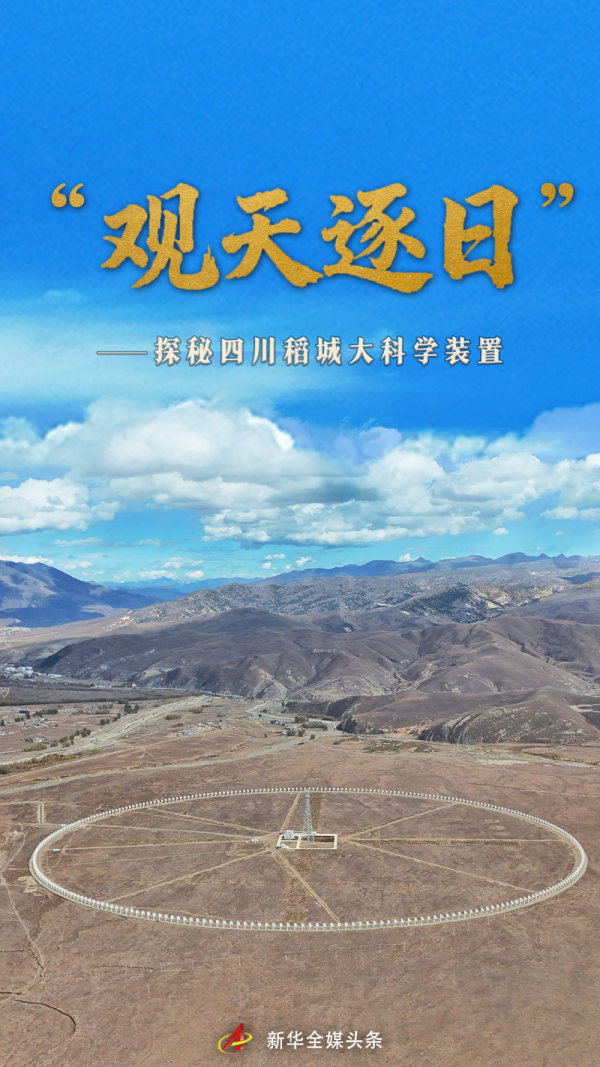
“观天逐日”——探秘四川稻城大科学装置
Xin Hua She· 2025-11-18 18:54
Core Viewpoint - The high-altitude cosmic ray observatory in Daocheng, Sichuan, has made significant advancements in understanding cosmic rays, particularly the "knee" phenomenon, providing crucial observational evidence for a long-standing mystery in the field of astrophysics [3][8][19]. Group 1: Cosmic Ray Observatory - The observatory, known as LHAASO, spans an area of 1.36 square kilometers and is designed to capture cosmic rays, which are high-energy particles from outer space [3][8]. - Since its establishment in 2016, LHAASO has become the world's highest and largest gamma-ray detection facility, achieving national acceptance in 2023 after 14 years of development [8][26]. - The observatory employs advanced detection technologies, including over 10,000 detectors, to analyze cosmic ray interactions and gather data on their origins and acceleration mechanisms [8][12][26]. Group 2: Solar Radio Imaging Telescope - The "Ring Array" solar radio imaging telescope, consisting of 313 antennas, is located near the Daocheng city and is designed to monitor solar activities that affect space weather [15][19]. - This telescope has successfully predicted solar eruption events, improving the accuracy of space weather forecasts significantly [16][19]. - The construction of the Ring Array was completed five months ahead of schedule, showcasing the efficiency of the research teams involved [32]. Group 3: Scientific Advancements and Collaborations - The observatory has led to breakthroughs in cosmic ray research, including the observation of the highest energy gamma photons and the identification of a super cosmic ray source [26][27]. - International collaborations have been established, with 32 astrophysical research institutions from various countries joining the LHAASO international cooperation group [32]. - The advancements in detection technology and the establishment of these facilities reflect China's commitment to becoming a leader in cosmic ray and astrophysics research [28][30].
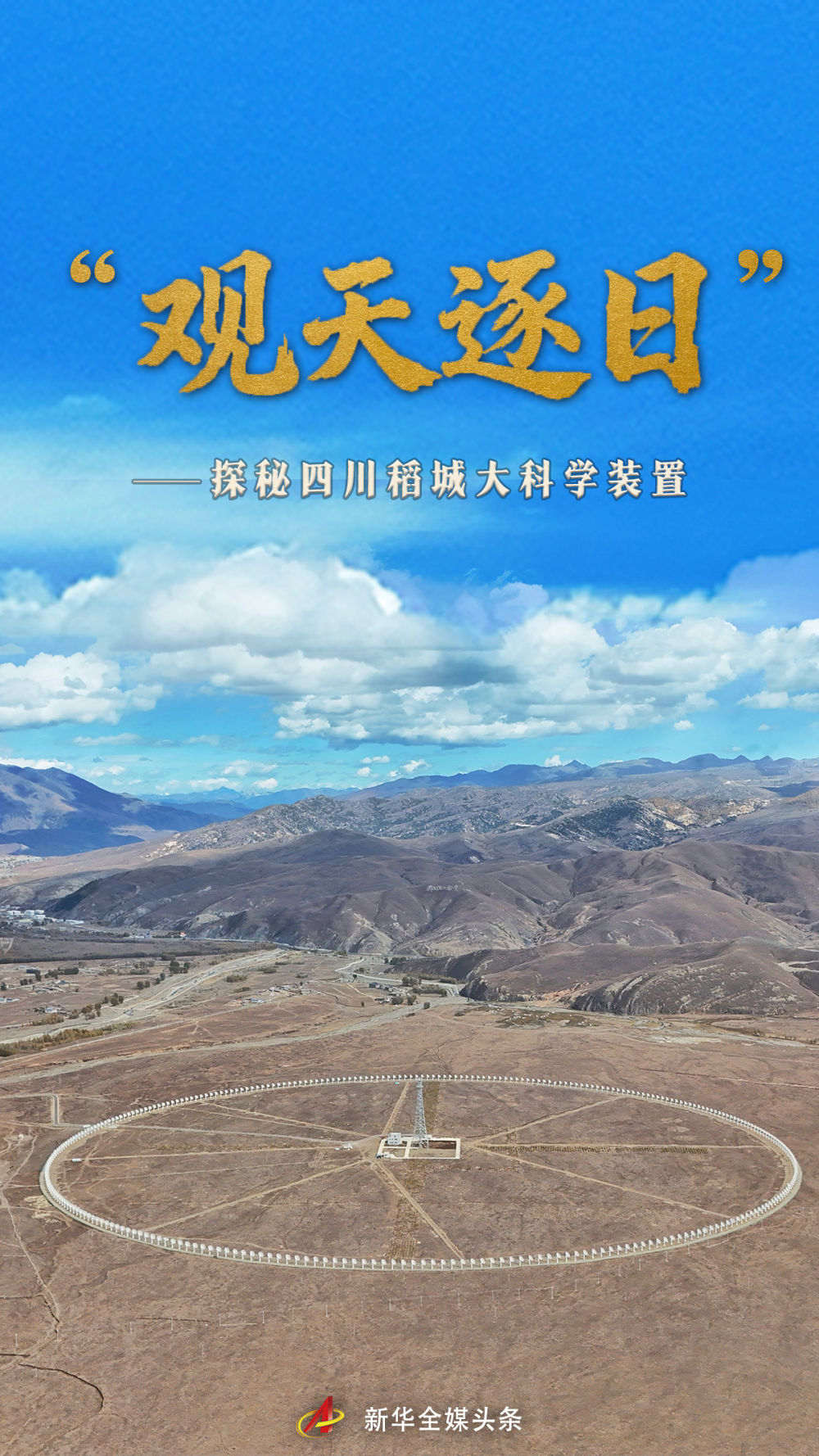
新华全媒头条|“观天逐日”——探秘四川稻城大科学装置
Xin Hua She· 2025-11-18 14:11
Core Insights - The article highlights the significant advancements in cosmic ray research facilitated by the LHAASO (Large High Altitude Air Shower Observatory) located in Daocheng, Sichuan, which has made key discoveries regarding cosmic ray origins and acceleration mechanisms [1][2][8] Group 1: LHAASO Overview - LHAASO is the world's highest and largest gamma-ray detection facility, built to address the long-standing mystery of cosmic ray "knee" formation [2][3] - The observatory covers an area of 1.36 square kilometers and employs nearly 10,000 advanced detectors using four different detection technologies [3][6] - The facility has successfully captured the highest energy gamma photons and confirmed the first super cosmic ray source, marking a leap in China's cosmic ray research capabilities [7][10] Group 2: Technological Innovations - The observatory's design and construction involved collaboration among over 50 research institutes, universities, and enterprises, overcoming numerous technical challenges [10] - The addition of 32 new large-scale imaging atmospheric Cherenkov telescopes is expected to enhance the observatory's spatial resolution by over five times [3][5] - The Ring Array Solar Radio Telescope, another major scientific installation in the region, has demonstrated its capability to predict solar events with high accuracy [5][10] Group 3: Research Impact - LHAASO's findings have revolutionized the understanding of cosmic rays and challenged traditional theories regarding their origins [8][9] - The observatory has recorded significant cosmic events, including the brightest gamma-ray burst to date, GRB 221009A, leading to new insights into gamma-ray bursts [7][8] - The advancements in cosmic ray research are part of China's broader strategy to enhance its scientific capabilities and achieve technological self-reliance [9][10] Group 4: Future Prospects - Daocheng is becoming a hub for major scientific installations, attracting more research projects and enhancing its capacity for sustainable development in scientific research [11] - The ongoing developments in the region are expected to further elevate China's position in deep space exploration and scientific research [11]
拉索发布新成果,发现黑洞在宇宙线起源中的作用
Xin Jing Bao· 2025-11-16 22:49
Core Insights - The latest findings from the High Altitude Cosmic Ray Observatory (LHAASO) indicate that cosmic ray protons in the PeV energy range primarily originate from microquasars, providing significant observational evidence for understanding the role of black holes in the origin of cosmic rays [1][2] Group 1: Cosmic Rays and Their Sources - Cosmic rays are high-energy particle streams from space that carry information about their astrophysical environments [1] - A critical turning point in the energy distribution of cosmic rays occurs around 3 PeV, where the number of cosmic rays sharply decreases, referred to as the "knee" [1] - Previous beliefs attributed cosmic rays to supernova remnants, but it has been found that they struggle to accelerate particles to energies above the "knee" [1] Group 2: Role of Microquasars - Microquasars, formed when black holes in binary systems accrete material from companion stars, are identified as significant PeV particle accelerators [2] - LHAASO has systematically detected ultra-high-energy gamma rays from five microquasars, highlighting their importance in the Milky Way [2] Group 3: LHAASO's Contributions - The High Altitude Cosmic Ray Observatory is designed, constructed, and operated by Chinese scientists, achieving globally impactful breakthroughs in gamma-ray astronomy and cosmic ray measurements [2] - The recent discoveries enhance the understanding of black holes' contributions to the origin of cosmic rays [2]
敢想 敢干 敢当
Ke Ji Ri Bao· 2025-06-23 00:53
Core Viewpoint - The articles highlight the perseverance and dedication of Chinese scientists in overcoming challenges in various research fields, emphasizing the spirit of innovation and responsibility in advancing scientific knowledge and technology [1][2][8]. Group 1: High-altitude Cosmic Ray Observatory "LHAASO" - The construction of the "LHAASO" observatory in Sichuan represents a significant leap in China's cosmic ray research, achieving international leadership [1]. - The project faced skepticism initially, but the team, led by Chief Scientist Cao Zhen, remained committed to enhancing detection sensitivity to make groundbreaking discoveries [1][2]. - The team demonstrated a spirit of resilience, overcoming numerous technical challenges in extreme conditions, embodying the motto that "nothing is impossible" [2]. Group 2: Agricultural Research and Food Security - The dedication of older scientists in ensuring national food security has created a legacy for younger generations to follow [4]. - Young scientists are now taking on the responsibility of advancing agricultural technology in the Northeast black soil region, focusing on protection and restoration efforts [5]. - The "black soil spirit" emphasizes accountability and thoroughness in agricultural practices, as highlighted by researcher Liang Aizhen [5]. Group 3: CO2 Detection Technology - The Shanghai Institute of Optics and Fine Mechanics has developed the world's first spaceborne laser radar for CO2 detection, enhancing China's international standing in climate research [6]. - The project faced significant technical challenges due to the low concentration of CO2 in the atmosphere, requiring high precision in various parameters [7]. - After a decade of persistent effort, the radar has been operational in orbit for three years, yielding numerous groundbreaking results and contributing to national goals [8].