城区NOA(领航辅助驾驶)

Search documents
城区NOA新格局:头部三强争霸,深圳VLA黑马拿下四成市场
3 6 Ke· 2026-02-04 08:27
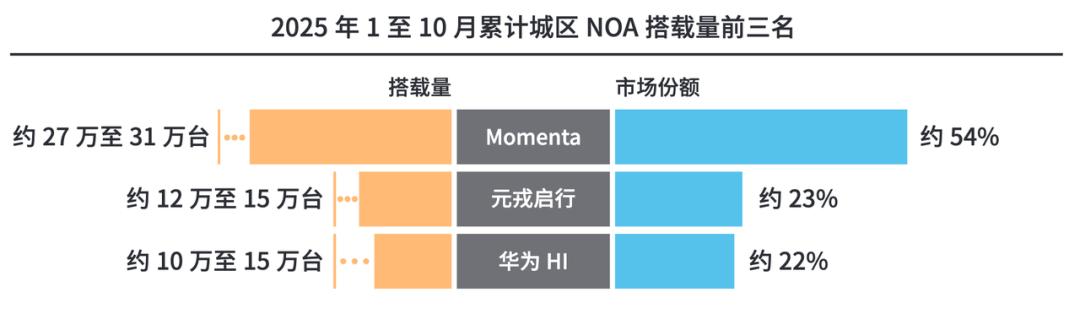
Core Insights - The Chinese smart driving industry is undergoing significant transformation driven by AI, with a focus on urban NOA (Navigation on Autopilot) as a key competitive feature, achieving a penetration rate of 10% by the end of 2025 [1][3] - Major players in the market include Huawei HI, Yuanrong Qixing, and Momenta, collectively capturing over 90% of the third-party market for urban NOA solutions [1][3][6] - The industry is witnessing a shift towards three main technical routes: VLA (Vision-Language-Action Model), world models, and end-to-end reinforcement learning, with ongoing debates about the necessity of incorporating language dimensions [2][9][10] Market Trends - Urban NOA has become the focal point for functionality, with a rapid increase in adoption, reaching a penetration rate of 7.01% in the first three quarters of 2025, and expected to exceed 10% by year-end [3][11] - The competitive landscape is evolving, with a clear head effect emerging among leading players, as Huawei HI, Yuanrong Qixing, and Momenta dominate the urban NOA market [3][6] Player Analysis - Huawei HI offers a full-stack solution primarily for mid-to-high-end vehicles, with an impressive selection rate of 80% [5] - Yuanrong Qixing focuses on partnerships with leading manufacturers to define popular products, experiencing a rapid increase in delivery volumes [5][6] - Momenta has the broadest market coverage, with its partnerships spanning various price segments, and has shown significant growth in market share [6] Technical Developments - The industry consensus has shifted towards end-to-end solutions, with three distinct technical routes emerging: VLA, world models, and end-to-end reinforcement learning [9][21] - VLA, which emphasizes the integration of language for enhanced cognitive capabilities, is gaining traction as a leading approach in the smart driving sector [10][21] Future Outlook - The penetration of urban NOA is expected to double in 2026, with predictions of 5 million vehicles equipped with advanced driving capabilities, highlighting the critical nature of this feature for automotive manufacturers [12] - Companies face a choice between developing their own solutions or opting for external suppliers, with the latter becoming increasingly necessary due to the high costs and time associated with in-house development [12][15] - The trend towards external partnerships is reinforced by the need for robust data and proven solutions, as well as the growing importance of international market expansion [15][18]