
基本型乘用车(轿车)

Search documents
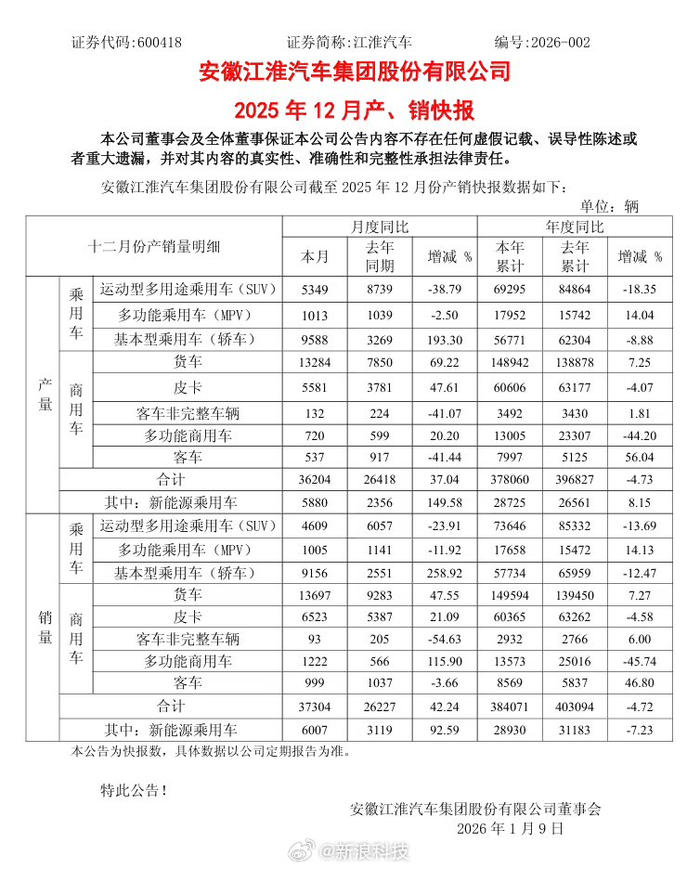
江淮汽车2025年销量38.4万辆,12月新能源车销量增92.59%
Xin Lang Ke Ji· 2026-01-09 00:27
Core Viewpoint - Jianghuai Automobile reported a total sales volume of 384,071 units for the year 2025, reflecting a decrease of 4.72% compared to the previous year [1]. Production and Sales Summary - In December 2025, the company produced 36,204 vehicles, which is a 37.04% increase from 26,418 vehicles in December 2024 [1]. - The total production for the year 2025 reached 378,060 units, down 4.73% from 396,827 units in 2024 [1]. - December sales amounted to 37,304 units, marking a 42.24% increase from 26,227 units in December 2024 [1]. - The cumulative sales for 2025 were 384,071 units, a decrease of 4.72% from 403,094 units in 2024 [1]. New Energy Vehicle Performance - In December 2025, the production of new energy passenger vehicles was 5,880 units, representing a year-on-year growth of 149.58% [1]. - The total production of new energy vehicles for the year was 28,725 units, an increase of 8.15% compared to 26,561 units in 2024 [1]. - December sales of new energy vehicles reached 6,007 units, a significant increase of 92.59% from 3,119 units in December 2024 [1]. - However, the cumulative sales of new energy vehicles for 2025 were 28,930 units, which is a decline of 7.23% from 31,183 units in 2024 [1].


2025年1-4月中国基本型乘用车(轿车)产量为381.9万辆 累计增长11.9%
Chan Ye Xin Xi Wang· 2025-10-23 01:17
Core Viewpoint - The Chinese automotive industry is experiencing growth, with a notable increase in the production of basic passenger cars, indicating a positive market trend for the coming years [1]. Industry Summary - According to the National Bureau of Statistics, the production of basic passenger cars in China reached 1 million units in April 2025, representing a year-on-year growth of 5.9% [1]. - From January to April 2025, the cumulative production of basic passenger cars was 3.819 million units, showing a cumulative growth of 11.9% [1]. Company Summary - Key listed companies in the automotive sector include BYD, SAIC Motor, Great Wall Motors, Changan Automobile, GAC Group, FAW Jiefang, Dongfeng Motor, and BAIC Blue Valley [1]. - The report by Zhiyan Consulting provides insights into the market operation status and investment potential of the Chinese automotive industry from 2025 to 2031 [1].

江淮汽车9月销量为3.35万辆,同比下降15.5%
Ju Chao Zi Xun· 2025-10-14 03:22
Core Insights - Jianghuai Automobile reported a decline in both production and sales for September 2025 compared to the same period last year [3][4][5] Production and Sales Data - In September 2025, the total production was 33,255 vehicles, a year-on-year decrease of 15.75%, while total sales were 33,455 vehicles, down 15.50% [3][4] - Cumulative production for the year reached 281,040 vehicles, reflecting a 10.53% decline year-on-year, and cumulative sales were 281,713 vehicles, down 10.66% [3][4] Segment Performance - For the SUV segment, production was 6,266 units, down 41.43%, and sales were 5,605 units, down 45.78% [4][5] - The MPV segment saw production increase by 107.91% to 2,470 units, with sales rising 44.01% to 2,091 units [4][5] - The sedan segment produced 6,259 units, down 34.50%, with sales of 6,921 units, a decrease of 7.01% [4][5] Commercial Vehicle Performance - Truck production was 11,937 units, up 35.89%, and sales were 11,908 units, up 21.56% [5] - Pickup production decreased by 33.61% to 4,224 units, with sales down 37.72% to 4,918 units [5] - Bus production increased significantly by 188.64% to 889 units, with sales rising 211.30% to 909 units [5] New Energy Vehicle Insights - New energy passenger vehicles produced 3,679 units, up 10.75%, with sales of 3,613 units, up 18.69% [5] - Year-to-date production for new energy vehicles was 16,503 units, down 10.26%, and cumulative sales were 16,043 units, down 25.64% [5]
2025年1-7月中国基本型乘用车(轿车)产量为683.7万辆 累计增长10%
Chan Ye Xin Xi Wang· 2025-09-29 02:09
Core Insights - The article discusses the growth of China's basic passenger car production, highlighting a production volume of 966,000 units in July 2025, representing an 8.4% year-on-year increase [1] - Cumulative production from January to July 2025 reached 6.837 million units, showing a 10% increase compared to the same period in the previous year [1] Industry Overview - The report by Zhiyan Consulting provides a deep assessment of the Chinese automotive industry from 2025 to 2031, focusing on market opportunities and investment forecasts [1] - Key players in the industry include BYD, SAIC Motor, Great Wall Motors, Changan Automobile, GAC Group, FAW Jiefang, Dongfeng Motor, and BAIC Blue Valley [1] Statistical Data - The production statistics for basic passenger cars in China from January to July 2025 indicate a steady growth trend, with a notable increase in both monthly and cumulative production figures [1] - The data is sourced from the National Bureau of Statistics and compiled by Zhiyan Consulting, emphasizing the reliability of the information presented [1]







江淮汽车7月销售汽车2.52万辆,今年累销同比下降9.46%
Ju Chao Zi Xun· 2025-08-10 12:16
Core Viewpoint - Jianghuai Automobile reported a significant decline in both production and sales for July 2025, with total vehicle production down 29.24% year-on-year and total sales down 21.73% compared to the same month last year [2][4]. Production and Sales Summary - In July, the company produced 24,843 vehicles, a decrease of 29.24% year-on-year, and cumulative production from January to July was 220,184 vehicles, down 7.76% year-on-year [2][3]. - Vehicle sales in July reached 25,197 units, reflecting a year-on-year decline of 21.73%, while cumulative sales for the first seven months totaled 215,811 units, down 9.46% year-on-year [2][3]. Segment Performance - In the passenger vehicle segment, SUV production was 4,908 units, down 44.57% year-on-year, and sales were 6,749 units, down 23.67% year-on-year. Cumulative SUV sales for the first seven months were approximately 46,400 units, remaining stable compared to the previous year [3][4]. - The MPV segment saw a positive trend, with July sales of 1,248 units, up 5.58% year-on-year, driven by the new Ruifeng series [3][4]. - The sedan segment faced a sharp decline, with July sales of 1,838 units, down 65.77% year-on-year, and cumulative sales of 20,582 units, a decrease of 46.22% [3][4]. Commercial Vehicle Performance - In the commercial vehicle sector, truck sales benefited from the demand for upgrading to National IV standards, with July sales reaching 10,040 units, up 15.43% year-on-year, and cumulative sales of 89,513 units, nearly flat compared to last year [4]. - Pickup truck sales were impacted by a drop in export orders, with July sales of 3,229 units, down 43% year-on-year, but cumulative sales still showed a 5.42% increase [4]. - Bus sales experienced a significant recovery, with July sales of 668 units, up 48.4% year-on-year, and cumulative sales of 4,410 units, reflecting a 39.4% increase [4]. New Energy Vehicle Performance - In the new energy vehicle segment, July sales were 1,925 units, down 29.23% year-on-year, with cumulative sales for the first seven months at 10,222 units, a decline of 34.06% [3][4]. - The company attributed the decline in new energy vehicle sales to intensified competition in the A00 pure electric market and the reduction of subsidies [4]. - To address the downturn, Jianghuai plans to launch a new pure electric platform vehicle developed in collaboration with Huawei in the fourth quarter and accelerate the deployment of battery-swapping heavy trucks and hydrogen fuel light trucks [4].