
皮卡

Search documents
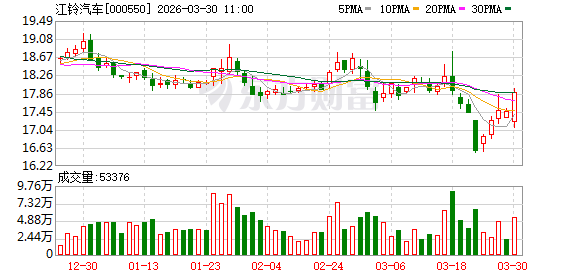
江铃汽车2025年营收稳步增长 拟10派5.5581元
Shang Hai Zheng Quan Bao· 2026-03-30 02:59
Group 1 - The core viewpoint of the articles highlights Jiangling Motors' strategic focus on quality improvement, new product development, cost control, and efficiency optimization in response to intensified market competition [2] - In 2025, the company achieved total vehicle sales of 377,253 units, a year-on-year increase of 10.56%, and total production of 378,338 units, up 9.71% from the previous year [2] - The company's revenue for 2025 reached 39.17 billion yuan, reflecting a 2.07% increase year-on-year, while R&D expenses decreased by 7.5% to 1.216 billion yuan [2] - Jiangling Motors plans to distribute a cash dividend of 5.5581 yuan per 10 shares (including tax) for the year [2] - In the automotive market segments, Jiangling's light commercial vehicle products hold the largest market share, while its pickup trucks rank second and light trucks seventh [2] - The company has set a production capacity of 320,000 units for 2025, achieving a capacity utilization rate of 118% [2] - Jiangling Motors aims to achieve sales of 430,000 units and revenue of 42 billion yuan in 2026 [2] Group 2 - For 2026, the company plans to accelerate the development of new energy vehicles, focusing on logistics and passenger transport markets with the introduction of high-capacity, long-range commercial models [3] - The company aims for significant growth in its new energy business through key technology and multi-business collaboration, while also enhancing asset risk management [3] - Jiangling Motors intends to expand its overseas business by implementing a "dual brand + dual channel" export strategy, improving product competitiveness, and exploring untapped markets [3] - The company will enhance its overseas brand management and service levels through customer service initiatives and localized operations [3]


江铃汽车2025年营收超391亿元,净利润同比下滑22.75%,2026年目标销量43万辆
Mei Ri Jing Ji Xin Wen· 2026-03-27 14:20
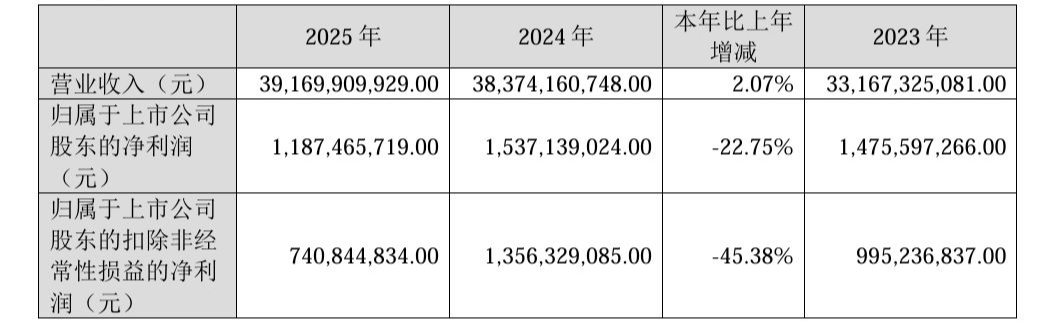
Core Viewpoint - Jiangling Motors reported a revenue of approximately 39.17 billion yuan for 2025, reflecting a year-on-year growth of 2.07% despite a significant decline in net profit [1][5]. Financial Performance - The total revenue for 2025 was 39,169,909,929 yuan, compared to 38,374,160,748 yuan in 2024, marking a 2.07% increase from the previous year [2]. - The net profit attributable to shareholders was approximately 1.19 billion yuan, a decrease of 22.75% from 1.54 billion yuan in 2024 [2][5]. - The net profit after deducting non-recurring gains and losses was about 740.84 million yuan, down 45.38% from 1.36 billion yuan in 2024 [2][5]. Revenue Breakdown - Vehicle sales generated approximately 35.96 billion yuan, up 1.89% year-on-year, accounting for 91.8% of total revenue [2]. - Revenue from materials and components was around 2.11 billion yuan, down 15.93% [2]. - Revenue from maintenance and technical services increased significantly by 92.25% to about 1.10 billion yuan [2]. Sales and Production - In 2025, Jiangling Motors sold approximately 377,300 vehicles, a 10.56% increase compared to 2024 [3][4]. - The breakdown of vehicle sales included about 99,800 light passenger cars, 83,200 trucks, 59,700 pickups, and 134,600 SUVs, with notable increases in light passenger cars (14.27%) and trucks (34.35%) [3][4]. Future Outlook - For 2026, the company aims to achieve sales of 430,000 vehicles and revenue of 42 billion yuan [5]. - The strategy includes focusing on urban logistics in the commercial vehicle sector and introducing differentiated products in the passenger vehicle sector, particularly for outdoor and off-road needs [5]. - The company plans to accelerate its transition to new energy vehicles and increase R&D investment [5]. Dividend Distribution - Jiangling Motors plans to distribute a cash dividend of 5.5581 yuan per 10 shares, totaling approximately 475 million yuan [5].
长城汽车(02333) - 海外监管公告
2026-03-27 12:17
香港交易及結算所有限公司及香港聯合交易所有限公司對本公告的內容概不負責,對其準確性或完整性亦不發表任何 聲明,並明確表示,概不對因本公告全部或任何部份內容而產生或因倚賴該等內容而引致的任何損失承擔任何責任。 GREAT WALL MOTOR COMPANY LIMITED* (於中華人民共和國註冊成立的股份有限公司) 股份代號:02333(港幣櫃台)及82333(人民幣櫃台) 海外監管公告 此海外監管公告是根據香港聯合交易所有限公司證券上市規則第 13.10B 條發出。以下為長城汽 車股份有限公司於上海證券交易所網站(www.sse.com.cn)所刊發之「長城汽車股份有限公司 2025年年度報告摘要」。 承董事會命 長城汽車股份有限公司 公司秘書 李紅栓 中國河北省保定市,2026 年 3 月27 日 於本公告日期,董事會成員如下: 執行董事: 魏建軍先生、趙國慶先生及李紅栓女士。 長 城 汽 車 股 份 有 限 公 司 职工董事:盧彩娟女士。 非執行董事:何平先生。 獨立非執行董事: 樂英女士、 輝先生及鄒兆麟先生。 * 僅供識別 长城汽车股份有限公司 2025 年年度报告摘要 公司代码:601633 公 ...
【乘联分会论坛】2026年2月皮卡市场分析
乘联分会· 2026-03-26 08:39
Core Viewpoint - The pickup truck market is experiencing fluctuations due to seasonal factors, with a notable decline in sales during February 2026, while exports continue to show strong growth, indicating a complex market landscape driven by both domestic and international demand [1][8][12]. Group 1: Pickup Truck Sales and Production - In February 2026, pickup truck sales reached 41,000 units, a year-on-year decrease of 13.2%, while production was 42,000 units, down 3.1% year-on-year [1]. - For January-February 2026, total sales were 91,000 units, reflecting a growth of 5.3%, marking a high level compared to the same period in the past five years [1]. - The sales performance of major manufacturers like Great Wall Motors remains strong, with a stable domestic and international presence [1][22]. Group 2: Export Performance - In February 2026, the national pickup truck export volume was 23,000 units, representing a year-on-year increase of 15%, while the cumulative export for January-February reached 50,000 units, up 30% year-on-year [1][12]. - The export share of total pickup truck sales is projected to reach 45% in 2024, 50% in 2025, and 56% in February 2026, indicating a robust growth trajectory for Chinese pickup brands in international markets [12][28]. Group 3: New Energy Pickup Trucks - In February 2026, new energy pickup truck sales were 5,000 units, down 6% year-on-year, while January-February sales totaled 11,000 units, reflecting a 5% increase year-on-year [2][14]. - The market for new energy pickups is gradually improving, with brands like BYD and Geely showing strong overseas sales, indicating a shift towards electrification in the pickup segment [2][14]. Group 4: Market Dynamics and Regional Analysis - The pickup truck market is characterized by a "one strong, many strong" competitive landscape, with Great Wall Motors holding nearly 50% of the domestic market share, while other brands like Jiangling and Zhengzhou Nissan maintain strong positions [22][25]. - The demand for pickups is primarily driven by the southwestern and northwestern regions, which account for approximately 48% of total demand, while eastern regions show a decline [16][18]. - The market is influenced by factors such as the economic activity in the western regions and the ongoing electrification trend, which is expected to enhance the demand for new energy pickups [18][30].

【周度分析】车市扫描(2026年3月9日-3月15日)
乘联分会· 2026-03-18 08:36
Group 1: Market Overview - From March 1 to 15, the national passenger car market retail sales reached 561,000 units, a year-on-year decrease of 21%, but a month-on-month increase of 2%. Cumulative retail sales for the year reached 3.14 million units, down 19% year-on-year [2][5] - During the same period, wholesale sales of passenger cars reached 648,000 units, a year-on-year decrease of 20%, but a month-on-month increase of 36%. Cumulative wholesale sales for the year reached 4.141 million units, down 12% year-on-year [2][9] - The penetration rate of new energy vehicles (NEVs) in retail sales was 50.7%, while the wholesale penetration rate was 50.1% [2] Group 2: Production and Sales Trends - In the first week of March, production of pure fuel light vehicles was 220,000 units, down 15% year-on-year, while production of hybrid and plug-in hybrid vehicles was 71,000 units, down 37% year-on-year [3] - The average daily retail sales for the first week of March were 31,000 units, down 24% year-on-year, while the second week saw an increase to 45,000 units, down 19% year-on-year [5][9] - The overall market performance in March is expected to improve gradually, with the second week showing signs of recovery [5][6] Group 3: Economic and Policy Environment - The automotive industry faced challenges due to rising prices of raw materials, oil, and chips, alongside geopolitical uncertainties affecting fuel vehicle sales negatively [6][10] - The government is expected to implement more proactive macro policies to stimulate demand and optimize supply, aiming for a stable market demand [10] Group 4: Investment and Consumer Behavior - Fixed asset investment in the automotive industry grew by 2.6% year-on-year in January and February 2026, outperforming the average growth rate of 1.8% across all industries [10] - Consumer pressure in the passenger car market remains high, with expectations for strong follow-up policies to stimulate car purchases [11] Group 5: Pickup Truck Market Analysis - In February 2026, pickup truck sales reached 41,000 units, down 13.2% year-on-year, while production was 42,000 units, down 3.1% year-on-year [12] - The export of pickup trucks in February 2026 was 23,000 units, a year-on-year increase of 15%, indicating strong growth in the export market [12] Group 6: Pricing Trends - The average retail price of passenger cars in February 2026 was 180,000 yuan, an increase of 15,000 yuan year-on-year, despite a significant decline in sales [6][13] - The average price of new energy vehicles has shown a structural change, with a recent increase to 188,000 yuan in February 2026, reflecting a shift in consumer preferences [13][14]

从大到强关键一跃:魏建军倡议中国汽车行业要“立信”
第一财经· 2026-03-18 08:19
Core Viewpoint - The transition of China from a major automotive power to a strong automotive nation faces significant challenges, despite its established status as the world's largest automotive producer and exporter [1][6]. Group 1: Industry Status and Challenges - China has maintained its position as the world's largest automotive producer and seller for several years, with a notable shift from meeting domestic demand to serving global markets, particularly in the electric vehicle sector [6][10]. - The automotive industry is currently experiencing intense price wars, driven by short-term performance pressures, which threaten the long-term health of the industry and compromise product quality [8][9]. - The industry's profit margins are under severe pressure, with the automotive manufacturing profit expected to decline to 4.1% in 2025, marking the lowest level since 2015 [9][10]. Group 2: Solutions and Recommendations - To address the challenges, the industry must focus on rebuilding trust and establishing a long-term perspective, moving away from price competition to value-based competition [14][23]. - Companies are encouraged to prioritize compliance and integrity, ensuring product quality and investing in research and development to regain consumer trust [16][24]. - Collaboration within the supply chain should be emphasized, fostering a cooperative environment rather than a zero-sum game, to enhance stability and resilience in the industry [16][24]. Group 3: Long-term Vision - The concept of "public trust" is highlighted as a foundational value that can guide the industry towards sustainable growth and high-quality development, aligning with national economic goals [21][24]. - The automotive sector's contribution to GDP is significant, and its public trust level directly impacts China's international manufacturing reputation [24]. - Emphasizing integrity and compliance is not merely a cost but a long-term competitive advantage that can strengthen the industry's position in the global market [24].

【月度排名】2026年2月皮卡厂商批发销量排名快报
乘联分会· 2026-03-16 08:41
Group 1: Overall Market Performance - The pickup truck market experienced a slowdown in sales due to the Spring Festival, with February 2026 sales at 41,000 units, a year-on-year decrease of 13.2%. However, sales for January-February 2026 reached 91,000 units, marking a 5.3% increase compared to the same period last year, which is the highest level in the past five years [2]. - In February 2026, pickup truck production was 42,000 units, down 3.1% year-on-year, while production for January-February 2026 totaled 94,000 units, reflecting a 13.7% increase [2]. - Great Wall Motors continues to lead the pickup truck market, with stable performance both domestically and internationally, supported by strong export growth [2]. Group 2: Export Performance - In February 2026, national pickup truck exports reached 23,000 units, a year-on-year increase of 15% but a month-on-month decrease of 14%. For January-February 2026, exports totaled 50,000 units, up 30% year-on-year, maintaining a high export ratio [2]. - The export share of pickup trucks is projected to reach 45% in 2024, 50% in 2025, and 56% in February 2026, indicating a strong growth trajectory for Chinese pickup brands in the export market [2]. Group 3: New Energy Pickup Trucks - In February 2026, new energy pickup truck sales were 5,000 units, down 6% year-on-year and 9% month-on-month. However, sales for January-February 2026 reached 11,000 units, reflecting a 5% year-on-year increase [3]. - The market for new energy pickup trucks is gradually improving, with notable sales from brands such as Zhengzhou Nissan (1,535 units), BYD (1,445 units), and Geely Radar (1,363 units) [3]. Group 4: Manufacturer Sales Rankings - In February 2026, the top pickup truck manufacturers by sales were: Great Wall Motors (12,011 units, down 30.4% year-on-year), SAIC Maxus (4,535 units, down 12.1%), and Zhengzhou Nissan (4,525 units, up 60.6%) [5]. - For January-February 2026, the sales rankings were led by Great Wall Motors (27,361 units, down 7.5%), followed by SAIC Maxus (10,459 units, up 6.0%), and Zhengzhou Nissan (8,578 units, up 92.0%) [6].

李书福/朱华荣/冯兴亚/张国强等建言 全国两会向行业释放哪些信号?| 头条
第一商用车网· 2026-03-11 03:04
Core Viewpoint - The article discusses the key suggestions from representatives at the 2026 National People's Congress regarding the commercial vehicle industry, focusing on the transition towards quality improvement, environmental sustainability, and technological advancements in the context of the "dual carbon" goals and global competition [1][24]. Group 1: Suggestions for New Energy Vehicles - Li Shufu, Chairman of Geely Holding Group, proposed promoting methanol electric trucks to enhance operational capacity and meet "dual carbon" targets, particularly for medium to long-distance transportation [3]. - Li Haihua from Yuchai Group emphasized the need for differentiated implementation timelines for emission standards and support for hybrid power products to facilitate the transition from internal combustion engines to new energy [5]. - Zhang Guoqiang, Chairman of Yihua Tong, suggested developing hydrogen energy highways and supporting policies to promote the large-scale development of fuel cell vehicles [15]. Group 2: Policy Recommendations for Commercial Vehicles - Li Xiaohong, Chairman of Hunan Jiahui Group, recommended adjusting the total weight limit for 4.2-meter blue牌 trucks to 7.5 tons to address safety and operational mismatches [6][8]. - Liu Hui from Jiangling Motors proposed removing the 15-year mandatory scrapping rule for non-operating pickups to stimulate market demand and support rural revitalization [9][11]. - Yang Yongxiu from China FAW called for a timeline for the implementation of L3 autonomous vehicle regulations and a clear framework for liability [22]. Group 3: Industry Development and Globalization - Feng Xingya, Chairman of GAC Group, highlighted the need for a unified battery swap standard and legislative support for autonomous driving to enhance the global competitiveness of the automotive industry [13]. - Zhu Huaron, Chairman of Changan Automobile, suggested policies to support mergers and acquisitions to cultivate globally competitive leading enterprises [17][18]. - The article concludes that the suggestions from the representatives address critical pain points in the industry and propose solutions for future development, including the promotion of new energy vehicles and the establishment of a robust regulatory framework for autonomous driving [24].

全国人大代表、江铃汽车特级技师刘辉:为皮卡“松绑” 激发市场消费活力
Zhong Guo Zheng Quan Bao· 2026-03-10 23:08
Group 1 - The government work report and the 14th Five-Year Plan indicate a clear direction for the green transformation of the automotive industry, emphasizing the need for accelerated transition to new energy commercial vehicles and promoting energy-saving and carbon-reduction efforts in manufacturing [2] - The pickup truck market in China is expected to experience strong growth during the 14th Five-Year period, with a projected market share of approximately 14% of the total commercial vehicle sales of 4.296 million units by 2025, which is significantly lower than the mature North American market [3] - The perception of pickup trucks is shifting from being merely tools to multifunctional vehicles suitable for both commercial and personal use, with an increasing focus on product diversification and high-end features [3] Group 2 - There is a need to differentiate between passenger and commercial pickup trucks, with current regulations imposing a mandatory inspection every year and a 15-year scrappage rule for light trucks, which is seen as wasteful and misaligned with consumer demand [4] - The suggestion is made to eliminate the 15-year mandatory scrappage policy for non-commercial pickup trucks, allowing them to be managed similarly to passenger vehicles, with a focus on mileage limits rather than age [4] - The exclusion of pickup trucks from the national "trade-in" policy is seen as a barrier to market consumption potential, highlighting the need for regulatory adjustments to stimulate demand [4] Group 3 - The rise of automation and smart factories necessitates a reevaluation of the role of traditional craftsmen, emphasizing that technology should enhance human capabilities rather than replace them [5] - The concept of "craftsmanship" is viewed as essential for product competitiveness, with a focus on precision and quality in every aspect of production [6] - There are challenges in the current vocational education system, including a lack of integration between industry and education, insufficient training resources, and low social recognition of skilled trades, which need to be addressed to meet the demands of advanced manufacturing [6]
全国人大代表、江铃汽车特级技师刘辉: 为皮卡“松绑” 激发市场消费活力
Zhong Guo Zheng Quan Bao· 2026-03-10 21:49
Group 1 - The government work report and the 14th Five-Year Plan indicate a clear direction for the green transformation of the automotive industry, emphasizing the need for accelerated transition to new energy commercial vehicles and promoting energy-saving and carbon-reduction efforts in manufacturing [1] - The pickup truck market in China is expected to experience strong growth during the 14th Five-Year Plan period, with a projected market share of approximately 14% of the total commercial vehicle sales of 4.296 million units by 2025, which is significantly lower than the mature North American market [2] - The classification of pickup trucks should differentiate between passenger and commercial use, with suggestions to eliminate the annual inspection and 15-year mandatory scrappage policy for non-operational pickups, which currently leads to resource waste and consumer reluctance [2][3] Group 2 - The current "trade-in" policy excludes pickup trucks, limiting their market potential, and there are recommendations to align the scrappage policy for non-operational pickups with that of passenger vehicles, allowing for continued use as long as they meet mileage requirements [3] - The rise of automation and smart factories necessitates a focus on enhancing the "craftsman spirit" among traditional workers, emphasizing that automation should free workers from dangerous tasks to engage in more skilled work [4] - There are challenges in the development of craftsman colleges in China, including a lack of top-level planning, insufficient integration of industry and education, and inadequate recognition of skilled trades, which hinder the growth of high-quality talent needed for advanced manufacturing [4]