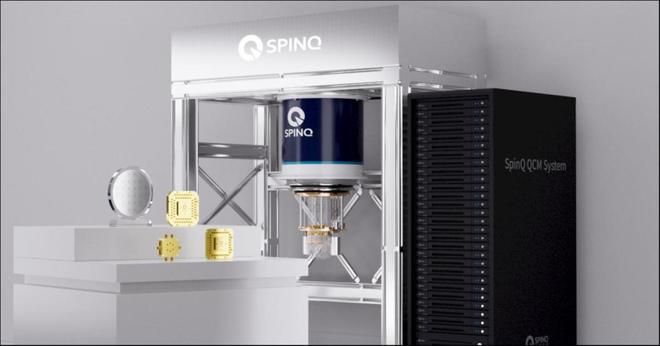
大熊座超导量子计算机

Search documents
清华75后,融资数亿
3 6 Ke· 2026-01-22 01:25
Core Insights - The quantum computing sector has seen significant investment, with Liangxuan Technology recently securing hundreds of millions in Series C funding, bringing its total funding to several hundred million since its inception in 2018 [2][3] Company Overview - Liangxuan Technology, founded in 2018 and headquartered in Shenzhen, has completed six rounds of financing, accumulating several hundred million in total [2] - The company has developed the world's first programmable desktop quantum computer, which has been sold to over 40 countries, and has also produced superconducting quantum chips and measurement control systems for export [2][3] Industry Challenges and Solutions - The traditional quantum computers are heavy (weighing around one ton) and expensive (costing several million dollars), making them inaccessible for most universities and research institutions [3] - Liangxuan Technology addresses this by offering a desktop quantum computer that, while not the most powerful, meets educational needs and is more affordable, priced at 400,000 yuan (approximately $60,000) [15] Market Transition and Future Outlook - The industry is transitioning from educational and research applications to industrial applications, with significant advancements expected by 2028 in fields like drug screening and new material design [5][21] - The quantum computing market is projected to exceed $1 billion in revenue by 2025, with potential growth to between $28 billion and $72 billion by 2035 [21][22] Product Development and Innovation - Liangxuan Technology's first product, the "Gemini" quantum computer, was introduced in 2020, weighing 90 kg and designed for educational use [15] - The company has also developed superconducting quantum chips, with the first exports occurring in November 2023, marking a significant milestone for Chinese companies in the global market [16] Investment and Growth Trajectory - The investment landscape for quantum computing has accelerated, with $700 million and $1.4 billion invested in 2020 and 2021, respectively, surpassing the total investment of the previous decade [19] - Liangxuan Technology has maintained a financing rhythm of approximately one round every 18 months, with a significant increase in orders, particularly for its superconducting products, which are expected to dominate sales by 2024 [21]

对话量旋科技项金根:黄仁勋预测太保守,10年后将实现百万物理比特的容错量子计算机
Tai Mei Ti A P P· 2025-07-21 11:01
Core Viewpoint - Quantum computing company "Quantum Spin Technology" has completed a Series B financing round amounting to hundreds of millions, with investors including government funds and various institutions. The funds will be used to expand research and production of superconducting quantum computers and to grow the research team [2][6]. Financing - Quantum Spin Technology has completed five rounds of financing since its establishment, with investors including Ming Shi Capital, Shenzhen High-tech Investment Group, and others [7]. - The recent financing round is primarily supported by government funds and industrial capital [2]. Technology and Products - Quantum Spin Technology focuses on the industrialization and popularization of quantum computing, providing a one-stop solution that includes superconducting quantum computers, desktop nuclear magnetic quantum computers, quantum computing cloud platforms, and application software [6][7]. - The company has developed a self-researched superconducting chip "Shaowei," which features high Qi value, long qubit lifespan, and high stability [7][11]. Market Potential - According to McKinsey, the global quantum computing revenue is expected to exceed $1 billion by 2025, with the market potentially reaching between $28 billion and $72 billion by 2035 [5]. - The entire quantum technology industry is projected to approach $100 billion by 2035 and reach $198 billion by 2040 [5]. Competitive Landscape - Quantum Spin Technology is positioned as a leading technology enterprise in the superconducting and nuclear magnetic quantum fields, competing with major companies like IBM and Google [10][11]. - The company aims to achieve breakthroughs in core technology areas by 2025, including material processes, chip design, and system integration [11][12]. Future Outlook - The company plans to focus on three main areas: advancing technology in superconducting quantum computers and cloud platforms, deepening application scenarios in finance and AI, and expanding its global market presence [12][25]. - The CEO believes that achieving fault-tolerant superconducting quantum computers will require significant time and investment, with milestones set for 2029 and 2035 [12][22].