大集合产品

Search documents
2025年上海地区资产管理公司总规模达2.98万亿元 头部效应明显
Xin Hua Cai Jing· 2026-02-06 06:43
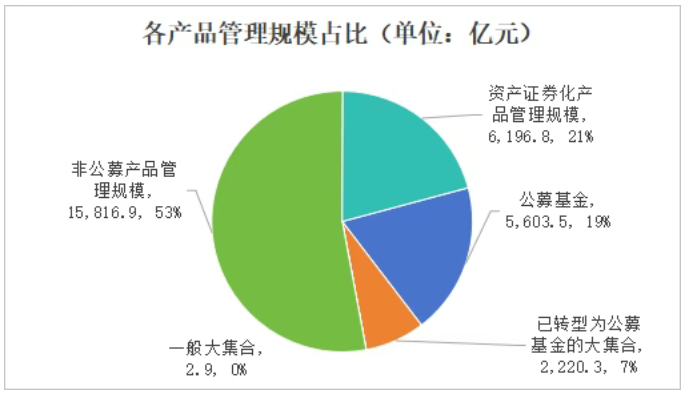
Group 1 - The core viewpoint of the article highlights the stability and growth of asset management companies in Shanghai, with a total asset management scale of 2.98 trillion yuan by the end of 2025, showing a year-on-year increase of 10.4% [2][4] - As of the end of 2025, there are 14 asset management companies in Shanghai, with the top three companies—Huatai Securities (Shanghai) Asset Management Co., Shanghai Guotai Haitong Securities Asset Management Co., and Shanghai Dongfang Securities Asset Management Co.—holding a combined market share of 63.1% [1][2] - The tax contribution from these 14 asset management companies reached 2.287 billion yuan in 2025, reflecting a year-on-year growth of 13.6% [2] Group 2 - The management scale of public funds increased by 27.8% compared to the same period in 2024, while the management scale of large collective funds that have transitioned to public funds decreased by 4.2% [4] - Non-public products saw a management scale increase of 7.2%, and asset securitization products experienced a growth of 16.3%, indicating a rising demand for standardized products in the market [4] - Innovative funds, particularly those related to the New Third Board and amortized cost method bond funds, have shown relatively large scales, reflecting a high market preference for specific asset allocation tools and long-term stable income products [4]

券商资管公募梦醒 发展岔路口重新导航
Zhong Guo Zheng Quan Bao· 2025-12-18 20:23
Core Viewpoint - The transition of large collective products to public fund management has reached a critical phase, with many asset management companies facing significant challenges due to regulatory changes and market dynamics [1][2][4]. Group 1: Industry Changes - The number of fund managers in the public fund department of companies has decreased from a peak of twenty to around seven or eight, indicating a contraction in the workforce [1]. - The final name of a broker's asset management company, "Guojin Asset Management," has been removed from the list of applicants for public fund management qualifications, signaling the end of the "public fund rush" among broker asset management firms [1]. - The deadline for transforming large collective products into public funds is approaching, with many firms either transferring products to affiliated public funds or opting for liquidation [1][2]. Group 2: Product Transition - Several asset management companies have successfully transferred their large collective products to public fund institutions with "blood relationship," such as Everbright Fund taking over products from Everbright Securities Asset Management [2]. - Some firms have also transferred products to public institutions without direct ownership ties, as seen with Wanlian Securities transferring its money market fund to Ping An Fund [2]. - Many broker asset management firms are choosing to convert non-compliant or smaller products into private asset management plans or liquidate them, with liquidation becoming a common outcome [2][3]. Group 3: Profitability and Future Strategies - The loss of large collective products represents a significant profit loss for broker asset management firms, which need to explore new profit growth points [3]. - Broker asset management firms are focusing on developing multi-strategy investments and creating quantitative products to provide a more stable investment experience [3]. - The competitive landscape is shifting, with licensed institutions leveraging their comprehensive resources to create differentiated offerings, while unlicensed firms may focus on private and customized solutions to build niche brands [4].





拥抱大资管竞合时代
Shang Hai Zheng Quan Bao· 2025-12-11 18:40
Group 1 - The core viewpoint of the article highlights the ongoing competition and collaboration among asset management institutions, with a shift from traditional "fixed income" strategies to "fixed income + multi-asset multi-strategy" approaches [4][5][17] - The scale of bank wealth management products reached 32.13 trillion yuan by the end of September, marking a 4.76% increase from the second quarter [6] - The structural changes in the bank wealth management market are evident, with a significant shift towards multi-asset allocation as investors seek stable returns in a low-interest-rate environment [5][6] Group 2 - The implementation of new asset management regulations is reshaping the valuation practices of wealth management products, moving towards a more transparent net asset value system [7][9] - The demand for diversified wealth management solutions is increasing among residents, with 18.5% of individuals preferring to invest more, particularly in non-guaranteed bank wealth management products [9][10] - The collaboration between various financial institutions and insurance companies is intensifying, driven by the need for stable investment channels and the regulatory environment that encourages such partnerships [11][12][13] Group 3 - The public offering transformation of large collective products in the securities asset management industry is nearing completion, leading to a potential reshaping of the industry landscape [18][24] - The recent trend of "non-affiliated transfers" in public offering transformations indicates a shift from traditional internal transfers to collaborations with external public funds [20][21] - The competition for public fund licenses has become increasingly challenging, with many institutions withdrawing their applications, reflecting a saturated market [23][24]

券商资管公募化改造,最后冲刺来了
Zhong Guo Ji Jin Bao· 2025-12-07 12:21
Group 1 - The core viewpoint of the article highlights the accelerated transformation of brokerage asset management public offerings, with a focus on research and collaboration capabilities as key differentiators in a competitive landscape [2][7] - The main paths for the transformation of large collective products include management changes, liquidation, or transitioning to private equity, with the transfer of products to affiliated public fund companies being the most prevalent method [3][4] - The recent trend of "cross-group migration" has emerged, where some brokerages transfer their products to third-party public fund managers without direct equity ties, indicating innovative approaches in the industry [4] Group 2 - The approval queue for brokerage asset management public licenses has been cleared, marking the end of the "license application frenzy" that began in 2023, and signaling a shift towards differentiated competition [5] - Some brokerages are leveraging their dual licenses (public and private) to accelerate business expansion, with examples like Caitong Asset Management, which has established a stable business structure focusing on active management [5][6] - Industry experts suggest that public licenses are not the only path for brokerage asset management, as unlicensed institutions can still build core competitiveness by focusing on private equity business [6] Group 3 - The ability to conduct research and collaboration is seen as crucial for brokerages to compete with banks, public funds, and insurance companies in the asset management sector [7][8] - Brokerages possess a unique advantage in integrating research, investment, trading, product, and service capabilities, which can help establish differentiation in a saturated public market [8] - Collaborative efforts between asset management and other business lines within brokerages can enhance service offerings and leverage existing resources, ultimately driving a dual development model of "wealth management + asset management" and "investment + investment banking" [8][9]

又见券商资管 批量变更管理人!
Zhong Guo Ji Jin Bao· 2025-11-28 09:40
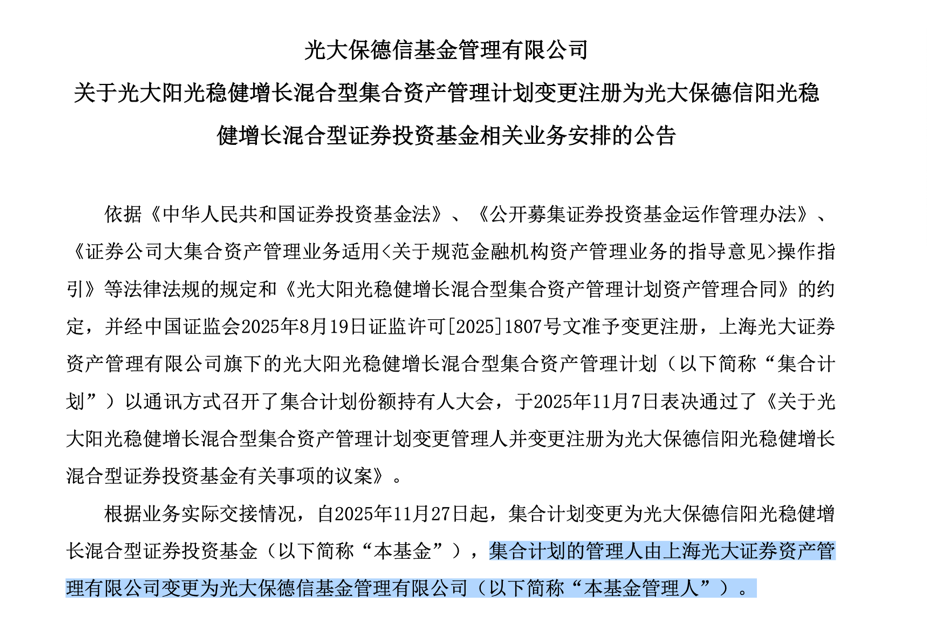
Core Viewpoint - The article discusses the recent changes in management for several large collective investment products under Guangzheng Asset Management, indicating a trend of transitioning these products to public fund management companies as the deadline for compliance with new regulations approaches [5][6]. Group 1: Management Changes - On November 27, Guangzheng Asset Management transferred eight large collective investment products to Everbright Pramerica Fund Management, which is 55% owned by Everbright Securities [5]. - This transfer is part of a broader trend where many securities firms are moving their collective investment products to affiliated public fund companies due to the expiration of the transitional period for compliance with new asset management regulations [5][6]. Group 2: Industry Trends - The transition to public fund management is becoming the mainstream approach for securities firms that do not hold public fund licenses, as they face three options: liquidation, extension, or changing the management [5][6]. - The pace of management changes has accelerated, with multiple firms, including GF Asset Management and Huafu Fund, also announcing similar transitions in November [6][7]. - As of now, only Guojin Asset Management remains in the queue for public fund license applications, while several firms, including Guangzheng Asset Management, have withdrawn their applications [8][9]. Group 3: Market Competition - The asset management industry is experiencing intense competition, particularly in fixed income and cash management products, from public funds and bank wealth management subsidiaries [9]. - Analysts suggest that the public fund path is more suitable for leading institutions with comprehensive financial ecosystems and retail channels, while specialized securities firms may find private fund paths more advantageous [9].
又见券商资管,批量变更管理人!
中国基金报· 2025-11-28 09:22
Core Viewpoint - The article discusses the recent management changes of large collective investment products under Guangzheng Asset Management, indicating a trend of transitioning these products to public fund management companies as the deadline for regulatory compliance approaches [2][5]. Group 1: Management Changes - On November 27, Guangzheng Asset Management transferred 8 large collective products to Everbright Pramerica Fund Management, which is 55% owned by Everbright Securities [5]. - This transfer is part of a broader trend where many securities firms are moving their collective investment products to affiliated public fund companies to comply with new regulations [5][7]. Group 2: Industry Trends - The transition period for securities firms' collective investment products is nearing its end, with many firms opting to change management to avoid issues related to liquidation or investor concerns [5][7]. - In 2024, Guangzheng Asset Management reported revenues of 675 million yuan and a net profit of 219 million yuan, with assets under management reaching 3,114 billion yuan, reflecting a growth of 3.71% from the beginning of the year [5]. Group 3: Regulatory Compliance - According to the 2018 asset management regulations, securities firms must complete the public offering transformation of their collective products by the end of the transition period, with options including liquidation, extension, or management change [5][8]. - The article notes that many firms have chosen to change management to public fund companies, which has become a mainstream approach in the industry [5][8]. Group 4: Competitive Landscape - The article highlights that securities firms face intense competition from public funds and bank wealth management subsidiaries, particularly in fixed income and cash management products [8]. - Analysts suggest that the public fund path is more suitable for leading institutions with comprehensive financial ecosystems, while specialized securities firms may find private paths more advantageous [8].

方正证券股份有限公司2025年半年度报告摘要
Shang Hai Zheng Quan Bao· 2025-08-30 02:47
Group 1 - The company plans to distribute a cash dividend of 0.061 yuan per share (including tax) to all shareholders, totaling 502,158,185.10 yuan (including tax), which accounts for 21.07% of the net profit attributable to shareholders for the first half of 2025 [27][29][28] - The total share capital as of June 30, 2025, is 8,232,101,395 shares, and the profit distribution will be based on this figure [29][28] - The board of directors and the supervisory board have unanimously approved the 2025 semi-annual profit distribution plan [30][31][6] Group 2 - The company held its fifth board meeting on August 29, 2025, to discuss and approve the semi-annual report and profit distribution plan [3][21][22] - The semi-annual report and profit distribution plan were published simultaneously in various financial newspapers and on the Shanghai Stock Exchange website [4][7][3] - The company assures that the content of the announcements is true, accurate, and complete, with no false records or misleading statements [21][27][22]

“破局”大集合产品到期困境 券商资管业务加速转型 “公募+私募”协同发展
Zheng Quan Ri Bao Zhi Sheng· 2025-05-20 16:09
Core Viewpoint - The asset management business of securities firms, approaching a scale of 10 trillion yuan, is undergoing a transformation amid intensified competition, with a focus on enhancing active management capabilities and obtaining public fund licenses [1][4]. Group 1: Industry Trends - The number of large collective products in the asset management industry totals 167, with a combined management scale of 357.032 billion yuan as of the end of the first quarter [1]. - Only 15 securities firms or their asset management subsidiaries hold public fund licenses, leading many to face restrictions when large collective products mature [1][4]. - The competition in the asset management industry is becoming increasingly fierce, prompting firms to seek differentiation through public fund penetration [1][4]. Group 2: Strategic Moves - Many firms are shifting from "passive rectification" to "active collaboration," changing the management of large collective products to affiliated public fund companies [2][3]. - For example, CITIC Securities Asset Management plans to change the management of 17 large collective products to Huaxia Fund, which is 62.2% owned by CITIC Securities [2]. - This strategy aims to maintain product continuity, avoid the loss of scale from liquidation, and enhance market competitiveness through resource sharing between securities firms and fund companies [3]. Group 3: Importance of Public Fund Licenses - Obtaining public fund licenses is crucial for securities firms to broaden their client base and enhance the competitiveness of their asset management services [4]. - As of the end of 2024, the total scale of the securities industry's asset management business is projected to reach 9.7 trillion yuan, a year-on-year increase of 5.7% [4]. - The active management product scale, including public funds and collective asset management, is expected to account for approximately 44% of the total, continuing to exceed the scale of directed asset management products for three consecutive years [4]. Group 4: Performance Disparities - The net income from asset management fees for 42 listed securities firms in 2024 totaled 44.092 billion yuan, a slight year-on-year decline of 0.35% [5]. - Despite the overall decline, some firms like Dongwu Securities and Guolian Minsheng have reported growth in asset management revenue for 2024 and the first quarter of 2025 [5]. - The private asset management scale of securities firms has decreased to 5.32 trillion yuan, down 530.962 billion yuan from its peak in July 2024 [5]. Group 5: Competitive Landscape - As of the end of the first quarter, four securities firms and their asset management subsidiaries have public fund management scales exceeding 100 billion yuan, indicating a tiered competitive landscape [6]. - Firms like Dongfanghong Asset Management and Huatai Asset Management lead with management scales of 158.559 billion yuan and 136.562 billion yuan, respectively [6]. - Many securities firms are leveraging their dual licenses to accelerate business expansion, focusing on optimizing product structures and enhancing investor experience [6].



开业!这家头部券商资管子公司来了!
券商中国· 2025-03-22 02:13
Core Viewpoint - Guosen Securities Asset Management Co., Ltd. officially commenced operations on March 21, 2024, marking a significant development in the company's asset management business [2][3]. Group 1: Company Establishment and Operations - Guosen Securities Asset Management Co., Ltd. was established after nearly three years of preparation, with the board approving the establishment in April 2022 and receiving regulatory approval in November 2023 [3]. - The registered capital of Guosen Asset Management is 1 billion yuan, headquartered in Shenzhen, and it is authorized to manage securities asset management and overseas securities investment [3]. - The company has a management team of five, with Cheng Fei as the chairman and Fang Qiang as the general manager [3]. Group 2: Business Strategy and Future Plans - Guosen Asset Management aims to differentiate itself in the market, focusing on customer satisfaction rather than merely maximizing returns or scale [8]. - The company plans to develop a product strategy system comprising 12 major strategies, covering fixed income, equity investment, fund of funds (FOF), and derivatives [8]. - The asset management business had a net asset value of 152.746 billion yuan as of June 30, 2024, with growth attributed to innovative strategies and targeted market management [9]. Group 3: Changes in Management and Operations - The asset management business will transition from Guosen Securities to Guosen Asset Management, with changes in management entities and operational accounts effective from the opening date [5][6]. - The company has established an internal control mechanism for related party transactions to ensure compliance and fairness in its operations [7].