
太空探源科学卫星计划

Search documents
我国空间科学取得新进展 将实施太空探源科学卫星计划
Yang Shi Wang· 2025-11-24 12:26
Core Viewpoint - The Chinese Academy of Sciences is set to implement a space exploration satellite program during the 14th Five-Year Plan, focusing on significant scientific breakthroughs in space science [1][3]. Group 1: Space Science Satellite Program - The program will include the development and launch of four space science satellite missions aimed at exploring cosmic mysteries [3]. - The four missions are: 1. "Hongmeng Plan" for detecting the cosmic dark age and dawn 2. "Kuafu-2" for direct imaging of the solar polar regions 3. An exoplanet survey mission to find "Earth 2.0" 4. An enhanced X-ray time-variable and polarization space observatory to study physical laws under extreme cosmic conditions [3]. Group 2: Achievements of Previous Missions - Since its launch in 2011, the space science pilot project has successfully developed and launched eight scientific satellite missions, including "Wukong," "Shijian-10," "Micius," "Huiyan," "Taiji-1," "Huairou-1," "Kuafu-1," and "Tianguan" [5]. - These missions have led to significant achievements, such as creating the world's first all-sky X-ray map, obtaining the most precise cosmic ray electron and proton energy spectrum structures, and directly measuring the strongest magnetic fields in the universe [5]. - The program has also made groundbreaking discoveries in areas like transient celestial bodies and solar eruptions, propelling China's space science innovation into a rapid development phase [5].

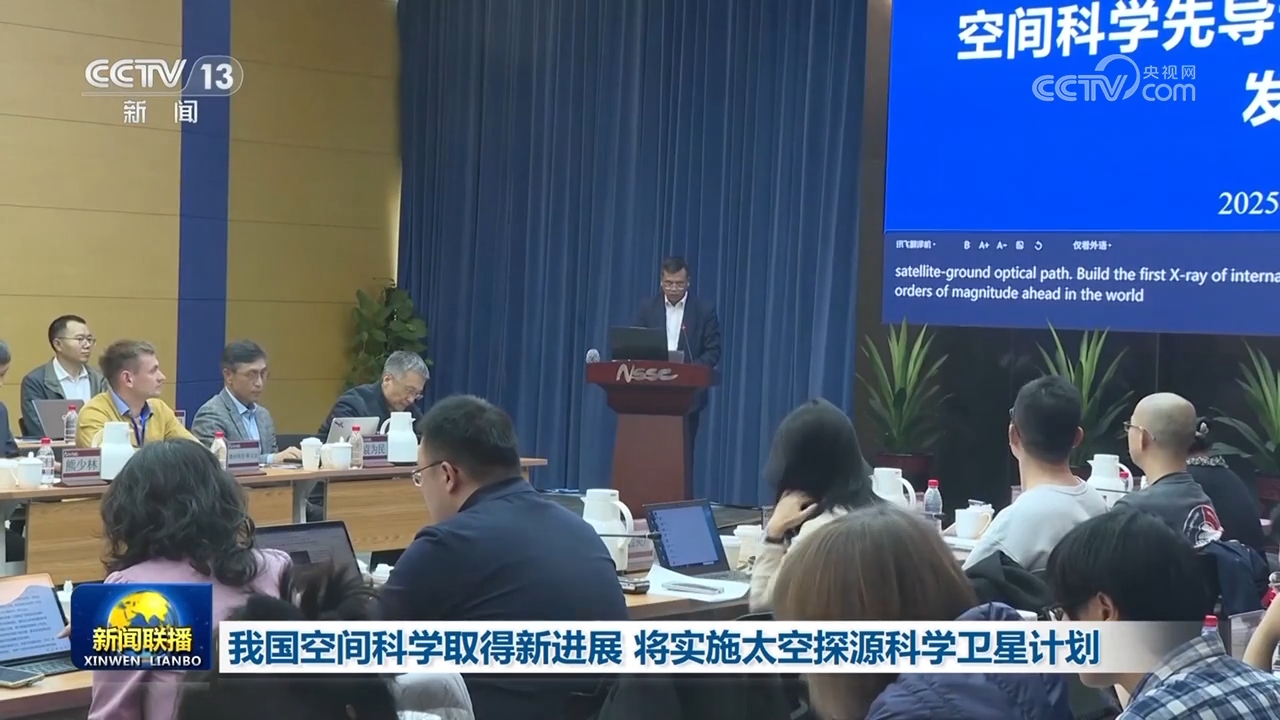
我国将开展太空探源科学卫星计划 探寻宇宙生命起源
Yang Shi Xin Wen Ke Hu Duan· 2025-11-24 08:32
Core Insights - The Chinese Academy of Sciences' National Space Science Center is implementing a series of space exploration satellite programs during the "14th Five-Year Plan" period, focusing on major frontier issues such as the origins of the universe, space weather, and life [1][2] - The initiative aims to achieve breakthroughs in fields like the cosmic dark age, solar magnetic activity cycles, and exoplanet detection, contributing significantly to China's status as a space and technology powerhouse [2] Group 1: Satellite Programs and Achievements - The space science pilot program, initiated in 2011, has successfully developed and launched eight scientific satellites, including "Wukong," "Shijian-10," "Micius," "Huiyan," "Taiji-1," "Huairou-1," "KuaFu-1," and "Tianguan," marking a historic leap from "following" and "keeping pace" to "leading" in certain areas [2][3] - The program has produced a series of significant original achievements, including the first international-level X-ray calibration beamline in China and a leading large field-of-view X-ray telescope [3] Group 2: Scientific Breakthroughs - The "Tianguan" satellite detected new types of X-ray transient sources, providing critical insights into these mysterious celestial bodies and opening new avenues for discovering stellar black holes [5] - The "Huiyan" satellite has made substantial contributions to understanding black holes, neutron stars, and gamma-ray bursts, including measuring the density of Earth's atmosphere and the mechanisms behind black hole accretion bursts [5][7] - The "Wukong" satellite achieved the first precise measurement of the boron energy spectrum of secondary cosmic rays above 1 TeV/n, revealing significant insights into cosmic ray propagation mechanisms [8] Group 3: International Collaboration and Talent Development - The program has established a new task system combining chief scientists and engineering leads, fostering a high-quality talent pool and innovative teams [3] - International collaborations have been initiated, such as the "Smile" satellite project with the European Space Agency, enhancing the global impact and effectiveness of China's scientific satellites [3]
