太阳能光伏电池板

Search documents
绿色低碳点亮新生活
Bei Jing Ri Bao Ke Hu Duan· 2025-11-06 03:14
Core Viewpoint - The article emphasizes the importance of promoting a green and low-carbon lifestyle in China, highlighting the integration of these principles into various aspects of economic and social development, as well as the tangible actions taken by the society to achieve the "dual carbon" goals set by the government [1]. Group 1: Green Transportation - The opening of the Shenyang-White Mountain high-speed railway significantly reduces travel time from approximately 4 hours to 1 hour and 53 minutes, showcasing a commitment to eco-friendly infrastructure [2]. - The construction team prioritized ecological preservation by opting for tunnel excavation over deforestation, demonstrating a commitment to minimizing environmental impact [2]. - The promotion of electric buses and the introduction of a carbon points system for subway users reflect a broader shift towards sustainable urban transportation [4]. Group 2: Electric Vehicles - The number of electric vehicles in Liaoning Province reached approximately 673,000 by the end of July, with a projected carbon reduction of over 2,000 tons by 2025 [3]. - The increasing availability and affordability of electric vehicles, along with supportive government policies, have led to a significant rise in consumer adoption [3]. Group 3: Green Buildings - The development of green buildings in Qinghai Province, including solar-powered structures, illustrates the integration of renewable energy into residential areas, contributing to a "zero-carbon village" [6][8]. - The implementation of photovoltaic technology in construction has resulted in substantial reductions in carbon emissions, with one company reporting an annual reduction of 5,388 tons [7][8]. - By 2024, the area of newly constructed green buildings is expected to reach 1.69 billion square meters, accounting for 97.9% of all new urban construction [8]. Group 4: Waste Recycling and Green Consumption - The introduction of smart recycling bins in urban areas has facilitated waste recycling, with over 10,000 participants in the program [10][11]. - The "trade-in" programs for appliances and the growing popularity of green products indicate a shift in consumer behavior towards sustainability [14]. - By 2024, over 70 million units of green and smart products are expected to enter Chinese households, reflecting a significant trend towards eco-friendly consumption [14].


产教融合 “订单式”协同培养打开毕业生就业新通道
Yang Shi Xin Wen· 2025-06-15 01:46
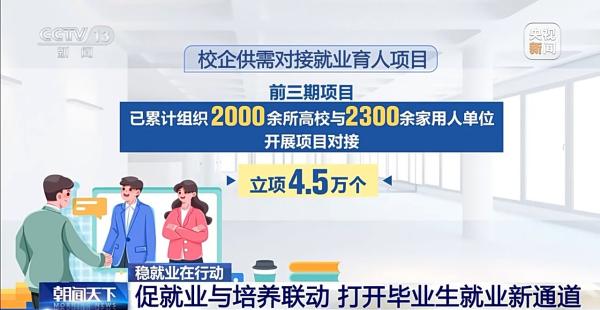
Group 1 - The "100-day sprint" action for the employment of 2025 college graduates is currently being implemented nationwide, with the Ministry of Education coordinating a new round of school-enterprise supply-demand matching employment education projects, involving 1,771 colleges and 13,000 cooperative projects [1] - Since 2021, the Ministry of Education has initiated the school-enterprise supply-demand matching employment education project, facilitating collaboration between colleges and employers to enhance the training and recruitment of innovative, composite, and application-oriented talents, with over 2,000 colleges and 2,300 employers participating in the first three phases, resulting in 45,000 projects [2] - In March of this year, the Ministry of Education began soliciting projects in the "artificial intelligence application" field to help colleges improve students' job awareness, practical experience, and employment capabilities, with 347 companies providing 11,000 cooperative projects [4] Group 2 - The implementation of the supply-demand matching employment education project focuses on "discipline optimization + targeted talent cultivation," creating an "order-based" school-enterprise collaborative training mechanism to achieve precise matching of talent supply and demand [5] - The "Elite Class" program co-established by Xi'an Jiaotong University and ZTE Corporation has successfully trained nearly 500 graduates over five years, addressing the mismatch between graduates' skills and employer requirements through a comprehensive "training-internship-employment" model [7] - Xi'an Jiaotong University has partnered with major companies like Huawei and Baidu to establish 26 "Elite Classes" in fields such as big data and artificial intelligence, training over 1,600 students with the help of industry experts [7] Group 3 - In Sichuan, a key province for the photovoltaic industry, colleges and enterprises are collaborating to create integrated training scenarios that accelerate the transformation of research results into productive forces, focusing on cultivating urgently needed technical innovation talents [10] - The "order class" model at Southwest Petroleum University allows students to engage in early internships and learn cutting-edge photovoltaic technology, with over 50% of the professional courses developed in deep collaboration with enterprises [12] - The "order class" has trained over 600 students in the past three years, with 12 out of 47 technical improvement projects completed by students being applied in production lines, demonstrating effective conversion of educational outcomes into industrial applications [14]