奥巴马医改补贴

Search documents
美参议院否决两项医保法案 奥巴马医改补贴或于年底到期
Xin Lang Cai Jing· 2025-12-11 21:06
Core Viewpoint - The U.S. Senate rejected two opposing healthcare bills, which means that the subsidies under the Affordable Care Act (Obamacare) enjoyed by over 20 million Americans are set to expire at the end of the year [1][4]. Group 1: Senate Voting Outcomes - The Senate voted 51-48 to advance a Republican healthcare plan aimed at expanding health savings accounts to replace the soon-to-expire tax credits [4]. - The Democratic proposal to extend the subsidies for three years also failed with a 51-48 vote, both proposals lacking the 60 votes needed to overcome procedural hurdles [4][5]. Group 2: Political Dynamics - The voting largely followed party lines, with only one Republican, Rand Paul, opposing his party's proposal, while several Republicans supported the Democratic plan [5]. - The votes were seen more as political statements rather than efforts to reach a bipartisan compromise, as acknowledged by Senate leaders [2][5]. Group 3: Implications of Subsidy Expiration - If no agreement is reached, the expiration of subsidies could lead to significant premium increases for many families, potentially rising by $1,000 or more annually [6]. - The Senate's ability to reach an agreement was viewed as a critical opportunity to prevent the expiration of subsidies and avoid premium hikes for those purchasing insurance through the ACA exchanges [6]. Group 4: House of Representatives Situation - The House is also experiencing partisan divisions, with no plans for a vote on subsidy extensions before the upcoming recess [3][6]. - Democratic leaders in the House align with their Senate counterparts in seeking a three-year extension of the tax credits, while two bipartisan proposals to shorten the extension period are stalled [3][6]. Group 5: Future Negotiations - Senate leaders expressed skepticism about reaching a last-minute bipartisan agreement, with the Senate expected to recess until January [6]. - Ongoing negotiations face multiple political disputes, including contentious issues surrounding abortion restrictions [6][7].
史上最长停摆现转机!美参议院达成临时协议 政府重启进入倒计时
智通财经网· 2025-11-10 12:55
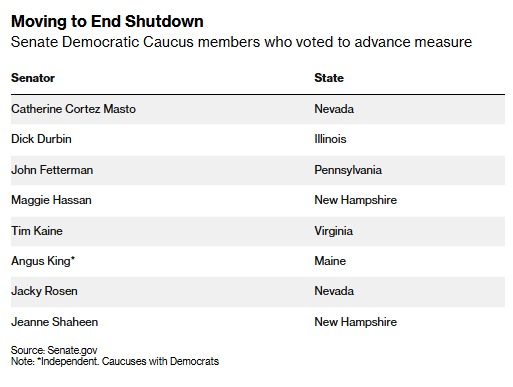
Core Points - The U.S. Senate passed a procedural motion to end the longest government shutdown in history with a vote of 60 to 40, paving the way for a temporary funding agreement [1] - The agreement includes full funding for the Department of Agriculture, the Department of Veterans Affairs, and Congress until the end of the fiscal year, while other federal agencies will receive funding to operate until January 30, 2026 [1] - The agreement aims to restore pay for furloughed federal employees and resume federal funding for state and local governments [1] Group 1 - The Senate requires unanimous consent from all members to expedite the process, and any opposition could delay the vote by several days [1] - House Speaker Mike Johnson has informed members to prepare for a vote within 36 hours [1] - President Trump expressed optimism about nearing an end to the shutdown [1] Group 2 - Some Democratic senators supported the agreement due to provisions preventing federal layoffs until January 30 [2] - The House's voting outcome remains uncertain, as Democratic leaders oppose any agreement lacking an extension of the Affordable Care Act subsidies [2][3] - The current agreement does not meet the core demands of Democratic leaders, who seek to extend expiring ACA subsidies and repeal cuts to Medicaid [3] Group 3 - The ongoing government shutdown has lasted for 40 days, marking a record in U.S. history, with previous attempts to leverage shutdowns for policy gains failing [3][4] - The Democratic Party has rejected a no-strings-attached temporary spending bill that could have kept the government running until November 21 [4] - The White House has pressured Congress, threatening mass layoffs and withholding pay for over 600,000 furloughed federal workers [4] Group 4 - The likelihood of reaching an agreement on extending ACA subsidies before the December deadline remains unclear, with House Republicans opposing the extension [5] - The political standoff has resulted in an estimated economic loss of approximately $15 billion per week, with a projected 1.5 percentage point decline in GDP growth rate due to the shutdown [5] - The funding bill includes provisions favored by Democrats, such as rejecting cuts to international food aid and increasing security funding for Congress [5]