宇树科技H2

Search documents
人形机器人崛起
机器人圈· 2026-02-26 07:52
Core Viewpoint - Humanoid robots are transitioning from conceptual ideas to tangible entities, gaining public attention, yet doubts remain about their practical applications and societal acceptance [5][16]. Group 1: Industry Development and Trends - The humanoid robot industry is characterized by a blend of skepticism and anticipation, with a focus on commercial viability, capital market trends, and global competition [5]. - Performance remains the primary application area for humanoid robots in 2026, as their current capabilities do not meet the expectations for industrial deployment [17][22]. - The development of humanoid robots is expected to follow a path from entertainment to practical applications, with skills demonstrated in performances potentially translating to real-world tasks [19]. Group 2: Technological Advancements - The "brain" of humanoid robots is becoming a critical competitive factor, with investments shifting towards advanced algorithms and decision-making capabilities [26][27]. - Current humanoid robot intelligence is likened to that of a "newborn," lacking sufficient data for growth and learning [29]. - The competition between China and the U.S. in the humanoid robot sector is intensifying, with China excelling in hardware manufacturing and the U.S. leading in AI and algorithm development [28][30]. Group 3: Market Dynamics and Investment - The humanoid robot sector is anticipated to enter a significant growth phase in 2026, with increased focus on core manufacturers and their ability to secure substantial orders [32]. - The market is witnessing a surge in investment, with the number of humanoid robot companies in China increasing from over 120 to more than 320, and total financing surpassing 58 billion yuan [34]. - Investors are expected to prioritize projects with sustainable value realization and practical applications, moving away from short-term technology demonstrations [35]. Group 4: Societal Implications - The integration of humanoid robots into society raises questions about job displacement and the future role of humans in the workforce [41][42]. - The societal impact of humanoid robots is expected to be profound, potentially transforming production methods and labor dynamics [42][43]. - The readiness of society to coexist with humanoid robots is a critical consideration, reflecting both hope and concern about the future [44].


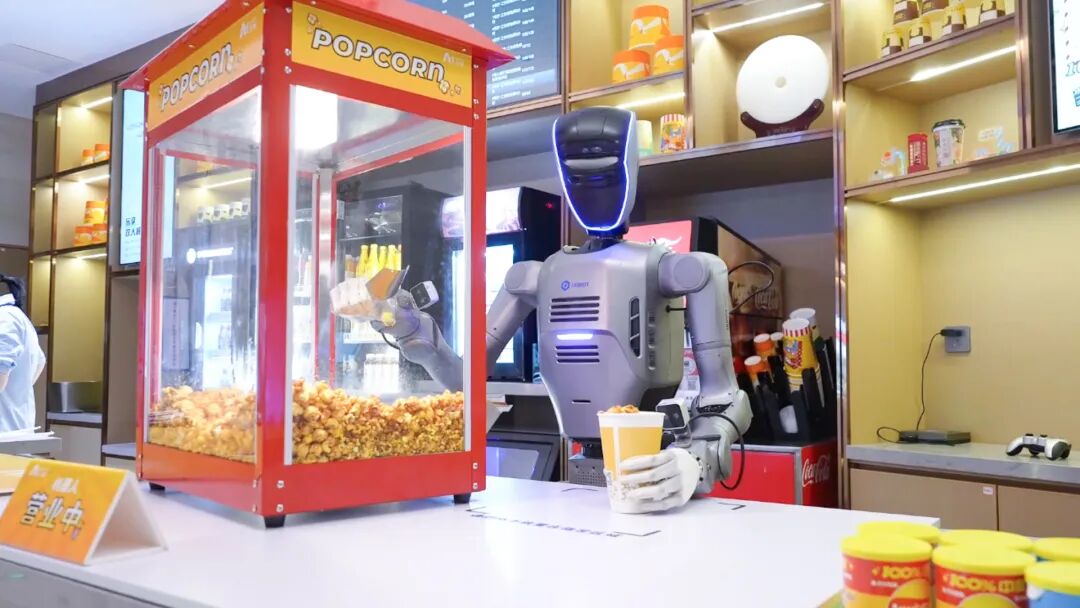
打工机器人在电影院正式“上班”!不用遥控器,工作14小时不累,卖了1000杯还零失误,一台19.9万元起
Mei Ri Jing Ji Xin Wen· 2026-01-05 11:20
Core Insights - The article highlights the successful deployment of the fully autonomous humanoid robot by Yuejiang Robotics at the K11 Art House cinema in Shenzhen, marking a global first in complex commercial environments [1][3]. Group 1: Robot Capabilities - The humanoid robot can operate continuously for 14 hours a day, independently producing and selling over 1,000 cups of popcorn without human assistance [1]. - It maintains a "zero-error" operation during its work period, autonomously completing tasks such as recognizing commands, grasping containers, and serving products [3]. - The robot is equipped with a millimeter-level grasping force control, allowing it to handle items without crushing them and to pour materials accurately without spillage [3]. Group 2: Technological Innovations - The breakthrough relies on Yuejiang's self-developed "big and small brain" collaborative intelligent system, enabling the robot to perceive its environment and adapt to changes [3]. - The core technology involves autonomous task planning and real-time error correction, allowing the robot to decompose complex tasks and monitor its status continuously [3]. - In case of unexpected disturbances, such as spilled popcorn or moved containers, the robot can autonomously diagnose issues and replan its tasks without external instructions [3]. Group 3: Product Variants - Yuejiang's humanoid robot, named Atom, is claimed to be the world's first "dexterous operation + straight-knee walking" embodied intelligent humanoid robot, available in multiple versions with varying joint degrees of freedom [4]. - The Atom Standard version features 20 degrees of freedom, suitable for first-time users, and supports basic walking and upper limb interaction, with OTA upgrade capabilities [12]. - The Atom D version is designed for large-scale data collection, equipped with 7 degrees of freedom in its arms and various end-effectors, including dexterous hands and grippers [15]. Group 4: Industry Trends - The humanoid robot production year is approaching, with companies like Yushutech and ZhiYuan Robotics expected to achieve mass production by 2025, and Tesla projected to produce 50,000 to 100,000 humanoid robots by 2026 [18]. - The industry is entering a phase of "mass production ramp-up and commercial exploration," indicating significant growth potential in the humanoid robotics sector [18]. Group 5: Market Performance - The robotics sector index rose by 2.78%, with notable gains from companies such as Robotec and Baichu Electronics, indicating strong investor interest [19]. - The E Fund Robotics ETF saw a trading volume exceeding 1 billion yuan, with net subscriptions surpassing 130 million units, reaching a record high of 15.2 billion yuan [19].