
家庭财险

Search documents
制造业巨头入局保险业背后的多维逻辑
Nan Fang Du Shi Bao· 2025-09-16 23:14
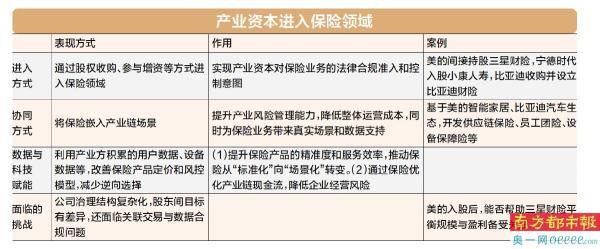
| | | 产业资本进入保险领域 | | | --- | --- | --- | --- | | | 表现方式 | 作用 | 零例 | | 讲入 方式 | 通过股权收购、参与增资等方式进 入保险领域 | 实现产业资本对保险业务的法律合规准入和控 制意图 | 美的间接持股三星财险,宁德时代 入股小康人寿,比亚迪收购并设立 | | | | | 比亚迪财险 | | 协同 方式 | 将保险嵌入产业链场景 | 提升产业风险管理能力,降低整体运营成本,同 时为保险业务带来直实场景和数据支持 | 基于美的智能家居、比亚迪汽车生 态,开发供应链保险、员工团险、设 | | | | | 备保障险等 | | 数据与 | 利用产业方积累的用户数据、设备 | (1)提升保险产品的精准度和服务效率,推动保 | | | 科技 | 数据等,改善保险产品定价和风控 | 龄从"标准化"向"场景化"转变。(2)通过保险优 | | | 赋能 | 精型,减少逆向选择 | 化产业链现金流,降低企业经营风险 | | | 面临的 挑战 | 公司治理结构复杂化,股东间目标 有差异,还面临关联交易与数据合 | | 美的入股后,能否帮助三星财险平 新规模与盈利备 ...


制造大亨“抢滩”保险业!美的曲线入股三星财险的多维逻辑
Nan Fang Du Shi Bao· 2025-09-11 14:17
Core Viewpoint - The entry of Midea Group into Samsung Property Insurance signifies a strategic shift in the insurance landscape, highlighting the integration of industrial capital into the insurance value chain, which brings both opportunities and challenges for governance and compliance [1][10]. Group 1: Midea's Strategic Entry - Midea Group, through its indirect ownership via Junlan Hotel Management, is set to become the third-largest shareholder of Samsung Property Insurance by acquiring 11.5% of the shares from Yuxing Technology [2][4]. - The indirect investment approach allows Midea to navigate regulatory constraints while minimizing risks to its core business operations [3][8]. - Midea's entry is seen as a potential catalyst for Samsung Property Insurance, leveraging its industrial resources and financial experience to drive growth [4][8]. Group 2: Samsung Property Insurance's Performance - Samsung Property Insurance has undergone a transformation, with Tencent becoming the second-largest shareholder in 2022, leading to significant changes in management and business structure [5]. - The company's insurance revenue grew from 899 million to 2.132 billion from 2022 to 2024, reflecting a compound annual growth rate of 33.35% [5]. - Despite revenue growth, net profit declined from 87 million to 12 million during the same period, indicating ongoing profitability challenges [6]. Group 3: Industry Trends and Challenges - The influx of industrial capital into the insurance sector is reshaping the value chain, moving towards a model that emphasizes scenario-based and data-driven insurance products [10][11]. - The integration of industrial capital presents governance challenges, as differing strategic goals among shareholders may complicate decision-making processes [11][12]. - The insurance industry requires high levels of actuarial and risk management expertise, which may pose challenges for manufacturing giants entering the sector [11][12].