小米汽车 SU7 Ultra

Search documents
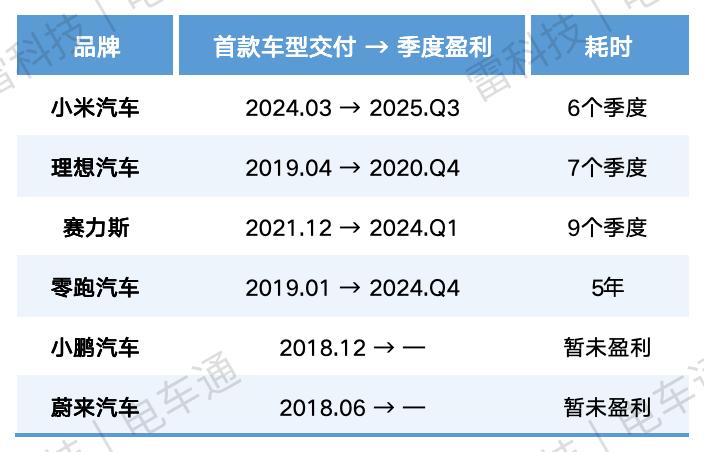
6个季度就盈利,小米汽车创纪录,但依然未能进入安全区
3 6 Ke· 2025-11-20 01:13
Core Insights - Xiaomi Group reported a significant performance in its automotive business for Q3 2025, achieving a revenue of 29 billion yuan, a year-on-year increase of 199.2%, and marking its first quarterly profit of 700 million yuan with a gross margin of 25.5% [1][6] Group 1: Financial Performance - The automotive business's revenue growth is attributed to a rapid increase in vehicle deliveries, with a target of 350,000 units for the year, reflecting a nearly threefold increase from the previous year [2][19] - The gross margin of Xiaomi's automotive division has risen from 17.1% to 25.5%, surpassing competitors like Tesla and Li Auto [6][10] Group 2: Production Capacity and Strategy - Xiaomi's production strategy involves parallel operation of multiple factories and supply chain collaboration, allowing for rapid scaling of production capacity [3][19] - The first-phase factory has a designed annual capacity of 150,000 vehicles, currently operating at a monthly capacity of 24,000 vehicles, while the second-phase factory is ramping up production from 8,000 to 20,000 vehicles per month [3][4] Group 3: Market Position and Competition - Xiaomi's dual vehicle strategy has positioned it well in the mid-to-high-end market, with a product matrix covering price ranges from 250,000 to 600,000 yuan [7][10] - The company faces increasing competition as traditional automakers accelerate their transition to electric vehicles, which may impact Xiaomi's market share and pricing strategy [12][19] Group 4: Future Challenges and Outlook - The upcoming reduction in new energy vehicle purchase tax subsidies poses a risk to Xiaomi's pricing competitiveness and could affect consumer demand [9][12] - Despite ambitious production targets of 1.17 to 1.2 million vehicles for 2026, achieving such goals will depend on market conditions and the company's ability to manage production and supply chain challenges [13][17]


雷军无法回头
Sou Hu Cai Jing· 2025-05-22 15:47
Core Viewpoint - Xiaomi's founder and CEO Lei Jun is shifting his focus from mobile phones to the automotive sector, indicating a significant strategic pivot for the company as it faces a trust crisis and seeks to reaffirm its market position [2][3][4]. Group 1: Leadership and Marketing Strategy - Lei Jun has stated that half of his energy will be dedicated to the automotive business, while only one-third will be allocated to mobile phones, highlighting a major shift in priorities [2]. - The recent product launch event on May 22 marks Xiaomi's 15th anniversary and is the first major event following a significant trust crisis, necessitating Lei Jun's return to the public eye to restore confidence [3]. - Lei Jun's personal branding is deeply intertwined with Xiaomi, making it difficult for him to abandon his previous marketing strategies despite recent controversies [3][4]. Group 2: Recent Challenges and Responses - Following a serious incident involving the Xiaomi SU7, Lei Jun reduced his social media presence, reflecting a period of introspection and strategic recalibration for the company [5][6]. - Xiaomi acknowledged issues with the SU7's carbon fiber hood, leading to customer complaints and a public apology, which indicates the company's responsiveness to consumer feedback [7]. - The legal department of Xiaomi reported the resolution of a network smear campaign against the company, which may help mitigate some of the negative publicity [8][10]. Group 3: Product Launch and Future Plans - During the recent product launch, Xiaomi announced a significant R&D investment plan, committing to 200 billion yuan over the next five years, emphasizing its focus on innovation and self-research [12]. - The new model, Xiaomi YU7, is positioned as a mid-to-large SUV, targeting a larger market segment compared to the previous SU7, which faced a more competitive environment [15]. - The launch event showcased Xiaomi's advancements in self-developed technology, including the mass production of its 3nm mobile processor, positioning the company as a key player in the tech industry [10][12].