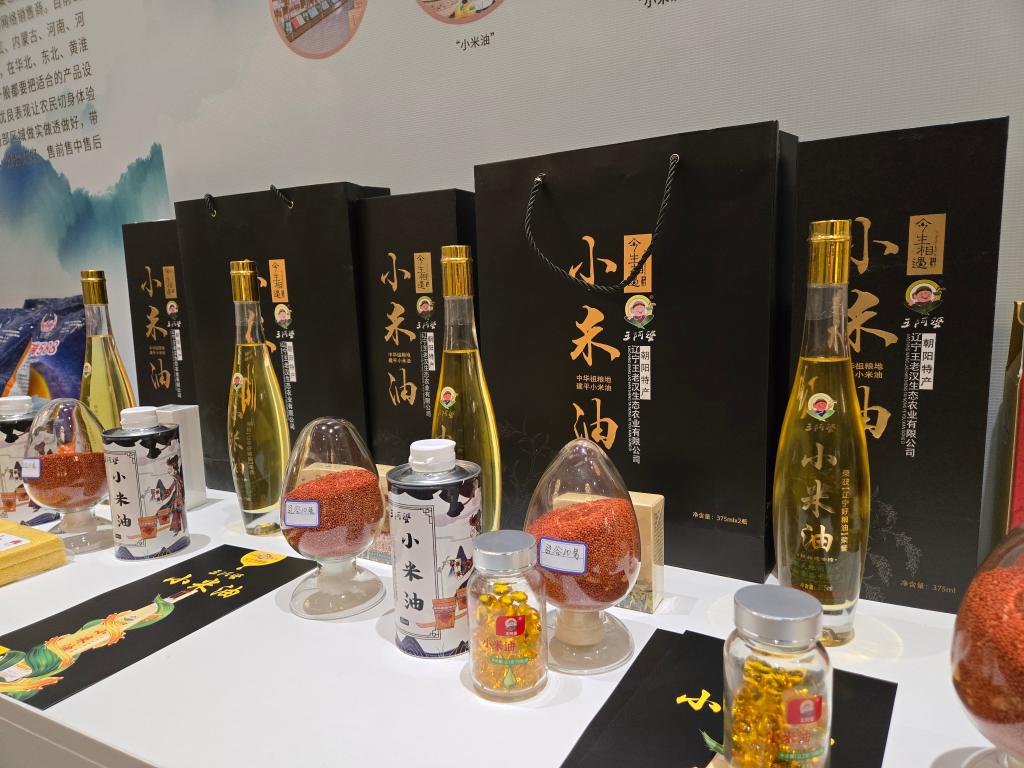
小米油

Search documents
绿色赋能:践行“两山”理念的沁县范式
Zhong Guo Jing Ji Wang· 2026-01-08 07:38
Core Viewpoint - The competition in China's millet industry is intensifying, with Inner Mongolia's Chifeng Aohan Banner and Shanxi's Changzhi Qinxian showcasing distinct development paths based on their unique natural endowments and industrial foundations. Aohan millet leads the industry with its historical heritage and comprehensive industrial chain, while Qinxian leverages its ecological advantages for steady progress. The establishment of a joint research institute aims to enhance Qinxian's millet industry through technological collaboration and innovation [1][8]. Group 1: Resource Endowment and Brand Marketing Comparison - Aohan's core advantages lie in its historical significance and large-scale production, with an 8,000-year history of millet cultivation and a stable planting area of over 1 million acres, yielding more than 600 million pounds annually, resulting in a brand value of 28.241 billion yuan [2][3]. - Qinxian focuses on ecological purity and quality, with a total cultivated area of 620,000 acres and certifications for geographical indication and organic products. Its millet has protein content 30% higher than national standards and is known for its rich nutritional profile [3][4]. Group 2: Brand Marketing Strategies - Aohan's brand marketing is characterized by a systematic, multi-dimensional, and digital approach, integrating cultural heritage into its branding and establishing a comprehensive industrial chain [4]. - Qinxian's marketing strategy emphasizes ecological branding and regional public branding, leveraging its certifications and hosting national industry conferences to promote its products [5][6]. Group 3: Challenges and Opportunities - Aohan faces challenges related to quality control and innovation as it scales up production, while Qinxian struggles with insufficient technical investment and a lack of high-value-added products [7][8]. - The establishment of a joint research institute is a strategic move for Qinxian to address its industry shortcomings by leveraging advanced research capabilities to enhance its production and branding [8][9]. Group 4: Technological and Standardization Initiatives - Qinxian aims to implement standardized planting techniques to improve quality and yield, supported by the joint research institute's expertise [9][10]. - The development of a comprehensive standardization system covering all aspects of millet production and processing is essential for Qinxian to ensure product quality and brand integrity [11][12]. Group 5: Marketing and Brand Expansion - Qinxian should focus on creating a differentiated brand narrative based on its ecological advantages and scientific validation, utilizing modern marketing strategies to enhance its national presence [12][13]. - The integration of agricultural tourism with millet production can further promote Qinxian's brand and attract consumers to experience its ecological farming practices [12][14]. Group 6: Sustainable Development and Economic Benefits - The collaboration with the research institute is expected to enhance both ecological sustainability and economic benefits for local farmers, creating a model for agricultural transformation [13][14]. - Qinxian's approach to combining millet cultivation with ecological restoration can lead to improved environmental conditions while providing economic opportunities for the community [14][15].
新技术新服务改造农业造福乡村
Jing Ji Ri Bao· 2025-10-06 22:04
Core Insights - The article highlights the successful transformation of the millet industry in Aohan Banner, Inner Mongolia, driven by improved seed varieties and agricultural technology [1][2] - The integration of processing enterprises and the establishment of cooperative models have enhanced the value chain and marketability of Aohan millet [2] Group 1: Agricultural Practices - The introduction of the Aogu 8000 variety has increased average yield by over 20%, with net profits reaching around 1200 yuan per mu [1] - The coverage rate of quality millet seeds in the region has reached 96%, supported by the establishment of a genetic resource protection base and the cultivation of 8 specialty varieties [1] - The implementation of advanced agricultural techniques, such as water and fertilizer integration and soil testing for fertilization, has stabilized millet planting area at over 1 million mu, with annual production exceeding 600 million jin [1] Group 2: Industry Development - The Aohan Millet Industry Development Group has unified 46 local processing enterprises under a "1+N" model, standardizing processing and sharing logistics resources [1] - The group has developed 9 deep-processing products, including millet oil and millet wine, along with 22 functional products like colored millet and selenium-rich millet [1] - The Hui Long Grain Planting Farmers' Cooperative has established a "cooperative + base + farmer" model, providing comprehensive support services to farmers, resulting in higher prices for their produce [2] Group 3: Marketing and Consumer Engagement - Efforts are being made to enhance the reputation and market reach of Aohan millet through the establishment of a millet museum and product exhibition hall [2] - A smart agriculture platform has been created to allow real-time monitoring of soil conditions, millet growth, and processing status, ensuring traceability and consumer confidence [2]
立足本地资源优势 推动杂粮产业发展——辽宁朝阳杂粮产业高质量发展观察
Xin Hua Wang· 2025-07-16 01:55
Core Insights - The demand for miscellaneous grain products is continuously growing due to diversified dietary structures, and Chaoyang City in Liaoning Province is leveraging its local resource advantages to promote the development of the miscellaneous grain industry [1][6] - The total planting area for miscellaneous grains in Chaoyang is projected to reach 1.054 million acres in 2024, accounting for 79% of the total in Liaoning Province, with a total output of 340,000 tons and a production value of nearly 8 billion yuan [1][6] Group 1: Industry Development - The Chaoyang region is located in the agricultural planting golden belt, characterized by favorable natural conditions that support the cultivation of high-quality products like "Chaoyang Millet" [3][6] - The recent high-quality development innovation conference for the miscellaneous grain industry resulted in the signing of eight cooperation agreements across three major areas, aimed at expanding market access for Chaoyang's miscellaneous grain products [1][6] Group 2: Sales and Market Expansion - Local enterprises are enhancing their e-commerce capabilities, achieving significant sales milestones, such as selling 60 tons of organic millet products in just 29.5 hours [6][7] - The physical market for miscellaneous grains in Zhuliu Ke Town is thriving, with over 90% of local growers signing contracts with enterprises, and some products being exported to countries like Japan, South Korea, and Malaysia, with annual export revenue exceeding 10 million dollars [6][7] Group 3: Challenges and Solutions - Despite being known as the "Capital of Miscellaneous Grains," Chaoyang faces challenges such as low scale, low added value, and passive market pricing, with average profits for miscellaneous grain products ranging from 0.1 to 0.15 yuan per pound, lower than mid-to-high-end products [6][7] - To address these challenges, the local government is promoting a "company + farmer + cooperative" model to create a shared benefits and risk-bearing system, which has already benefited 12,000 households and increased farmers' income by 12 million yuan [7]