小鹏城市NOA

Search documents
竞品挤压叠加高研发,比亚迪步入盈利阵痛期
Bei Jing Shang Bao· 2025-10-31 07:21
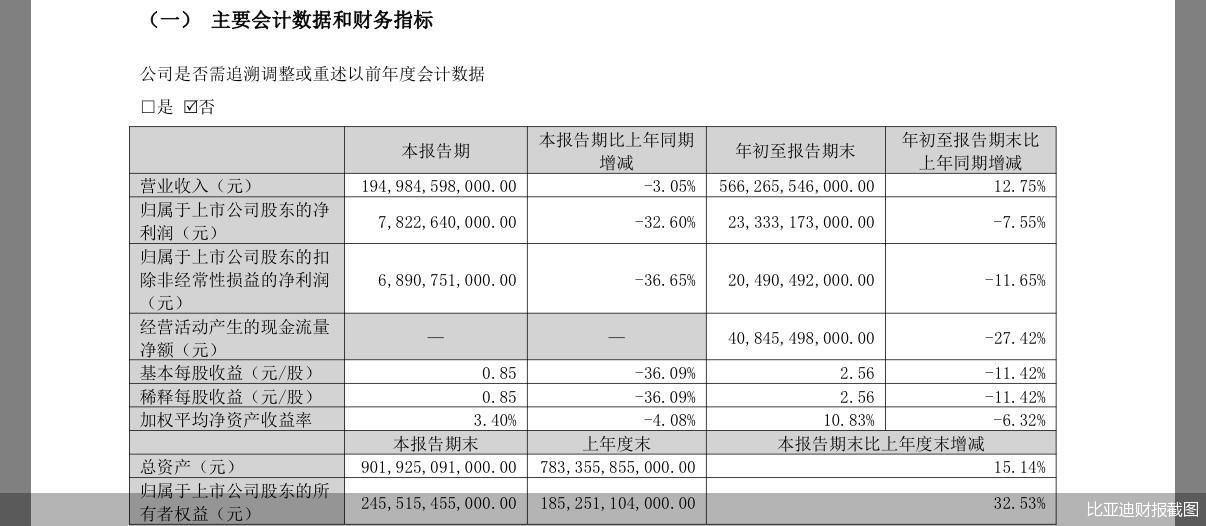
Core Viewpoint - BYD's Q3 2025 financial results show a significant divergence with a decline in revenue and a sharp drop in net profit, indicating pressure on performance amid increased competition and high R&D costs [1][3]. Financial Performance - Q3 revenue reached 194.99 billion yuan, a year-on-year decrease of 3.05%, marking the first quarterly revenue decline since 2022 [3]. - Net profit for Q3 was 7.82 billion yuan, down 32.6% year-on-year, continuing a trend of profit decline over two consecutive quarters [1][3]. - For the first three quarters, total revenue was 566.27 billion yuan, reflecting a 12.75% year-on-year growth, while net profit decreased by 7.55% to 23.33 billion yuan [2][3]. Sales and Market Dynamics - BYD's global sales for the first three quarters reached 3.26 million units, a year-on-year increase of 18.64%, but Q3 sales saw a decline of approximately 1.8% [3]. - The company adjusted its annual sales target from 5.5 million to 4.6 million units, with Q3 sales of 396,300 units falling short of the target [3]. R&D Investment - R&D expenses for the first three quarters amounted to 43.75 billion yuan, a 31.3% increase year-on-year, significantly exceeding net profit [5]. - The high R&D costs are impacting short-term profitability, with the average vehicle cost rising to 112,000 yuan in Q2 [5][6]. Competitive Landscape - The intensifying competition in the smart driving sector is a critical factor affecting BYD's performance, with competitors like Tesla and Huawei gaining market share [7][8]. - BYD's "Tiangshen Eye" smart driving system has been installed in 1.7 million vehicles, but the company faces challenges in expanding its urban navigation capabilities [7]. Strategic Recommendations - Industry experts suggest that BYD should enhance the differentiation of its smart driving technology and improve R&D efficiency to avoid resource wastage [6][8]. - Building an integrated smart ecosystem and accelerating localized R&D for different markets are also recommended to enhance user engagement and adapt to local regulations [8].