居易白酒

Search documents
买白酒送“原始股”?新三板居易文化“A+H股上市”揭秘|拆解股市骗局
Sou Hu Cai Jing· 2026-02-11 23:41
Core Viewpoint - The article discusses a fraudulent scheme involving the sale of original shares linked to a company called "居易文化" (Juyi Culture), which is purportedly preparing for an IPO on the Hong Kong Stock Exchange. The scheme involves misleading investors into purchasing original shares under the guise of a legitimate investment opportunity, promising high returns and fixed dividends. Group 1: Company Overview - The company "居易文化" is planning to go public on the Hong Kong Stock Exchange, with a timeline suggesting a listing by April 2026 [3] - The company has been promoting its products, such as "居易白酒" (Juyi Baijiu), as part of its investment strategy, requiring investors to purchase products to qualify for original shares [3][6] - The company is reportedly in the process of acquiring control of a listed shell company, 恒泰裕集团 (Heng Tai Yu Group), to facilitate its listing [3][6] Group 2: Investment Scheme Details - The scheme involves initial trust-building through stock trading education, followed by the promotion of original shares with promises of significant returns, such as a 50-fold increase [1] - Investors are misled into believing they can purchase original shares by first buying products, which is a tactic to create a façade of legitimacy [1][3] - The company has been accused of engaging in illegal fundraising practices, as the sale of original shares to the public without proper registration is prohibited [7][9] Group 3: Legal and Regulatory Concerns - Legal experts highlight that the public sale of original shares constitutes illegal fundraising and may lead to serious legal repercussions for the company [7][9] - The distinction between listing and trading is emphasized, indicating that the company’s actions may mislead investors regarding the nature of their investments [7][8] - There are warnings that such schemes often evolve into more severe forms of fraud, including Ponzi schemes, as financial pressures mount [9]

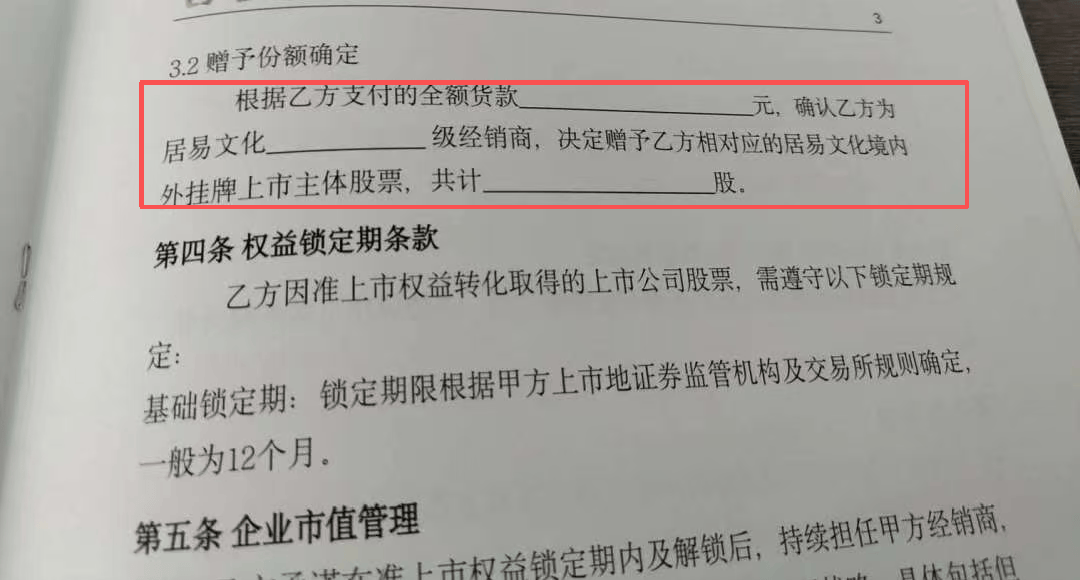
买白酒送“原始股”?新三板居易文化“A+H股上市”揭秘
Xin Lang Cai Jing· 2026-02-10 06:44
Core Viewpoint - The article highlights a fraudulent scheme involving the sale of original shares linked to a company, "居易文化" (Juyi Culture), which is allegedly preparing for an IPO in Hong Kong. The scheme promises high returns and fixed dividends, luring investors through deceptive practices [1][17]. Group 1: Company Overview - "居易文化" is reportedly planning to go public on the Hong Kong Stock Exchange, with claims that original shares priced at 1 yuan could yield a 50-fold return upon listing [1][17]. - The company has been promoting an 8% fixed dividend and a buyback guarantee after three years, which raises concerns about the legitimacy of these claims [1][17]. - The company is currently classified as a basic tier entity on the New Third Board, and there is no official record of its IPO plans in past announcements [5][21]. Group 2: Fraudulent Practices - The scheme involves convincing individuals to purchase products, such as "居易白酒" (Juyi Baijiu), to qualify for the purchase of original shares, creating a façade of legitimacy [1][17]. - The promotional tactics include creating a sense of urgency and exclusivity, with claims of ongoing updates about the company's IPO progress [1][17]. - Legal experts indicate that the sale of original shares in this manner may constitute illegal public offerings, as it bypasses regulations governing stock issuance [29][32]. Group 3: Market Implications - The article discusses the broader implications of such fraudulent activities in the capital market, emphasizing the risks of illegal securities issuance and the potential for investor losses [1][32]. - It is noted that the conditions for listing on platforms like the Hong Kong GEM and NASDAQ are relatively low, which may encourage such schemes [15][30]. - The article warns that these types of fraudulent schemes can evolve into more severe forms of financial crime, such as collective fraud, especially when companies face financial pressures [32].

买白酒送“原始股”?新三板居易文化“A+H股上市”揭秘|拆解股市骗局②
Sou Hu Cai Jing· 2026-02-10 06:43
Core Viewpoint - The article highlights a fraudulent scheme involving the sale of original shares linked to a company purportedly preparing for an IPO, emphasizing the risks of investing in unregulated securities and the tactics used to lure investors into scams [1][8][18]. Group 1: Company and IPO Claims - The company, referred to as "居易文化" (Juyi Culture), is allegedly planning to go public in Hong Kong by 2026, with claims of significant returns on original shares purchased [8][14]. - The company has made promises of an 8% fixed dividend and a buyback after three years, which raises red flags regarding the legitimacy of these claims [1][18]. - Reports indicate that the company is attempting to acquire control of a listed entity, 恒泰裕集团 (Heng Tai Yu Group), as part of its strategy to achieve a public listing [9][14]. Group 2: Investor Experience and Fraud Tactics - Investors, like the father of the individual referred to as 小艾 (Xiao Ai), were initially attracted by stock trading education and were later persuaded to invest in original shares under the guise of an upcoming IPO [1][8]. - The scheme involved requiring investors to purchase a certain amount of products, such as liquor, to qualify for the original shares, creating a façade of legitimacy [1][8]. - The article notes that many investors remain hopeful about the company's IPO despite the lack of credible information or progress towards an actual listing [18]. Group 3: Legal and Regulatory Concerns - Legal experts have pointed out that the sale of original shares without proper regulatory compliance constitutes illegal fundraising and could lead to severe legal repercussions for the company [14][15][18]. - The distinction between public and private offerings is emphasized, with warnings that any public sale of shares without proper registration is illegal [15][17]. - The article suggests that the company's promotional tactics may mislead investors into believing they are participating in a legitimate investment opportunity, while in reality, it may be a form of fraud [14][18].