工小审

Search documents
监管明确加快发展“人工智能+金融”,银行如何布局?
Huan Qiu Wang· 2025-12-30 08:02
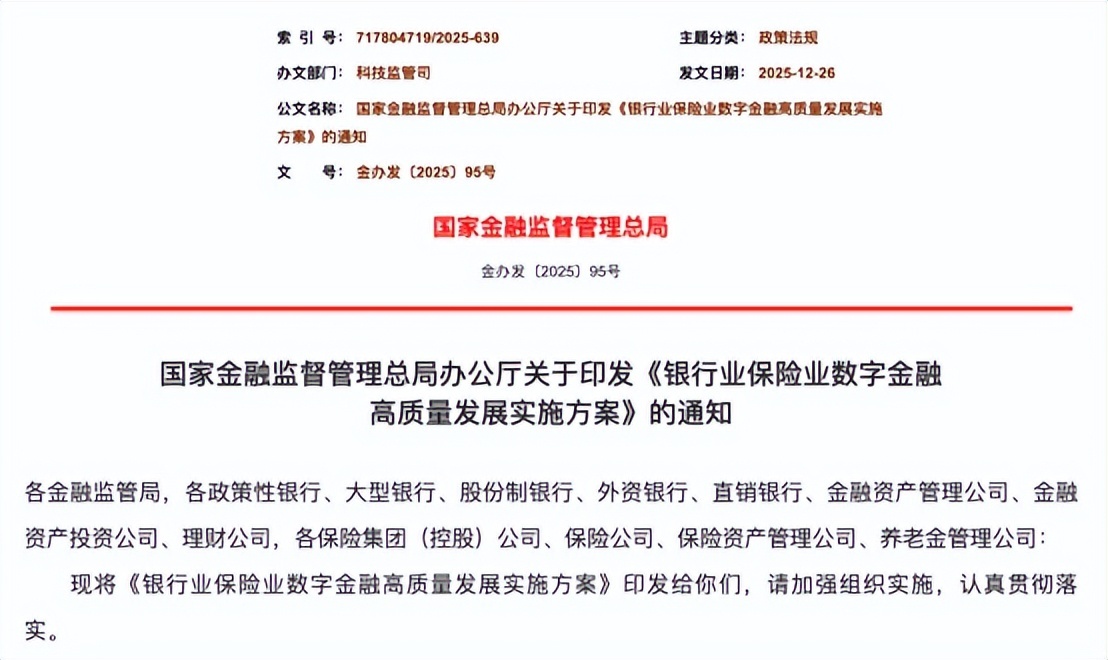
Core Viewpoint - The implementation plan for the high-quality development of digital finance in the banking and insurance sectors emphasizes the integration of artificial intelligence and other new technologies to enhance financial services and optimize resource allocation [1][5]. Policy Guidance - The plan builds on previous guidelines and introduces new elements such as "AI+" and "data elements ×", outlining specific requirements across six areas including governance, service empowerment, and risk prevention [5][8]. - Financial institutions are encouraged to develop enterprise-level AI platforms to enhance modeling and application capabilities, while exploring advanced technologies like quantum computing and blockchain [5][8]. - The focus is on aligning technological innovation with business needs to create a positive cycle of technology-driven business development [5][8]. Practical Exploration - Several listed banks have actively integrated AI into customer service, risk control, and marketing, with applications such as intelligent assistants and credit AI agents [6]. - For instance, China Merchants Bank reported that its AI assistant "AI Xiao Zhao" served over 61,300 corporate clients and 458,500 individuals by mid-2025 [6]. - Industrial banks like Industrial and Commercial Bank of China have developed AI-driven tools for risk control and marketing, enhancing their operational efficiency [6][7]. Technology Resource Allocation - The plan provides clear guidance on technology resource allocation, urging banks to focus on core business areas and increase R&D investment [8]. - It aims to break down barriers between technology and business departments, fostering collaboration and innovation [8]. - The plan also emphasizes the importance of building a skilled workforce in digital finance, advocating for the training of professionals in data analysis and regulatory technology [8][9]. Talent Development - The plan highlights the need for cultivating a workforce that understands both finance and technology, rather than solely pursuing top algorithm talent [9]. - It suggests that banks should prioritize data governance based on business needs to enhance model quality [9].

AI赋能 银行业加快数智化转型
Jin Rong Shi Bao· 2025-05-22 03:12
Core Insights - The banking industry is accelerating the exploration of artificial intelligence (AI) technologies, with AI becoming a frequent topic during the 2024 earnings announcements [1] - AI is reshaping banking business models, enhancing operational efficiency, customer service capabilities, and management processes [1][2] - The deployment of AI technologies, such as the DeepSeek model, is being widely adopted across various banking functions, leading to improved efficiency and cost reduction [1][2] Group 1: AI Implementation in Banking - Several banks, including Industrial and Commercial Bank of China (ICBC), have reported significant workforce efficiency gains through AI, with ICBC's AI applications replacing over 42,000 jobs annually [2] - ICBC has developed a comprehensive financial model system, "工银智涌," which is applied across more than 20 business areas, demonstrating AI's strong support for high-quality financial development [2] - Other banks, like China Merchants Bank, have also reported substantial productivity increases from AI applications, equating to the work of over 5,000 full-time employees [2] Group 2: Operational Efficiency Gains - AI technologies are enhancing internal operations, with banks reporting time savings of up to 60% in tasks such as due diligence report generation [3] - For example, China Merchants Bank's AI assistant has improved loan processing times by 54%, while Minsheng Bank has achieved over 30% adoption of AI-generated code in its development processes [3] - Postal Savings Bank's "小邮助手" has improved internal operations, handling over 3,000 inquiries daily and reducing processing times by approximately 20% [4] Group 3: Customer Interaction and Service Enhancement - AI applications in customer-facing roles, such as intelligent customer service and financial advisory, have significantly improved efficiency, with ICBC reporting a threefold increase in transaction efficiency [5] - Postal Savings Bank's trading robots have reduced transaction inquiry times by about 94%, showcasing the effectiveness of AI in streamlining operations [5] - Major banks are integrating AI into core business functions, such as credit management, with ICBC's AI assistant facilitating comprehensive credit approval processes [5] Group 4: Human-Machine Collaboration - The concept of "human-machine collaboration" is gaining traction, with banks focusing on how employees can effectively utilize AI technologies [6] - Agricultural Bank of China emphasizes the need for a "machine processing + human assistance" model to adapt to AI's impact on business processes [6] - Banks are also developing AI-driven tools to enhance employee productivity and decision-making, with initiatives to create a unified knowledge management system [6] Group 5: Challenges and Future Directions - Despite the advantages of AI, there are concerns about its implementation, with a significant portion of respondents expressing reluctance to deploy AI in customer service roles [7] - The rise of general models like DeepSeek presents opportunities for banks to enhance efficiency while addressing the challenges of human-AI interaction [7] - Industry experts suggest that banks should focus on AI infrastructure improvements, talent development, and fostering a collaborative environment to maximize AI's potential [7]
邮储、建行、工行集体出手!
21世纪经济报道· 2025-03-10 10:26
Core Viewpoint - The article discusses the advancements in the deployment of the DeepSeek open-source large model by major banks in China, highlighting its role in enhancing financial services through intelligent upgrades and operational efficiencies [2][6][10]. Group 1: Deployment and Adoption - As of March 8, Industrial and Commercial Bank of China (ICBC) has completed the private deployment of the latest DeepSeek model, integrating it into its "ICBC Intelligent Surge" model matrix to enhance financial business scenarios [2][6]. - Over 20 banks have adopted the DeepSeek model, with major state-owned banks like Postal Savings Bank and China Construction Bank also initiating their deployments [3][8]. Group 2: Focus Areas of Application - Banks are focusing on four main areas for the application of DeepSeek: intelligent customer service upgrades, business process optimization, intelligent decision-making and risk management, and intelligent marketing and customer insights [4][12]. - DeepSeek is expected to replace repetitive tasks and enhance cognitive capabilities, driving business process optimization and innovation [4][16]. Group 3: Specific Implementations - ICBC has empowered over 20 major business areas with the DeepSeek model, implementing more than 200 practical scenarios, including a smart dialogue trading product and a remote banking assistant that improves service efficiency by reducing call durations by approximately 10% [6][12]. - Postal Savings Bank has integrated DeepSeek models to enhance its "Little Postal Assistant," improving service efficiency and customer experience through advanced logical reasoning capabilities [9][13]. Group 4: Future Implications - The integration of DeepSeek into banking services signifies a shift from "informationization" to "cognition" in financial services, indicating a transformative phase in how banks interact with customers and manage operations [16][17]. - The technology is expected to reshape the banking industry's approach to AI applications, focusing on personalized customer interactions and efficient resource allocation [17][19].