抹香鲸

Search documents
浦发银行(600000):数智转型赋能质效提升,化风险轻装上阵
Ping An Securities· 2026-03-17 09:48
Investment Rating - The report gives a "Buy" rating for the company, marking the first coverage of the stock [1]. Core Insights - The company is undergoing a digital transformation aimed at enhancing operational efficiency and reducing risks, positioning itself for future growth [8][9]. - The management team has been renewed, focusing on a strategic shift towards digitalization and optimizing business structures around five key financial sectors [25][30]. - The bank's asset quality is improving, with a significant reduction in non-performing loans and an increase in provision coverage, indicating a stronger risk management framework [9][36]. Summary by Sections Company Overview - The company, Shanghai Pudong Development Bank, was established in January 1993 and is headquartered in Shanghai, with a balanced and stable shareholding structure [8][13]. - As of the end of 2025, the bank's total assets are projected to exceed 10 trillion yuan, with a year-on-year growth of 6.55% [8][20]. Management and Strategic Transformation - The new management team, which took office in 2024, is focused on a digital transformation strategy that emphasizes technology finance, supply chain finance, inclusive finance, cross-border finance, and treasury finance [25][30]. - The organizational structure has been optimized to support this transformation, with new departments established to enhance focus on key business areas [32][36]. Risk Management and Profitability - The bank has actively managed and resolved existing risks, with a cumulative write-off of risk assets reaching 548.5 billion yuan from 2017 to mid-2025 [8][9]. - The non-performing loan ratio has decreased significantly, and the provision coverage ratio is expected to reach 201% by the end of 2025, indicating improved risk resilience [9][36]. Investment Recommendations - The report anticipates continued improvement in profitability, with projected earnings per share (EPS) of 1.49 yuan, 1.65 yuan, and 1.81 yuan for 2025, 2026, and 2027, respectively [9][36]. - The bank's current stock price reflects a low price-to-book (P/B) ratio, suggesting potential for valuation recovery as profitability improves [9][36].

监管明确加快发展“人工智能+金融”,银行如何布局?
Huan Qiu Wang· 2025-12-30 08:02
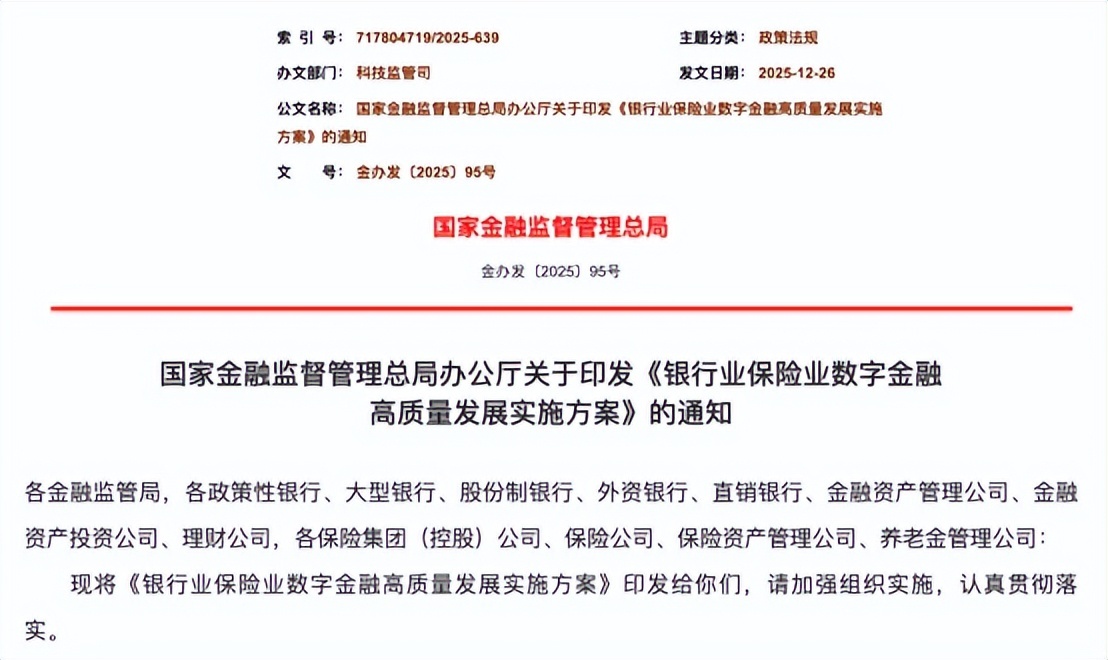
Core Viewpoint - The implementation plan for the high-quality development of digital finance in the banking and insurance sectors emphasizes the integration of artificial intelligence and other new technologies to enhance financial services and optimize resource allocation [1][5]. Policy Guidance - The plan builds on previous guidelines and introduces new elements such as "AI+" and "data elements ×", outlining specific requirements across six areas including governance, service empowerment, and risk prevention [5][8]. - Financial institutions are encouraged to develop enterprise-level AI platforms to enhance modeling and application capabilities, while exploring advanced technologies like quantum computing and blockchain [5][8]. - The focus is on aligning technological innovation with business needs to create a positive cycle of technology-driven business development [5][8]. Practical Exploration - Several listed banks have actively integrated AI into customer service, risk control, and marketing, with applications such as intelligent assistants and credit AI agents [6]. - For instance, China Merchants Bank reported that its AI assistant "AI Xiao Zhao" served over 61,300 corporate clients and 458,500 individuals by mid-2025 [6]. - Industrial banks like Industrial and Commercial Bank of China have developed AI-driven tools for risk control and marketing, enhancing their operational efficiency [6][7]. Technology Resource Allocation - The plan provides clear guidance on technology resource allocation, urging banks to focus on core business areas and increase R&D investment [8]. - It aims to break down barriers between technology and business departments, fostering collaboration and innovation [8]. - The plan also emphasizes the importance of building a skilled workforce in digital finance, advocating for the training of professionals in data analysis and regulatory technology [8][9]. Talent Development - The plan highlights the need for cultivating a workforce that understands both finance and technology, rather than solely pursuing top algorithm talent [9]. - It suggests that banks should prioritize data governance based on business needs to enhance model quality [9].