人工智能+金融

Search documents
陈刚在香港出席“智联桂港,融通东盟”人工智能+金融合作新机遇交流会
Guang Xi Ri Bao· 2026-02-27 01:52
Core Viewpoint - The "AI + Finance" cooperation conference held in Hong Kong highlights the significant opportunities for collaboration between Guangxi, Hong Kong, and ASEAN countries in the realm of artificial intelligence and financial services [1][2]. Group 1: Event Overview - The conference featured speeches from key figures including Chen Gang, Secretary of the Guangxi Autonomous Region, and Sun Yu, Vice Chairman and President of Bank of China (Hong Kong) [1]. - Representatives from various financial institutions showcased the latest applications of "AI + Finance" [1]. Group 2: Strategic Insights - Chen Gang emphasized that artificial intelligence is reshaping the global economy and financial industry, and Guangxi aims to leverage its position as a gateway to ASEAN for AI cooperation [2]. - The conference aimed to establish platforms for cross-border data flow, financial collaboration, and the creation of a financial corpus for ASEAN countries [2]. Group 3: Collaborative Agreements - A series of cooperation agreements were signed among Guangxi, Hong Kong, and ASEAN financial institutions focusing on AI and financial service innovations [3]. - The agreements include initiatives for cross-border settlement and the establishment of a financial technology strategic cooperation framework [3].

2025年广西金融运行平稳向好
Sou Hu Cai Jing· 2026-01-30 00:44
Financial Performance - In 2025, Guangxi's financial system provided a total funding of 186.7 billion yuan, with 87.216 billion yuan allocated for agricultural and small enterprise loans [1] - The total social financing increment reached 508.211 billion yuan, with over 140 billion yuan raised by enterprises through the interbank market [1] - By the end of 2025, various loan categories such as technology loans, inclusive small micro loans, medium to long-term manufacturing loans, and elderly care industry loans grew by 10.4%, 8.4%, 17.3%, and 58.4% respectively, all exceeding the overall loan growth rate [1] Cross-Border Financial Innovation - Guangxi achieved a significant milestone in cross-border financial services, with cross-border receipts and payments reaching 72.163 billion USD, marking a 14.4% year-on-year increase [2] - The cross-border RMB settlement volume reached 852.4 billion yuan, a 44% increase, maintaining the highest settlement volume among border and western provinces [2] - The province launched the first provincial-level "Artificial Intelligence + Finance" implementation plan, supporting over 20 billion yuan in enterprise financing through innovative credit products [2] Capital Market Development - By the end of 2025, the total scale of private equity and venture capital funds in Guangxi reached 163.134 billion yuan, reflecting a year-on-year growth of 10.24% [3] - Four new domestic IPOs and two new companies listed on the New Third Board were added during the year, with the total market capitalization of listed companies in the region increasing by 25% compared to the previous year [3]
广西金融优结构保供给 着力提升服务实体经济质效
Xin Hua Cai Jing· 2026-01-29 09:56
Group 1 - The core viewpoint of the article highlights the significant improvements in financial services for the real economy in Guangxi, with rapid growth in direct financing and low financing costs [1][2][3] Group 2 - Direct financing scale has rapidly increased, with enterprises in Guangxi raising over 140 billion yuan through the interbank market in 2025, and capital market financing growing by 74.3% year-on-year to 845.83 billion yuan [3] - The financing cost remains low, with a weighted average interest rate for new loans at 3.02% in 2025, a decrease of 48 basis points year-on-year [2] - The insurance industry is performing steadily, with total assets reaching 281.87 billion yuan and premium income of 87.82 billion yuan, reflecting year-on-year growth of 11.9% and 2.2% respectively [3] - The financial support for key strategic areas has been enhanced, with significant growth in technology loans (10.4%), inclusive small and micro loans (8.4%), and loans for the elderly care industry (58.4%) [1][2] - The financing guarantee service system has been improved, with government-backed loans increasing by 19.5% and the average guarantee fee rate dropping to 0.66% [2]
广西面向东盟金融开放门户优势凸显
Sou Hu Cai Jing· 2026-01-29 08:49
Group 1 - The core viewpoint highlights the significant advantages of Guangxi as a financial open portal towards ASEAN, with continuous improvements in cross-border financial services [1] - In 2025, Guangxi's cross-border payment and receipt scale reached $72.163 billion, marking a 14.4% year-on-year increase, with goods trade receipts at $58.482 billion, up 15.4% [1] - The total amount of bank foreign exchange transactions reached $41.938 billion, a historical high with an 11.1% year-on-year growth [1] Group 2 - The cross-border RMB settlement scale in Guangxi reached 852.4 billion yuan, a 44% increase year-on-year, maintaining the top position among border and western provinces [2] - Guangxi has implemented a series of new policies to promote cross-border trade and investment financing, with over 100,000 facilitation and digital transactions expected in 2025, amounting to $48.5 billion [1] - The financing structure in Guangxi continues to optimize, with increased financial support in key areas, and the introduction of the first provincial-level "Artificial Intelligence + Finance" implementation plan in China [2]
非银行业月报:金融行业:多项监管法规首次出台,夯实非银行业长期业绩根基
金融街证券· 2026-01-23 13:30
Investment Rating - The report provides a positive outlook on the non-banking financial sector, indicating a strong performance and potential for continued growth in the coming years [1][2]. Core Insights - The report highlights the introduction of multiple regulatory frameworks aimed at strengthening the long-term performance of the non-banking sector, which is expected to enhance the overall stability and growth prospects of the industry [1][39]. - The insurance market is expanding steadily, with significant growth in premium income and investment returns, indicating a robust recovery and potential for further development [7][58]. - The report emphasizes the performance of various non-banking sectors, with insurance leading the growth, followed by diversified finance and securities [22][58]. Summary by Sections Regulatory Dynamics - The China Banking and Insurance Regulatory Commission (CBIRC) has introduced several new regulations, including adjustments to risk factors for insurance companies and management guidelines for financial leasing companies, aimed at enhancing regulatory efficiency and promoting high-quality development in the non-banking sector [3][39]. - New regulations also include the asset-liability management guidelines for insurance companies and the information disclosure management for asset management products, which are expected to improve transparency and investor protection [40][43]. Industry Dynamics - The non-banking sector has shown varied performance, with the insurance sector achieving a premium income of CNY 5.76 trillion, a year-on-year increase of 7.56% [58]. - The report notes that the A-share market's average daily trading volume reached CNY 10,768 billion, reflecting a year-on-year growth of 53.24%, although there was a slight decline in trading activity towards the end of the year [10][64]. Market Performance - In December 2025, the non-banking index rose by 6.31%, outperforming major indices, with insurance stocks showing the highest gains at 14.59% [19][22]. - The report identifies key ETFs in the non-banking sector, highlighting strong performance in the securities insurance ETFs and financial technology ETFs, which saw significant inflows [13][38]. Investment Opportunities - The report recommends focusing on the valuation recovery logic in the non-banking sector, particularly in ETFs such as the Hong Kong Stock Connect Non-Banking ETF and the Financial Technology ETF, which are expected to benefit from the positive market dynamics [13][38]. - The insurance sector's dividend yields are becoming increasingly attractive, with several companies offering yields above 3.5%, indicating a potential investment opportunity for income-focused investors [12].






苏州“十五五”规划建议:深化投融资体制改革,积极发展股权、债券等直接融资
Zheng Quan Shi Bao Wang· 2026-01-21 12:16
Core Viewpoint - The proposal from the Suzhou Municipal Committee emphasizes the enhancement of the financial service system, focusing on five key areas: technology finance, green finance, inclusive finance, pension finance, and digital finance [1] Group 1: Financial Service System Enhancement - The plan includes the establishment of a high-level international cooperation development zone for technology finance [1] - It aims to improve the integrated linkage mechanism for stocks, loans, bonds, insurance, and guarantees based on the "Innovation Index" [1] - The city will implement a high-quality development action plan for digital finance, expanding the innovative application of digital RMB across all areas [1] Group 2: Support for Enterprises - The proposal emphasizes optimizing the financing coordination mechanism for small and micro enterprises and promoting innovation in "four loan linkage" products and services [1] - It calls for deepening the reform of the investment and financing system, actively developing direct financing through equity and bonds, and supporting enterprises in going public [1] - The goal is to cultivate more listed companies with a market capitalization of over 100 billion [1] Group 3: Financial Cooperation and Development - The plan includes accelerating the pilot program for equity investment by financial asset investment companies and exploring effective investment paths for social security technology innovation funds [1] - It aims to enhance the capabilities and service functions of financial institutions in Suzhou [1] - The proposal also highlights the importance of deepening financial cooperation and openness, actively attracting financial resources from Shanghai, and strengthening collaboration with international financial centers like Hong Kong [1]
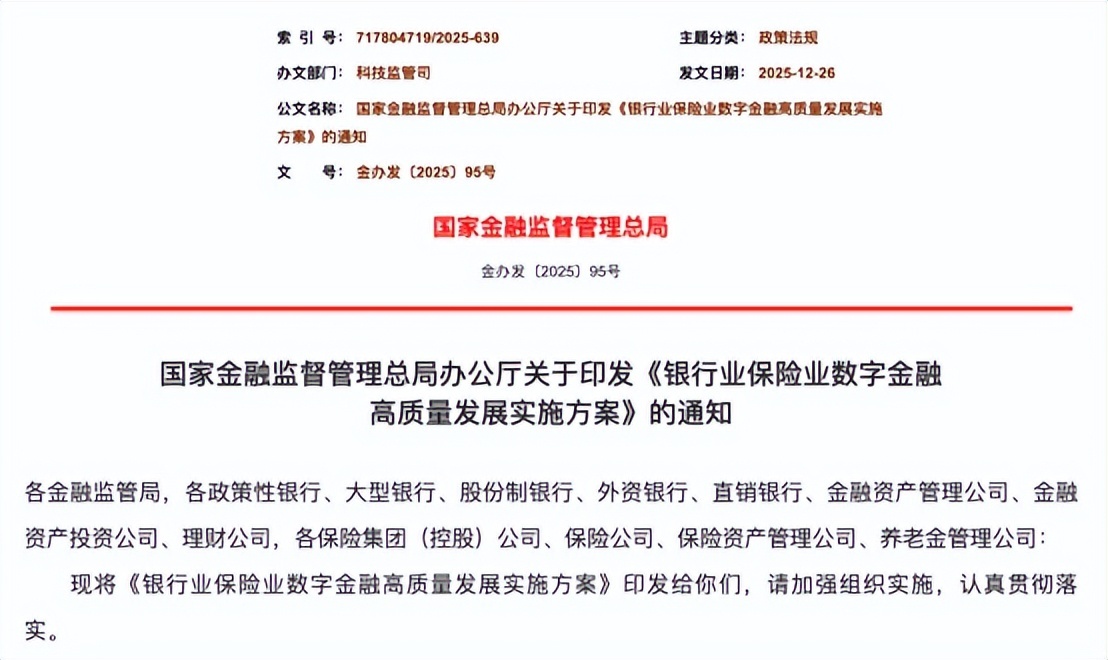
上级动态|国家金融监督管理总局发布《银行业保险业数字金融高质量发展实施方案》
Xin Lang Cai Jing· 2026-01-05 10:32
Core Viewpoint - The Financial Regulatory Administration has released the "Implementation Plan for High-Quality Development of Digital Finance in the Banking and Insurance Industries" to promote the rapid development of digital finance in alignment with the directives from the 20th National Congress of the Communist Party of China and subsequent meetings [1][3]. Group 1: Overall Requirements - The "Implementation Plan" consists of three main parts: overall requirements, work tasks, organizational guarantees, and supervision management [2][4]. - It outlines 33 work tasks focusing on digital finance governance, services, technology application, data element development, risk management, and the digital transformation of regulation [2][4]. Group 2: Work Tasks - Establish a sound digital finance governance mechanism, requiring financial institutions to develop scientific digital finance development plans and adapt business management models [2][4]. - Promote high-quality digital financial services driven by digital technology and data elements, enhancing service quality in various sectors including technology innovation, advanced manufacturing, and rural revitalization [2][4]. - Leverage new technologies like artificial intelligence to drive innovation in finance, enhance research and development capabilities, and improve digital infrastructure [2][4]. - Activate the potential of data elements by improving data governance mechanisms, standards, and quality control, while promoting high-level applications of financial data [2][4]. - Strengthen risk management by building intelligent risk control systems and focusing on various risks such as strategic, compliance, operational, outsourcing, and liquidity risks [2][4]. Group 3: Organizational Guarantees and Supervision Management - The Financial Regulatory Administration will ensure the implementation of the plan, guiding financial institutions in their digital transformation to enhance service convenience and competitiveness [3][5]. - The plan emphasizes the importance of balancing development and safety, with ongoing monitoring to prevent systemic financial risks [3][5].
建言金融政策 引领金融实践 | 《清华金融评论》2025年度回顾
清华金融评论· 2025-12-31 09:29
Group 1 - The global economy is experiencing a shift towards more accommodative monetary policies, with central banks expected to enter a rate-cutting cycle in 2024, except for Japan [6] - The resilience of the US economy is attributed to effective macroeconomic policies and the collaboration between fiscal and monetary measures, which have helped avoid recession despite aggressive interest rate hikes [5][6] - The US GDP has shown unexpected growth, with a 2.9% increase in 2023 and a projected 2.8% growth in 2024, largely supported by excess savings accumulated during the pandemic [5] Group 2 - The article emphasizes the need for a new development model in China's real estate sector to stabilize the market and promote high-quality economic growth, as highlighted in recent central government meetings [9][10] - The current real estate model has led to high debt levels among companies, necessitating a shift towards a more sustainable approach that addresses both supply and demand issues in the housing market [10][11] - Key focus areas for the new real estate model include improving housing supply systems, enhancing financial services for homebuyers, and reforming sales systems to stabilize the market [11][12] Group 3 - The article discusses the challenges and opportunities presented by low interest rates in China, suggesting that a combination of proactive fiscal policies and accommodative monetary policies is essential for economic stability [40][41] - It highlights the importance of addressing structural issues in the economy, such as improving public services and enhancing the efficiency of resource allocation [41][42] - The financial sector is urged to adapt to the low interest rate environment by providing innovative financial products and services that meet the evolving needs of consumers and businesses [43] Group 4 - The rise of digital assets is reshaping the global financial landscape, with significant developments in regulatory frameworks and market structures [55][56] - Digital assets, including central bank digital currencies and cryptocurrencies, are becoming mainstream, prompting major economies to establish strategic frameworks for their development [55] - Challenges remain in terms of technology, regulation, and market liquidity, necessitating careful consideration of the future direction of digital assets [56][57]


银行业保险业数字金融高质量发展实施方案印发
Zhong Guo Jing Ji Wang· 2025-12-31 02:48
Core Viewpoint - The Financial Regulatory Administration has released a plan to promote the high-quality development of digital finance in the banking and insurance sectors, outlining 33 tasks across various areas including governance, services, technology application, data development, risk management, and regulatory transformation [1][2][3]. Group 1: Overall Goals - The main goal for the next five years is to achieve significant progress in digital transformation, enhance the capabilities driven by digital technology, and improve the value conversion of data elements [1][2]. - The plan aims to explore innovative applications of digital technology and data elements, improve financial services in key areas such as technology, green finance, and rural revitalization, and promote replicable good practices in digital finance [1][2]. Group 2: Implementation Requirements - Financial institutions are required to develop scientific digital finance development plans, optimize organizational structures, and establish a digital talent system [2][3]. - The plan emphasizes the development of "AI + finance," the exploration of cutting-edge technology applications, and the enhancement of data governance mechanisms [2][3]. Group 3: Risk Management - The plan calls for the establishment of an intelligent risk control system, focusing on strategic, compliance, operational, outsourcing, and liquidity risks, while enhancing data and cybersecurity protections [2][3]. - It also emphasizes the need for effective management of algorithm model risks and external cooperation risks within the digital ecosystem [2][3]. Group 4: Regulatory Transformation - The plan aims to promote the digital transformation of regulatory processes, develop intelligent analysis tools, and strengthen the construction of regulatory big data and digital human resources [2][3]. - It highlights the importance of maintaining a balance between development and security, ensuring that systemic financial risks are effectively monitored and managed [3].
监管明确加快发展“人工智能+金融”,银行如何布局?
Huan Qiu Wang· 2025-12-30 08:02
Core Viewpoint - The implementation plan for the high-quality development of digital finance in the banking and insurance sectors emphasizes the integration of artificial intelligence and other new technologies to enhance financial services and optimize resource allocation [1][5]. Policy Guidance - The plan builds on previous guidelines and introduces new elements such as "AI+" and "data elements ×", outlining specific requirements across six areas including governance, service empowerment, and risk prevention [5][8]. - Financial institutions are encouraged to develop enterprise-level AI platforms to enhance modeling and application capabilities, while exploring advanced technologies like quantum computing and blockchain [5][8]. - The focus is on aligning technological innovation with business needs to create a positive cycle of technology-driven business development [5][8]. Practical Exploration - Several listed banks have actively integrated AI into customer service, risk control, and marketing, with applications such as intelligent assistants and credit AI agents [6]. - For instance, China Merchants Bank reported that its AI assistant "AI Xiao Zhao" served over 61,300 corporate clients and 458,500 individuals by mid-2025 [6]. - Industrial banks like Industrial and Commercial Bank of China have developed AI-driven tools for risk control and marketing, enhancing their operational efficiency [6][7]. Technology Resource Allocation - The plan provides clear guidance on technology resource allocation, urging banks to focus on core business areas and increase R&D investment [8]. - It aims to break down barriers between technology and business departments, fostering collaboration and innovation [8]. - The plan also emphasizes the importance of building a skilled workforce in digital finance, advocating for the training of professionals in data analysis and regulatory technology [8][9]. Talent Development - The plan highlights the need for cultivating a workforce that understands both finance and technology, rather than solely pursuing top algorithm talent [9]. - It suggests that banks should prioritize data governance based on business needs to enhance model quality [9].