
广州至湛江高铁

Search documents
【海报】盘点2025年开通了哪些高铁,有你的家乡吗
Zhong Guo Jing Ji Wang· 2025-12-31 01:05
Core Viewpoint - By 2025, China's high-speed rail operating mileage will exceed 50,000 kilometers, marking the largest and most modern high-speed rail network in the world, with several new lines opening across the country [1] Summary by Sections New High-Speed Rail Openings - The Xiangyang to Jingmen high-speed rail opened on September 28, 2025, with a length of 116 kilometers and a design speed of 350 km/h, allowing travel from Xiangyang East to Jingmen West in just 29 minutes [3] - The Shenyang to Baihe section of the Liu Jia high-speed rail also opened on September 28, 2025, featuring multiple stations and enabling travel from Shenyang North to Changbai Mountain in as little as 1 hour and 39 minutes [4] - The Panzhou to Xingyi high-speed rail, part of Guizhou's "city-to-city" high-speed rail initiative, opened on November 28, 2025, with travel times from Xingyi South to Panzhou in 33 minutes [5] - The Nanning to Pingxiang high-speed rail, which connects to the ASEAN international corridor, was fully operational by December 5, 2025, allowing travel from Nanning to Pingxiang in 1 hour and 15 minutes [6] - The Zhanjiang to Beibu Gulf high-speed rail, completed on December 22, 2025, spans 401 kilometers with a design speed of 350 km/h [7] - The Baotou to Yinchuan high-speed rail, part of the Jinglan corridor, opened on December 23, 2025, covering 519 kilometers with a travel time of 2 hours and 38 minutes from Baotou to Yinchuan [8] - The Wuhan to Yichang section of the Huzhou-Yichang high-speed rail opened on December 26, 2025, with a length of 314 kilometers and a travel time of 69 minutes from Wuhan to Yichang [9] - The Hangzhou to Quzhou high-speed rail, which creates a dual high-speed rail corridor between the two cities, opened on December 26, 2025, covering 131 kilometers [10] - The Maba high-speed rail, serving the revolutionary areas of northern Shaanxi, also opened on December 26, 2025, with a length of 299 kilometers [11]


大湾区携手北部湾 广州至湛江高铁建成通车
Ren Min Ri Bao Hai Wai Ban· 2025-12-23 04:54
Core Viewpoint - The Guangzhou-Zhanjiang High-Speed Railway (GZHSR) has been completed and opened for operation, significantly reducing travel time between the North Bay city cluster and the Guangdong-Hong Kong-Macao Greater Bay Area, thus supporting high-quality regional economic and social development [1][2] Group 1: Project Overview - The GZHSR connects multiple cities including Guangzhou, Foshan, Zhaoqing, Yunfu, Yangjiang, Maoming, and Zhanjiang, with a designed speed of 350 km/h and a total length of approximately 401 kilometers [1] - The project includes significant engineering feats such as the Zhujiang Four-Line Bridge and the Zhanjiang Bay Railway Undersea Tunnel, which is 9,640 meters long, allowing trains to traverse it in about 3 minutes [1] - The construction utilized an intelligent management system for shield tunneling, overcoming technical challenges and achieving tunnel completion in 33 months [1] Group 2: Future Connectivity - Following the opening of the GZHSR, future connections with the He-Zhan High-Speed Railway and the Zhanhai High-Speed Railway will create a continuous high-speed rail corridor along the coast, linking the Yangtze River Delta, North Bay, and Hainan Free Trade Port [2] - This development is expected to enhance the connectivity between the Guangdong-Hong Kong-Macao Greater Bay Area, North Bay city cluster, and Hainan Free Trade Port, forming a "golden corridor" for regional coordinated development [2]
广东两重点高铁线路开通 “轨道上的大湾区”添动能
Zhong Guo Xin Wen Wang· 2025-12-22 11:52
Core Viewpoint - The opening of the Guangzhou-Zhanjiang high-speed railway and the Shantou South to Shantou section of the Shantou-Shanwei high-speed railway enhances connectivity in the Guangdong-Hong Kong-Macau Greater Bay Area, marking a significant development in the region's transportation infrastructure [1][4]. Group 1: High-Speed Railway Details - The Guangzhou-Zhanjiang high-speed railway (Guangzhan High-speed Railway) spans 401 kilometers with a bridge-tunnel ratio of 76.7%, featuring the longest single-bore underwater tunnel in China [1]. - The Shantou South to Shantou section of the Shantou-Shanwei high-speed railway is approximately 19.8 kilometers long, completing the connection of the entire Shantou-Shanwei high-speed railway [2]. Group 2: Economic and Social Impact - The new rail lines reduce travel time significantly, allowing for a 1.5-hour journey from Guangzhou to Zhanjiang and a 2-hour journey from Shantou to Guangzhou, facilitating tourism and economic activities [1][2]. - The high-speed rail network is expected to boost the tourism industry in coastal areas like Yangjiang and Zhanjiang, with increased hotel bookings and the introduction of new tourism routes [4]. Group 3: Infrastructure Development - The completion of these rail lines contributes to a broader high-speed rail network in Guangdong, which has reached 6,433 kilometers in total operational length, with 3,411 kilometers of high-speed rail [4]. - The ongoing development aims to achieve a "city-to-city" high-speed rail connection across all cities in Guangdong, enhancing regional integration and economic growth [4][6].

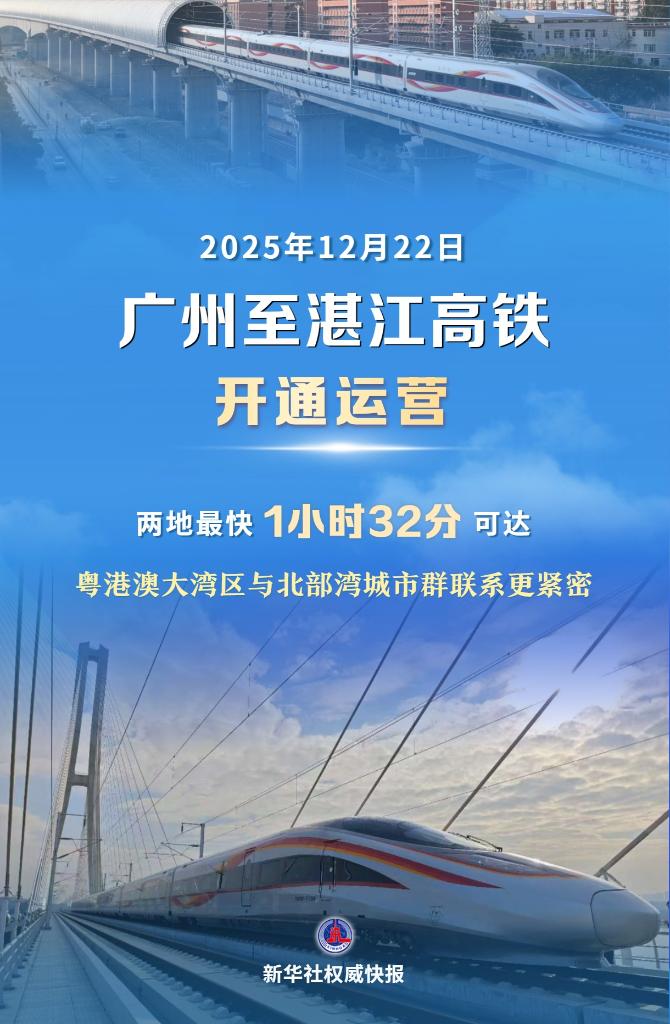
大湾区携手北部湾 广州至湛江高铁开通运营
Xin Hua She· 2025-12-22 03:37
Core Viewpoint - The Guangzhou-Zhanjiang high-speed railway has officially commenced operations, significantly enhancing connectivity between the Guangdong-Hong Kong-Macao Greater Bay Area and the Beibu Gulf city cluster [3]. Group 1: Project Details - The high-speed railway, designated as G9785, connects Guangzhou Baiyun Station to Zhanjiang North Station, with a travel time of as little as 1 hour and 32 minutes [3]. - The railway features a design speed of 350 kilometers per hour and spans approximately 401 kilometers, passing through cities such as Foshan, Zhaoqing, Yunfu, Yangjiang, and Maoming before reaching Zhanjiang [3]. Group 2: Economic and Regional Impact - The opening of the Guangzhou-Zhanjiang high-speed railway marks the end of the history of Yangjiang, Maoming, and Zhanjiang being without high-speed rail service at 350 kilometers per hour, advancing Guangdong's goal of achieving "350 high-speed rail access for every city" [3]. - This railway is expected to play a crucial role in improving the regional transportation network, enhancing the radiating and driving effect of the Guangdong-Hong Kong-Macao Greater Bay Area, and promoting high-quality economic and social development in the region [3].
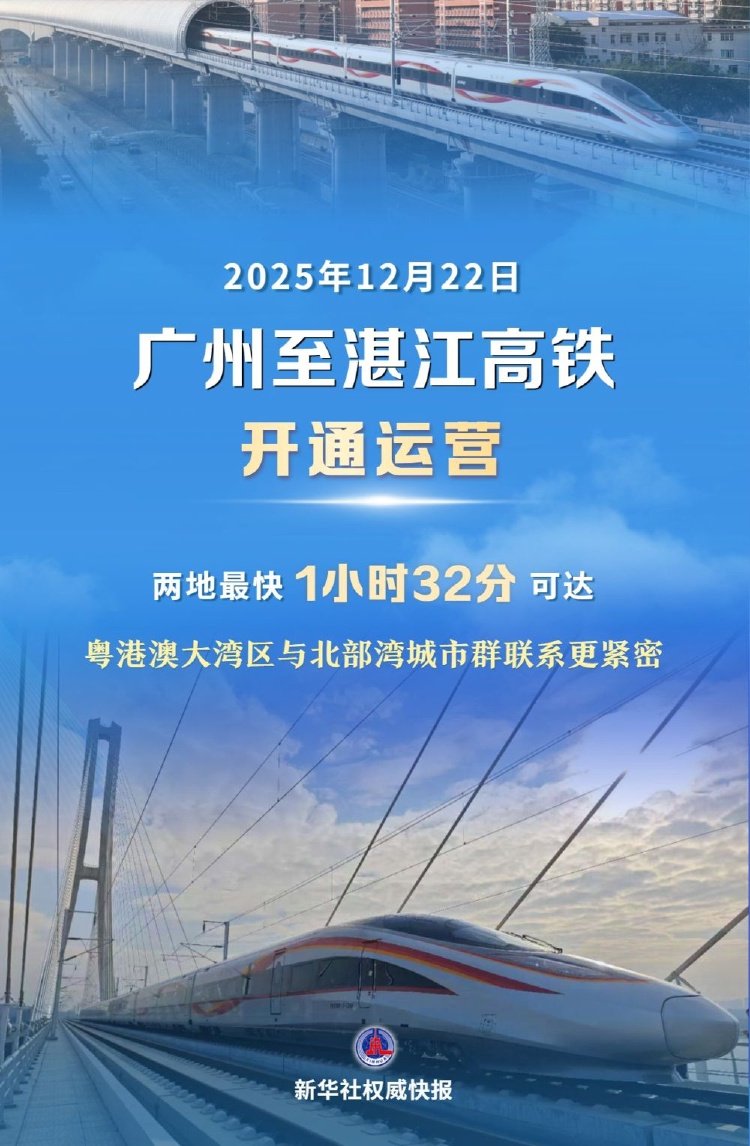
新华社权威快报丨大湾区携手北部湾 广州至湛江高铁开通运营
Xin Hua She· 2025-12-22 03:10
Core Viewpoint - The opening of the Guangzhou-Zhanjiang high-speed railway significantly enhances connectivity between the Guangdong-Hong Kong-Macao Greater Bay Area and the Beibu Gulf city cluster, reducing travel time to as little as 1 hour and 32 minutes [3]. Group 1: Infrastructure Development - The Guangzhou-Zhanjiang high-speed railway, with a design speed of 350 km/h and a total length of approximately 401 km, connects major cities including Guangzhou, Foshan, Zhaoqing, Yunfu, Yangjiang, and Maoming, ending in Zhanjiang [3]. - The railway's operation marks the end of the history of Yangjiang, Maoming, and Zhanjiang being without high-speed rail service at 350 km/h, indicating progress towards the goal of "every city connected by 350 km/h high-speed rail" in Guangdong [3]. Group 2: Economic Impact - The completion of the Guangzhou-Zhanjiang high-speed railway is expected to improve the regional transportation network, enhance the radiating and driving effect of the Guangdong-Hong Kong-Macao Greater Bay Area, and promote high-quality economic and social development in the region [3]. - The railway is considered crucial for building a vibrant and internationally competitive first-class bay area and world-class city cluster [3].
前11个月全国铁路完成固定资产投资7538亿元
Xin Lang Cai Jing· 2025-12-10 23:25
Core Insights - The railway construction in China has seen a fixed asset investment of 753.8 billion yuan from January to November, marking a year-on-year increase of 5.9%, significantly contributing to social investment and supporting high-quality economic development [1][3]. Group 1: Investment and Progress - The China National Railway Group (referred to as "National Railway Group") has effectively implemented the decisions of the central government, focusing on national strategies and regional economic development [1][3]. - Key projects such as the Panxian to Xingyi high-speed railway have commenced operations, enhancing tourism resource development along the route and promoting regional economic growth [1][3]. - Several high-speed rail projects, including Xi'an to Yan'an, Guangzhou to Zhanjiang, and Hangzhou to Quzhou, have entered trial operation phases, with full operations imminent [1][3]. Group 2: Future Plans - The National Railway Group plans to accelerate the construction of a modern railway infrastructure system, optimizing resource allocation and construction organization to achieve higher investment and physical work volume [2][4]. - The goal is to ensure the successful completion of the annual railway construction investment tasks and to fulfill the objectives of the "14th Five-Year Plan" for railways [2][4].