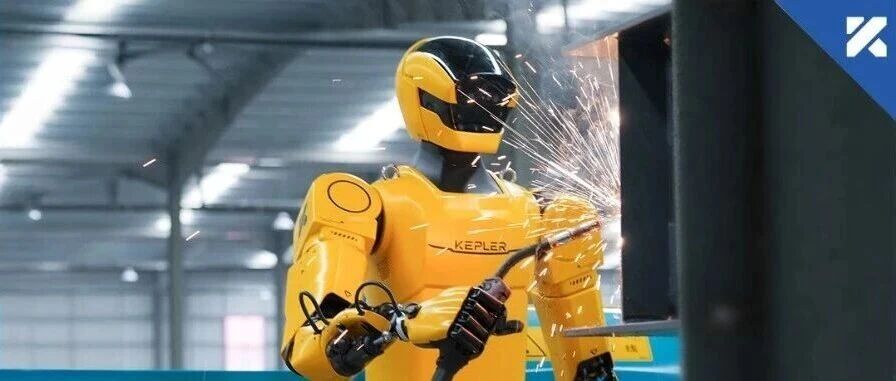
开普勒自研沉浸式全身遥操系统

Search documents
开普勒全球首例“人机协作”高空焊接作业震撼亮相!
机器人大讲堂· 2026-01-16 04:01
Core Viewpoint - The article highlights the successful application of humanoid robots in high-altitude welding tasks, showcasing the capabilities of the Kepler K2 Bumblebee robot in industrial settings, emphasizing its strong load capacity, long endurance, and autonomous evolution [1][2][12]. Group 1: Technology and Innovation - The Kepler immersive full-body remote control system integrates motion capture, low-latency communication, and force feedback, enabling precise 1:1 control of the robot [4][10]. - The system records multi-modal motion data during operations, allowing the robot to autonomously optimize its action strategies over time, significantly reducing the training period for new tasks from weeks to minutes [7][15]. - Key technological advantages include a transmission delay of less than 100 milliseconds, motion reproduction accuracy of 0.1mm, and real-time data collection for continuous learning [10][20]. Group 2: Market Demand and Pain Points - The article addresses the high incidence of accidents in high-altitude welding and the increasing demand for high-precision, strong-load, and long-endurance capabilities in industrial production [8][12]. - Traditional remote operation systems face challenges such as complex deployment, poor compatibility, and limited control capabilities, which the Kepler solution effectively overcomes [9][18]. Group 3: Safety and Efficiency - The Kepler solution aims to eliminate human presence in hazardous environments, allowing operators to control the robot from a safe distance, thus reducing the risk of accidents [13][14]. - With a load capacity of 30 kg and an operational endurance of 8 hours, the Kepler K2 Bumblebee can handle heavy industrial tasks, improving productivity by over 200% and enabling continuous operation [14][16]. Group 4: Flexibility and Deployment - The deployment of the Kepler system is straightforward, requiring minimal modifications to existing factory layouts, allowing for quick setup and ease of use by operators with basic training [18][20]. - The solution supports remote operation over distances of up to 2000 kilometers, facilitating the optimization of resources and expertise across different geographical locations [16][22]. Group 5: Future Outlook - The article emphasizes the potential of the Kepler system to redefine industrial production boundaries, making high-risk tasks routine for robots while enhancing human creativity in safer environments [22][23].