彩色胶卷

Search documents
晶合集成、乐凯胶片发布2025年报
WitsView睿智显示· 2026-03-27 07:43
Core Viewpoint - The article discusses the annual reports of Jinghe Integrated and Lekai Film for 2025, highlighting Jinghe's revenue and profit growth driven by its wafer foundry business, while Lekai faces performance pressure due to industry conditions and policy factors [2]. Group 1: Jinghe Integrated - Jinghe Integrated specializes in 12-inch wafer foundry services and has achieved mass production across various process platforms, including 150nm to 40nm [4]. - In 2025, Jinghe reported a total revenue of 10.885 billion yuan, a year-on-year increase of 17.69%, and a net profit attributable to shareholders of 696 million yuan, up 30.66% [4]. - Revenue growth was primarily driven by increased product sales and the transfer of photomask-related technology [5]. - The company has made significant advancements in display driver chips, with 28nm OLED products under validation and 40nm high-voltage OLED driver chips in mass production [5]. - The CIS business covers 90-55nm processes, with mass production of 55nm full-process stack CIS chips achieved [5]. - The power management chip segment accounted for 12.16% of the company's main business revenue in 2025, with ongoing development of AI server-related power management chips [5]. - Research and development expenses reached 1.453 billion yuan, a 13.20% increase year-on-year, representing 13.35% of total revenue [5]. Group 2: Lekai Film - Lekai Film focuses on the research, production, and sales of imaging, medical, and optoelectronic materials, with main products including color photographic paper and medical dry films [6]. - In 2025, Lekai reported a revenue of 1.32 billion yuan, a year-on-year decline of 11.13%, and a net loss attributable to shareholders of 98.73 million yuan [6]. - The revenue decline was mainly due to national policies and industry factors, leading to reduced sales of medical films and photovoltaic products [7]. - The company's operating cash flow net amount was 68.51 million yuan, down 52.32% year-on-year, attributed to decreased sales revenue and cash collection [7]. - Lekai is adapting to market changes by diversifying its product offerings and optimizing its business structure to stabilize sales and enhance competitiveness [8].


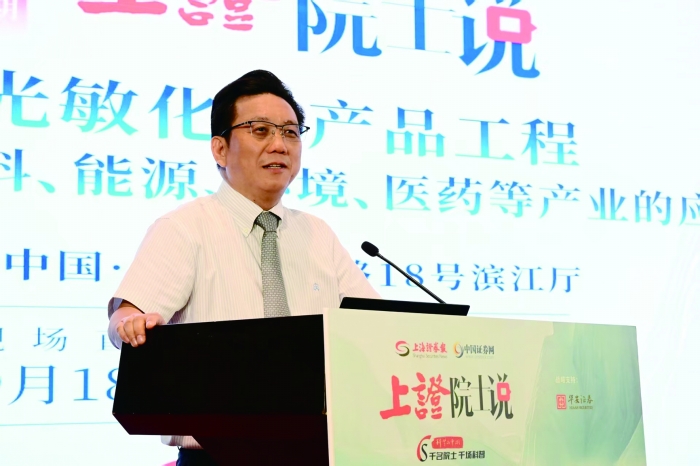
中科院院士朱为宏:从一块变色玻璃看光敏化学产品工程的应用前景
Shang Hai Zheng Quan Bao· 2025-10-23 18:39
Core Viewpoint - The article discusses the advancements and applications of photochromic chemical products, highlighting their significance in various industries and the importance of research in chemical engineering for strategic high-end chemical technology autonomy [2][4]. Group 1: Applications of Photochromic Products - Photochromic glass, which changes color when exposed to UV light, serves as an energy-saving solution by absorbing sunlight [2]. - The applications of photochromic chemical products extend across materials, energy, environment, and medicine, showcasing their versatility [2]. - The development of photochromic products has led to innovations in various fields, including color-changing glasses and films, which have been integrated into industries such as construction and energy [7]. Group 2: Research and Development in Chemical Engineering - The importance of chemical engineering research is emphasized, particularly in the context of the need for autonomous and controllable high-end chemical technology due to changing international circumstances [4]. - The research approach focuses on a "three-in-one" collaborative innovation chain that integrates basic research, core technology development, and industrial application [5]. - The article highlights the shift towards a collaborative innovation model where universities and enterprises work together, leveraging their respective strengths in basic and applied research [7]. Group 3: Future Prospects and Trends - There is optimism regarding the future of light-controlled soft matter science as a frontier area within photochromic chemical product engineering [4]. - The article suggests that the era of enterprises as innovation leaders has arrived, with increasing collaboration between universities and companies in talent development and project research [7].