恒裕金系列金条

Search documents
这类个人贵金属账户请注意!工商银行19日开始清理
Xin Lang Cai Jing· 2025-12-16 10:17
Core Viewpoint - The recent adjustments by major banks in China regarding personal precious metals trading reflect a cautious approach towards market risks, with several banks tightening their management of such businesses to protect investor interests [1][3][7]. Group 1: Bank Adjustments - On December 15, Industrial and Commercial Bank of China (ICBC) announced enhanced management for personal precious metals trading, urging clients with idle accounts to withdraw funds by December 19 [1][4]. - Other banks, including Agricultural Bank of China, China Construction Bank, and several regional banks, have also followed suit, indicating a broader trend of reducing personal precious metals business [1][6][7]. - The adjustments are part of a larger industry trend, with banks closing accounts that have had no trading activity for extended periods, reflecting a shift in risk management strategies [7][8]. Group 2: Market Context - The tightening of personal precious metals trading comes in the wake of a new tax policy implemented in October, which distinguishes between investment and non-investment gold, increasing compliance costs for banks [11][12]. - The new tax regulations require banks to track the use of physical gold more stringently, leading to operational challenges, particularly for smaller banks [11][12]. - The demand for gold has shifted towards more liquid financial products like ETFs, which offer lower costs and greater convenience compared to physical gold investments [12]. Group 3: Future Outlook - The global gold market has seen significant price increases, with a reported rise of over 60% in 2025, driven by economic expansion and geopolitical uncertainties [12]. - Looking ahead to 2026, the gold market is expected to experience a dynamic balance of various forces, with ongoing structural demand from investors and central banks potentially supporting prices, while economic recovery and interest rate changes may exert downward pressure [12].



黄金税收新政落地,首度有银行退出自营品牌金销售,或基于合规压力
Feng Huang Wang· 2025-12-15 07:40
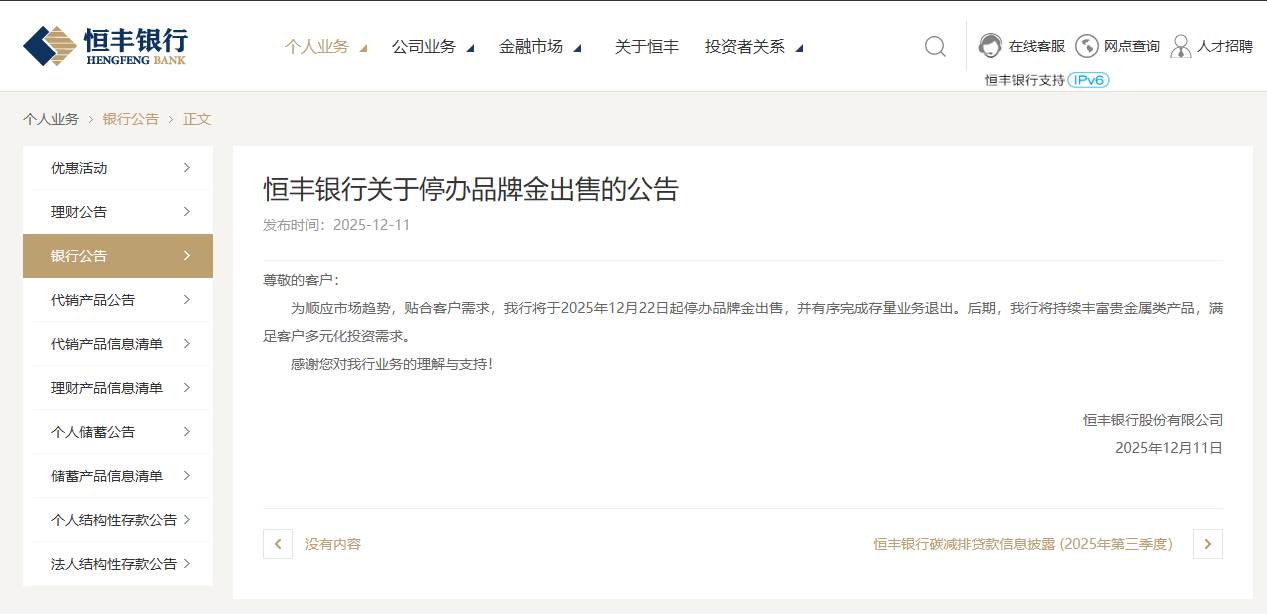
Core Viewpoint - The recent tax policy changes have led several banks, including Hengfeng Bank, to announce their exit from the brand gold sales business, citing compliance pressures and market trends as primary reasons [1][4]. Group 1: Bank Actions - Hengfeng Bank will cease brand gold sales by December 22, 2025, and will gradually exit existing business [1]. - It is the first commercial bank to announce such a decision since the implementation of the new tax policy [1]. Group 2: Compliance and Market Dynamics - The new tax policy has increased compliance requirements for banks, particularly regarding internal accounting and usage declarations, which has added operational complexity and risk [4]. - Industry insiders believe that compliance pressure is a direct trigger for banks to stop brand gold sales [4]. Group 3: Market Trends and Consumer Preferences - There is a structural shift in market demand towards financial products like gold ETFs, which are more convenient and cost-effective compared to physical gold [5]. - The new tax policy exempts transactions without physical delivery from VAT, making non-physical products like accumulative gold and paper gold more attractive for banks to promote [5]. Group 4: Future Directions for Banks - Banks are likely to transition from selling physical gold to promoting standardized products like gold ETFs and accumulative gold, moving towards a role as asset allocation service providers [5][6]. - The regulatory environment is increasingly favoring a shift towards standardized, transparent, and low-friction virtual gold markets, which may further diminish the commercial viability of physical gold sales for banks, especially smaller ones [6].