慢病毒载体

Search documents
传法国生物科技公司TheraVectys拟赴港上市 或集资数亿美元
Zhi Tong Cai Jing· 2026-01-06 05:52
Group 1 - TheraVectys SA, a French biotech company, is considering an IPO in Hong Kong, potentially raising several hundred million dollars, with plans to execute as early as this year [1] - The company specializes in immunotherapy and is focused on developing lentiviral vectors for the prevention and treatment of cancer and other diseases, having been spun off from the Pasteur Institute [1] - Typically, foreign biotech companies opt for listings in Europe or the US, making a Hong Kong IPO a rare choice for non-Chinese biotech firms, amidst China's challenge to Western dominance in medical innovation [1] Group 2 - In the previous year, healthcare companies raised approximately $13 billion in the Hong Kong stock market [1]
新股消息 | 传法国生物科技公司TheraVectys拟赴港上市 或集资数亿美元
智通财经网· 2026-01-06 05:49
Core Viewpoint - TheraVectys SA, a French biotech company, is considering an IPO in Hong Kong, potentially raising several hundred million dollars, with plans to proceed as early as this year [1] Company Overview - TheraVectys is an immunotherapy company primarily operating in France and the United States, focusing on the development of lentiviral vectors for the prevention and treatment of cancer and other diseases [1] - The company was spun off from the Pasteur Institute and has backing from Tethys Invest SAS [1] Industry Context - Foreign biotech companies typically opt for listings in Europe or the United States, making a Hong Kong IPO a rare move for non-Chinese biotech firms [1] - China is challenging Western dominance in medical innovation, reshaping the biotech industry landscape [1] - In the previous year, healthcare companies raised approximately $13 billion in the Hong Kong stock market [1]
体内CAR-T带火上游卖水人?
Xin Lang Cai Jing· 2025-09-12 05:49
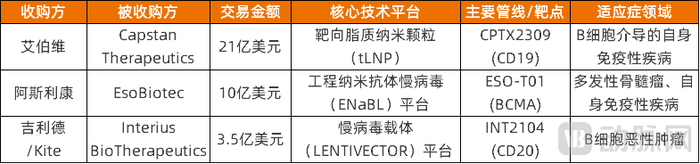
Core Insights - The in vivo CAR-T therapy market is rapidly gaining traction, with significant mergers and acquisitions by major multinational corporations (MNCs) indicating a strategic shift towards this innovative treatment approach [1][2][3] - The advancements in delivery vector technologies are driving the development of in vivo CAR-T therapies, with a focus on improving targeting efficiency and safety [3][4] Group 1: Mergers and Acquisitions - AstraZeneca acquired EsoBiotec for $1 billion to enhance its in vivo CAR-T therapy portfolio [1][2] - AbbVie announced the acquisition of Capstan Therapeutics for up to $2.1 billion, marking a significant investment in the in vivo CAR-T space [1][2] - Gilead's Kite acquired Interius for $350 million, further expanding its capabilities in cell therapy [1][2] Group 2: Technology Platforms - EsoBiotec's core technology is the engineered nanobody lentivirus (ENaBL) platform, which enhances the specificity of immune cell transfection [4] - Interius utilizes a lentiviral vector to deliver CAR genes, generating CAR-T and CAR-NK cells directly in vivo for targeting B-cell malignancies [3][4] - The mRNA-LNP (lipid nanoparticle) delivery system is gaining attention for its safety profile, allowing for transient CAR expression without permanent genetic modification [7][8] Group 3: Clinical Developments - EsoBiotec's product ESO-T01 has shown promising clinical trial results for multiple myeloma, indicating potential effectiveness in treating relapsed or refractory cases [15][17] - Capstan Therapeutics' candidate CPTX2309 is currently in Phase I trials for autoimmune diseases, showcasing the therapeutic potential of the LNP delivery approach [8][9] Group 4: Industry Trends - The shift from ex vivo to in vivo CAR-T therapies is reshaping the ecosystem, with increased collaboration among technology partners and a focus on delivery efficiency [3][6] - The reliance on upstream CXO (Contract Research Organization) services is significant, with over 65% of CGT (Cell and Gene Therapy) projects involving CXO participation [6][12] - The industry is witnessing a dual approach, with companies like AbbVie investing in both lentiviral and mRNA-LNP technologies to mitigate risks associated with single technology pathways [16][17]