
医疗创新

Search documents
【特稿】短短2个月6项合作:顶尖医院从采购方变身创新者
思宇MedTech· 2026-02-17 03:53
Core Insights - Mayo Clinic has announced six cross-disciplinary collaborations, indicating a shift from being mere technology consumers to becoming organizers of innovation within the healthcare ecosystem [2][4][19] - The collaborations span various technologies, including wearable oxygen monitoring, AI imaging protocols, digital outpatient services, and gene testing, showcasing a significant expansion beyond traditional hospital procurement [2][4] Group 1: Demand Structure Transformation - The demand logic in hospitals is undergoing a three-tier leap, moving from single-point solutions to system capability building [4][5] - The first leap involves a shift in focus from "single-use effectiveness" to "long-term data value," emphasizing the importance of data systems in future medical devices [6][10] - The second leap sees hospitals transitioning from end-users to co-creation partners, indicating that those who define the technology path will likely shape the future market [8][12] - The third leap reflects a change from short-term procurement to long-term ecological collaboration, with hospitals now evaluating partnerships based on ecosystem development rather than one-time transactions [12][13] Group 2: Mayo Clinic's Strategic Layout - The Mayo Clinic Platform is not just a technology platform but a foundational infrastructure for innovation, allowing hospitals to create an innovative environment and select partners to define technology paths [14][15] - The Center for Digital Health at Mayo Clinic plays a strategic role, emphasizing that digital capabilities are core competitive advantages rather than mere support tools [15][18] Group 3: Global Trends and Driving Factors - A similar transformation is occurring globally, with hospitals shifting from passive technology acceptance to active innovation organization [19][20] - Four key driving factors include: 1. Medical data becoming a strategic asset, no longer viewed as a byproduct but as a resource for innovation [20] 2. AI entering substantive clinical applications, requiring continuous training and validation in real-world settings [21] 3. Increased demand for real-world evidence, positioning hospitals as critical nodes for evidence generation [21] 4. Dual pressures of quality and efficiency, making technological innovation a necessity rather than an option [21] Group 4: Systemic Impact on Medical Device Companies - The logic of product definition is evolving, requiring consideration of data dimensions, system integration capabilities, and collaborative support for multi-center research [22] - Market organization capabilities must upgrade, shifting from promotional execution to strategic dialogue and long-term partnerships [23] - The collaboration model is fundamentally changing from supplier relationships to innovation partnerships, emphasizing value co-creation over product supply [24] Group 5: Strategic Opportunities and Competitive Positioning - The current period is a critical window for companies to adapt to the evolving demand structure, as hospitals seek long-term partners that fit their innovation ecosystems [25][28] - Three key capabilities will determine future competitive positioning: data value creation, ecosystem integration, and collaborative co-creation [27][28]


机构称医疗器械有望迎来行业新发展周期,医疗创新ETF(516820)交投活跃
Xin Lang Cai Jing· 2026-02-06 02:57
Group 1 - The core viewpoint of the news highlights the positive performance of the Chinese pharmaceutical and medical device innovation index, with significant gains in specific stocks and a new development plan for traditional Chinese medicine [1] - The China Securities Regulatory Commission and eight other departments have issued a plan to promote the high-quality development of traditional Chinese medicine, aiming to approve a batch of innovative traditional Chinese medicines and cultivate ten major traditional Chinese medicine products by 2030 [1] - The overall funding congestion in the innovative drug sector has slightly decreased compared to Q2, with some funds temporarily withdrawing from innovative drugs, while the medical device sector remains stable and is expected to attract more investment [1] Group 2 - The China Medical and Medical Device Innovation Index (931484) includes 30 listed companies with good profitability and growth potential, reflecting the overall performance of profitable and growth-oriented pharmaceutical and medical device companies [2] - As of January 30, 2026, the top ten weighted stocks in the index account for 63.9% of the total index, including companies like WuXi AppTec, Mindray Medical, and Hengrui Medicine [2]
启明创投张奥:携手北芯生命六载,对中国医疗创新的基本面保有强烈信心
IPO早知道· 2026-02-05 03:04
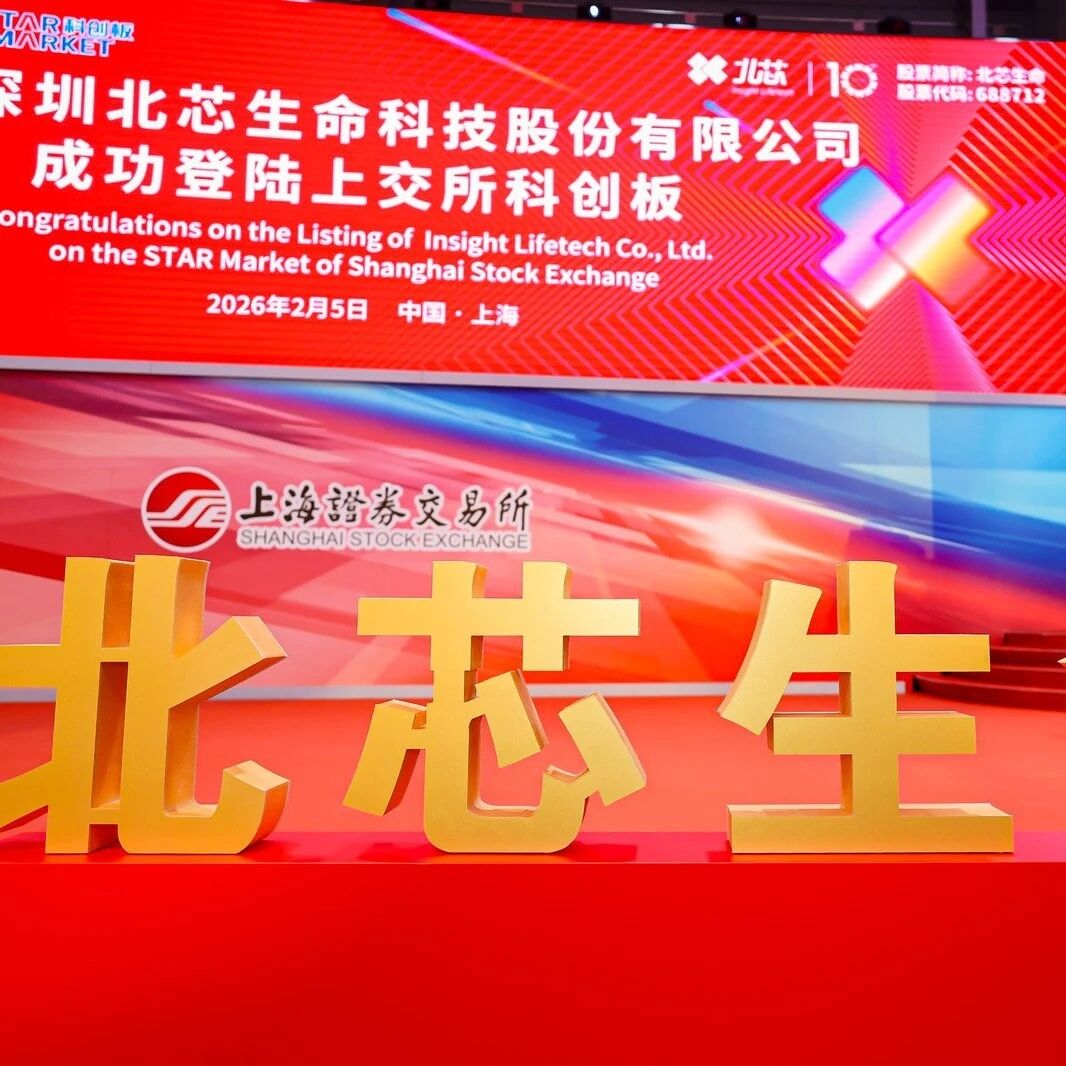
Core Viewpoint - Shenzhen Beixin Life Technology Co., Ltd. (Beixin Life) officially listed on the Sci-Tech Innovation Board on February 5, 2026, under the stock code "688712.SH," marking it as the first medical device company to successfully list under the new fifth set of standards since its restart and the first medical device company to list in 2024 [3]. Group 1: Company Overview - Beixin Life is the first domestic medical device company with a product portfolio that includes intravascular functional flow reserve (FFR) and intravascular ultrasound (IVUS) [3]. - The company has received investments from several well-known institutions, including Qiming Venture Partners, which led its Series C financing in 2020 and continued to support its development in Series D financing [4]. Group 2: Investment Insights - Qiming Venture Partners holds over 6% of Beixin Life's shares prior to the IPO, indicating its role as a major institutional investor [4]. - The firm has a strong interest in the cardiovascular and other medical device sectors, having a history of successful cases in these fields [4]. Group 3: Strategic Approach - Beixin Life's strategy focuses on building a robust product portfolio and company capabilities rather than merely pursuing rapid registration, emphasizing the creation of differentiated and competitive products [5]. - The company has maintained this strategy for over a decade, which has instilled confidence among shareholders [5]. Group 4: Future Expectations - Post-IPO, Beixin Life is expected to continue strengthening its product line in the coronary field and expand into high-potential new areas such as electrophysiology [5]. - There is significant untapped international market potential for Beixin Life's products, with plans for deeper internationalization following the IPO [5]. Group 5: Market Context - In 2025, Qiming Venture Partners invested in over 30 projects in the medical innovation sector, contributing more than 3 billion yuan, despite a cautious investment environment in the medical sector [5]. - The firm maintains strong confidence in the fundamentals of Chinese medical innovation, believing that China's clinical experience, engineering teams, and entrepreneurial spirit can foster globally competitive medical device products [6].
A股1月新股数据曝光:首日平均涨幅超180%,公私募打新超15亿
Bei Ke Cai Jing· 2026-02-03 09:16
Group 1 - In January 2026, the A-share new stock market showed remarkable performance, with an average first-day increase of over 180% for 9 newly listed stocks [1][3][6] - The enthusiasm for new stock subscriptions has risen, with public and private funds participating in offline placements, totaling over 1.5 billion yuan, with public institutions accounting for more than 1.2 billion yuan [1][7] - The newly listed stocks include companies from various sectors, primarily manufacturing, with notable mentions being Hengyun Chang and Zhenstone Co., which are highly favored by institutions [4][8] Group 2 - The average first-day increase for the 9 new stocks exceeded 187%, with Hengyun Chang and Kema Materials both experiencing surges of over 300% [6] - The issuance prices varied, with Hengyun Chang at 92.18 yuan per share and the lowest being around 11 yuan for Zhenstone and others [5] - Institutional participation in new stock subscriptions is driven by the low-risk, quick-return nature of offline placements, especially in high-growth sectors like technology and healthcare [10]
1月公募打新获配超10亿元
Guo Ji Jin Rong Bao· 2026-02-03 00:47
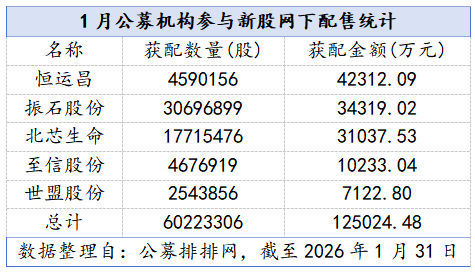
Group 1 - In January 2026, the A-share IPO market saw increased activity, with public funds becoming the dominant force in offline allocations due to their capital scale, research capabilities, and pricing advantages [1][4] - Public funds participated in the offline allocation of 5 new stocks, acquiring a total of 60.22 million shares worth 1.25 billion yuan, covering high-growth sectors such as semiconductors, wind power, medical devices, and automotive manufacturing [1][3] - Among the new stocks, semiconductor equipment and wind power materials were particularly favored, with Hengyun Chang and Zhenstone Co. receiving significant allocations, reflecting public funds' strong recognition of domestic semiconductor substitution and long-term optimism for high-end manufacturing in the renewable energy sector [1][2] Group 2 - In the medical innovation sector, Beixin Life, the first domestic company with a combination of vascular functional FFR and imaging IVUS products, attracted public fund allocations of 17.72 million shares worth 310 million yuan, highlighting the investment appeal in this field [2] - Public funds also participated in the offline allocations of Zhixin Co. (automotive welding components) and Shimon Co. (supply chain logistics solutions), with allocations of 102.33 million yuan and 71.22 million yuan respectively, further diversifying the coverage of public fund IPO activities [2] Group 3 - A total of 107 public fund institutions participated in the offline allocations in January, with a clear differentiation in allocation amounts; 31 institutions received less than 1 million yuan, while the top twenty institutions received no less than 10 million yuan, dominating the market [3] - Leading public funds such as E Fund, Southern Fund, and ICBC Credit Suisse Fund excelled in offline allocations, with E Fund acquiring 7.19 million shares worth 148 million yuan, leading among public institutions [4] - The active participation of public funds in IPOs is driven by the low-risk and quick-return characteristics of offline allocations, which have become an important stabilizer for fund returns, especially during market fluctuations [4][5] Group 4 - Public funds view IPO participation as a key strategy for accessing high-growth sectors, allowing them to lock in quality assets early and optimize their portfolio structure [5] - Looking ahead, the focus on hard technology, renewable energy, and medical innovation is expected to continue, with a stable supply of quality new stocks, although competition for allocations may intensify [5] - Top public funds with strong research capabilities and precise pricing will likely continue to dominate the IPO market, while smaller funds may need to seek differentiation through niche strategies and optimized pricing [5]
2026中国创新医疗图景:源头活水何在,产业生态又将如何重塑?
Xin Lang Cai Jing· 2026-01-26 06:56
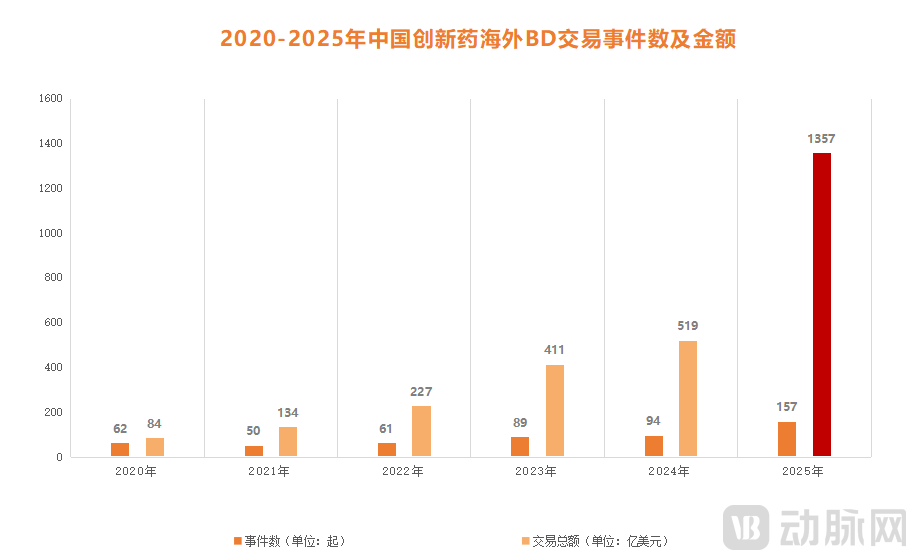
Core Insights - The Chinese healthcare industry experienced a significant surge in 2025, marked by a record number of innovative medical devices and drugs approved for market entry, indicating a growing focus on innovation in the sector [1][3] - The total value of overseas business development (BD) transactions for innovative drugs reached $135.7 billion in 2025, accounting for 49% of the global total, surpassing the United States for the first time [3] - The IPO market for healthcare companies in China saw a revival, with 37 companies successfully listed in 2025, doubling the number from 2024, reflecting strong investor interest in the sector [7] Innovation in Medical Devices and Drugs - In 2025, 109 innovative medical devices were approved, with a 19.67% year-on-year increase in Class III devices, while 76 innovative drugs were approved, focusing on advanced fields like oncology and autoimmune diseases [1] - The rapid growth in innovative drug approvals and medical device registrations highlights China's increasing capabilities in healthcare innovation [1][8] Business Development and Market Dynamics - The number of overseas BD transactions for innovative drugs reached 157 in 2025, with a total transaction value of $135.7 billion, both figures representing historical highs [3] - The increasing recognition of Chinese innovative drugs by global pharmaceutical companies is evident, particularly as they face pressures from patent expirations and global competition [8] IPO Activity and Market Sentiment - The healthcare sector in China saw a resurgence in IPO activity, with 37 companies going public in 2025, compared to 17 in 2024, indicating a robust market sentiment [7] - Over 60 healthcare companies are currently in the IPO pipeline on the Hong Kong Stock Exchange, reflecting sustained investor enthusiasm for the healthcare sector [7] Challenges and Industry Landscape - Despite the growth, challenges persist, including difficulties in financing and market entry for medical companies, exacerbated by domestic healthcare cost controls and intensified competition [7] - The industry is undergoing significant consolidation, presenting both opportunities and challenges for companies navigating this complex landscape [7][11] AI Integration in Healthcare - AI technology is increasingly integrated into the healthcare sector, enhancing the efficiency and safety of medical devices and drug development processes [10] - The shift towards data-driven, proactive healthcare solutions is transforming traditional practices, with AI expected to play a crucial role in future clinical pathways [10] Investment Trends and Future Outlook - The investment landscape in the healthcare sector is shifting towards high-tech, innovative companies, with a notable decrease in the number of financing events but an increase in total investment amounts [16] - The next 5-10 years are anticipated to be a golden period for innovation in Chinese healthcare, with a focus on projects that address unmet clinical needs [17]

内外兼修,当好医疗创新排头兵
Xin Lang Cai Jing· 2026-01-22 23:18
Core Viewpoint - The continuous advancement of new technologies such as brain-computer interfaces, artificial intelligence, and the Internet of Things is expected to provide breakthroughs in previously challenging medical issues and unsolved healthcare problems [1] Group 1: Role of National Regional Medical Centers - National regional medical centers, equipped with strong research capabilities and high-level talent, can deeply engage in clinical practice while understanding patient needs, thus driving medical technology innovation [1] - To lead in medical innovation, healthcare institutions must strengthen their internal capabilities and establish integrated platforms for industry, academia, research, and application [1] Group 2: Strategies for Medical Innovation - Establishing research outpatient clinics can help doctors identify problems from clinical practice, enhancing the quality and relevance of research [1] - A reformed research evaluation system is necessary to encourage the identification of research topics from frontline clinical experiences, allowing clinical and research efforts to mutually benefit and ultimately serve public health [1] Group 3: Collaborative Innovation - Medical innovation is not a solitary endeavor but requires cross-disciplinary collaboration to achieve synergistic effects [1] - As a national team in medical innovation, national regional medical centers should actively expand their roles as cross-border hubs, collaborating with universities, research institutions, and enterprises to create a cooperative mechanism that shares demands, resources, and risks [1]
传法国生物科技公司TheraVectys拟赴港上市 或集资数亿美元
Zhi Tong Cai Jing· 2026-01-06 05:52
Group 1 - TheraVectys SA, a French biotech company, is considering an IPO in Hong Kong, potentially raising several hundred million dollars, with plans to execute as early as this year [1] - The company specializes in immunotherapy and is focused on developing lentiviral vectors for the prevention and treatment of cancer and other diseases, having been spun off from the Pasteur Institute [1] - Typically, foreign biotech companies opt for listings in Europe or the US, making a Hong Kong IPO a rare choice for non-Chinese biotech firms, amidst China's challenge to Western dominance in medical innovation [1] Group 2 - In the previous year, healthcare companies raised approximately $13 billion in the Hong Kong stock market [1]
Novo Nordisk A/S: China’s Supreme People’s Court delivers a positive ruling on the semaglutide compound patent
Globenewswire· 2025-12-31 13:24
Core Viewpoint - The Supreme People's Court in China upheld the validity of the semaglutide compound patent, which is a significant positive outcome for Novo Nordisk and demonstrates strong government support for medical innovation [1][2]. Group 1: Company Overview - Novo Nordisk is a leading global healthcare company founded in 1923 and headquartered in Denmark, focusing on chronic diseases, particularly diabetes [4]. - The company employs approximately 78,500 people across 80 countries and markets its products in around 170 countries [4]. Group 2: Product Information - Semaglutide is a long-acting GLP-1 analogue developed by Novo Nordisk, used in medications such as Wegovy for obesity and Ozempic and Rybelsus for type 2 diabetes [2]. - Since its launch, semaglutide has achieved broad clinical recognition with approximately 38 million patient-years of use [2]. Group 3: Market Impact - The ruling regarding the semaglutide patent is expected to bolster confidence for foreign companies in China and encourage further development of innovative medicines [2]. - Novo Nordisk anticipates that the compound patent expiry in certain countries will have a low-single-digit negative impact on global sales growth in 2026, but this ruling does not change previous communications regarding this impact [3].

药闻丨百余家企业竞速体内CAR-T技术“新赛道”
Xin Hua Cai Jing· 2025-12-31 07:17
Core Insights - The launch of the first "Commercial Health Insurance Innovative Drug Directory" has brought CAR-T therapy back into focus, despite its high costs and complex manufacturing processes [1] - The industry is shifting attention to In Vivo CAR-T technology, which is expected to see significant investment and acquisitions from multinational corporations (MNCs) by 2025 [2][3] Industry Overview - Traditional CAR-T therapy is limited by its complex "autologous preparation" process, which involves extracting T cells from patients, modifying them in a lab for 2-4 weeks, and then reinfusing them, leading to high costs of approximately 1 million to 1.2 million RMB in China [2] - In Vivo CAR-T technology aims to eliminate the need for external cell preparation, potentially reducing costs and wait times, making it a strategic focus for global pharmaceutical giants [2][3] Market Dynamics - MNCs are making substantial investments in In Vivo CAR-T, with notable acquisitions including AstraZeneca's $1 billion purchase of EsoBiotec, AbbVie's $2.1 billion acquisition of Capstan Therapeutics, and BMS's $1.5 billion acquisition of Orbital Therapeutics [2] - The investment community views these acquisitions as not just supplementary to existing pipelines but as a strategic shift towards a complete replacement of traditional CAR-T therapies [3] Competitive Landscape - The In Vivo CAR-T sector is crowded, with over 100 domestic companies entering the field, raising concerns about potential homogenization and profit dilution similar to the PD-1 inhibitor market [4] - However, the exploration of In Vivo CAR-T is seen as fundamentally different from previous market entries, as it involves pioneering technology rather than following established paths [4] Technological Development - The In Vivo CAR-T industry is still in its early stages, with significant differentiation in technology routes, including viral vector-based frameworks and lipid nanoparticle (LNP) delivery systems [5] - Companies must focus on core technological differentiation, clinical data quality, and development speed to maintain competitive positioning [5] Future Outlook - The next 1-2 years are critical for validating In Vivo CAR-T technologies, with companies like Fengxun Bio preparing for initial human clinical trials [5][6] - The favorable policy environment in China is expected to accelerate the transition of technologies from the lab to clinical validation, with anticipated clarity in the technological roadmap as clinical data emerges [6]