房产税

Search documents
收藏!房产税和城镇土地使用税申报指引
蓝色柳林财税室· 2026-01-19 09:16
Group 1 - The article discusses the tax declaration process for property tax and urban land use tax in Xiamen, with specific deadlines for submission [2] - The first-time declaration requires tax source registration, followed by two methods of declaration: "confirmation declaration" and "form-filling declaration" [4] - The article provides links to guides for tax source collection and declaration procedures, as well as a FAQ section addressing common questions related to property tax and urban land use tax [5][8] Group 2 - The article outlines the maintenance of tax sources, including how to update information for new tenants, contract terminations, changes in property use, and rent adjustments [7] - It addresses common questions such as whether property without a certificate is subject to property tax and the implications of rent-free periods on tax obligations [8]


完善直接税体系 更好发挥税收调节作用
2 1 Shi Ji Jing Ji Bao Dao· 2026-01-15 23:38
Core Viewpoint - The Chinese government aims to improve the local tax and direct tax systems as part of the "14th Five-Year Plan," emphasizing the need for a comprehensive reform to enhance the tax structure and promote economic and social development [1][13]. Summary by Sections Current Status of China's Direct Tax System - Direct taxes in China primarily include income taxes and property taxes, such as personal income tax, urban land use tax, and vehicle and vessel tax [2][14]. - Some taxes, like property tax, have characteristics of both direct and indirect taxes, complicating the classification [3][15]. - The current direct tax system includes 13 types of taxes, with local taxes making up a significant portion, yet the revenue from these taxes is relatively low, totaling over 800 billion yuan in 2024, which is less than half of the national tax revenue [4][16]. Recent Progress in Direct Tax System Improvement - Significant advancements have been made since 2013, including the abolition of certain taxes and the introduction of the environmental protection tax in 2018 [6][18]. - By 2024, direct tax revenue increased from 61,225.9 billion yuan in 2012 to 81,462.6 billion yuan, marking a 33.1% growth, although the proportion of direct taxes in total tax revenue decreased from 60.9% to 46.5% [7][19]. Proposed Measures for Further Improvement - The government may consider simplifying the tax system by integrating various taxes and ensuring a more rational tax burden [8][20]. - There is a need to enhance the legal framework for taxes, particularly for property tax and personal income tax, to ensure effective implementation and compliance [9][21]. - Suggestions include adjusting corporate and personal income tax structures, such as lowering the corporate tax rate from 25% to around 20% and revising personal income tax brackets and deductions [10][22]. - Expanding the scope of direct taxes by merging certain fees and taxes could significantly increase direct tax revenue, potentially raising the proportion of direct taxes in total revenue to 64.5% by 2024 [11][23]. Conclusion - The ongoing efforts to refine China's direct tax system are crucial for enhancing fiscal capacity and ensuring equitable tax distribution, which will support broader economic and social objectives [12][24].
21评论丨完善直接税体系,更好发挥税收调节作用
2 1 Shi Ji Jing Ji Bao Dao· 2026-01-15 23:13
Group 1 - The core viewpoint of the articles emphasizes the need to improve China's direct tax system as part of the broader economic and fiscal reforms outlined in the "14th Five-Year Plan" [1][12] - The current direct tax system in China primarily includes income taxes and property taxes, with a significant portion being local taxes [2][4] - The existing issues within the direct tax system include a high number of tax types, particularly local taxes, and a relatively low income scale from these taxes, which hampers government revenue and the redistributive function of direct taxes [4][5] Group 2 - Recent progress in improving the direct tax system includes the abolition of certain taxes and the introduction of new ones, such as the environmental protection tax, which reflects a shift towards more sustainable fiscal policies [5][6] - The reform of the personal income tax system in 2018 marked a significant change, transitioning to a combined assessment model that aligns with international practices [7][8] - Proposed measures for further improvement include simplifying tax types, enhancing the legal framework for tax laws, and considering pilot programs for new tax implementations [8][9] Group 3 - Specific recommendations for enhancing the direct tax system involve adjusting tax rates and deductions for corporate and personal income taxes to ensure fairness and efficiency [10][11] - The potential expansion of direct taxes could include merging certain local fees into direct tax categories, which would increase the overall share of direct taxes in total tax revenue [11][12] - Overall, the goal of these reforms is to create a more equitable and efficient tax system that supports economic and social development in China [12]
【涨知识】一文了解房土两税!
蓝色柳林财税室· 2025-12-26 09:42
Group 1 - The article discusses the combination of property tax and urban land use tax, commonly referred to as "housing and land taxes," which are essential tax types for many taxpayers [2] - The taxation scope for both property tax and urban land use tax includes cities, county towns, built towns, and industrial and mining areas [2] Group 2 - The taxpayers for property tax are the property owners, while for urban land use tax, it is the units or individuals holding land use rights [3] - In cases where the property owner or land use right holder is not present at the property location, the property manager or user is responsible for tax payment [3] Group 3 - Property tax is calculated based on the property value or rental income, with specific formulas provided for each method [4] - Urban land use tax is categorized into five tax levels based on location, with specific annual tax amounts per square meter for each level [4] Group 4 - The obligation to pay property tax and urban land use tax begins from the month following the delivery of new properties or the transfer of ownership for existing properties [5] - Specific timelines for tax obligations are outlined for various scenarios, including self-built houses and land acquisition [5] Group 5 - There are reductions in property tax rates for individuals renting out housing and for organizations renting to individuals, both set at a reduced rate of 4% [6] - Small-scale taxpayers and micro-profit enterprises are eligible for a 50% reduction in both property tax and urban land use tax [7] Group 6 - Certain entities, such as government agencies, military, and specific non-profit organizations, are exempt from both property tax and urban land use tax [8] - Personal non-business properties and other properties approved for tax exemption by the Ministry of Finance are also exempt from property tax [9] Group 7 - Public lands used for agriculture, forestry, animal husbandry, and fishing, as well as other specified lands, are exempt from urban land use tax [10] - Land that has been approved for reclamation or transformation is exempt from land use tax for a period of 5 to 10 years from the month of use [11] Group 8 - Individuals renting out housing are exempt from urban land use tax [12]

完善地方税体系,促进经济和社会发展
2 1 Shi Ji Jing Ji Bao Dao· 2025-12-03 22:13
Core Viewpoint - The article emphasizes the importance of improving the local tax system in China as a crucial task for enhancing the tax, financial, and economic systems, which is essential for promoting economic and social development [2] Summary by Sections Current Local Tax System - The current local tax system in China includes eight types of taxes that are entirely allocated to local governments, such as property tax, urban land use tax, deed tax, land value increment tax, arable land occupation tax, vehicle and vessel tax, environmental protection tax, and tobacco leaf tax [3] - Since 2011, five of these taxes have been legislated and implemented, while the other three are based on regulations established in the late 1980s and early 1990s [3] Revenue Statistics - In 2024, the total revenue from these eight local taxes is projected to be 2,007.13 billion yuan, accounting for 11.5% of the national tax revenue and 24% of local tax revenue [4] - The deed tax generates the highest revenue at 516.96 billion yuan, representing 25.8% of local tax revenue, while the tobacco leaf tax generates the least at only 14.76 billion yuan [4] Issues in the Local Tax System - The local tax system is not fully developed, facing issues in tax category settings, tax legislation, tax elements, and revenue scale [4][5] - The current tax categories do not align well with international standards, and some tax laws are outdated, failing to meet the needs of modern economic and social development [5][6] Legislative and Reform Directions - The central government has prioritized the improvement of the local tax system, with various directives emphasizing the need for tax law principles, real estate tax legislation, and environmental protection tax reforms [7] - Future reforms may include rationalizing tax categories, expanding local tax sources, and enhancing local government financial autonomy [8][9] Proposed Measures for Improvement - Suggested measures include setting reasonable tax categories, expanding local tax sources, and further implementing the principle of tax legality [8][9] - It is recommended to adjust tax elements to avoid overlapping tax burdens and to enhance local tax management authority to improve efficiency and reduce costs [9]
河南登封拟对一小镇征收房产税?消息人士:自住房一直是免税的!相关链接已不见
Mei Ri Jing Ji Xin Wen· 2025-10-25 16:23
Core Viewpoint - The news regarding the proposed property tax in Dengfeng's Tangzhuang Town has circulated widely, but the official announcement was deleted shortly after its release, indicating potential changes or reconsiderations in the local government's tax policy [1][4]. Group 1: Proposed Tax Details - On October 21, Dengfeng City released a draft proposal for the collection of property tax and urban land use tax in Tangzhuang Town, covering an area of 118 square kilometers and 27 villages (communities) [4]. - The proposed tax rate for land in Tangzhuang Town is set at 3 yuan per square meter annually, with property tax calculated at 1.2% of the property value or 12% of rental income [4][9]. - The property tax is specifically aimed at commercial properties and factories, with residential properties exempt from taxation [5][8]. Group 2: Historical Context and Legal Framework - Tangzhuang Town was established as an administrative town in 2017 and has not previously imposed property tax or urban land use tax since its establishment [5]. - The local government plans to submit a request to the Henan Provincial Government regarding the implementation of these taxes, as indicated in the draft proposal [5]. - The legal basis for property tax collection is outlined in the "Interim Regulations on Property Tax," which states that property tax is applicable in cities, county towns, administrative towns, and industrial and mining areas [6][9]. Group 3: Current Taxation Landscape - As of now, only Shanghai and Chongqing have implemented pilot programs for personal property tax, with exemptions for non-operating residential properties [9][10]. - The property tax in these pilot cities is calculated based on the property's original value after a deduction of 10% to 30%, or based on rental income, with rates typically at 1.2% for property value and 12% for rental income [9][13]. - The latest adjustments to the property tax policies in Shanghai and Chongqing reflect ongoing developments in local taxation practices [10][13].
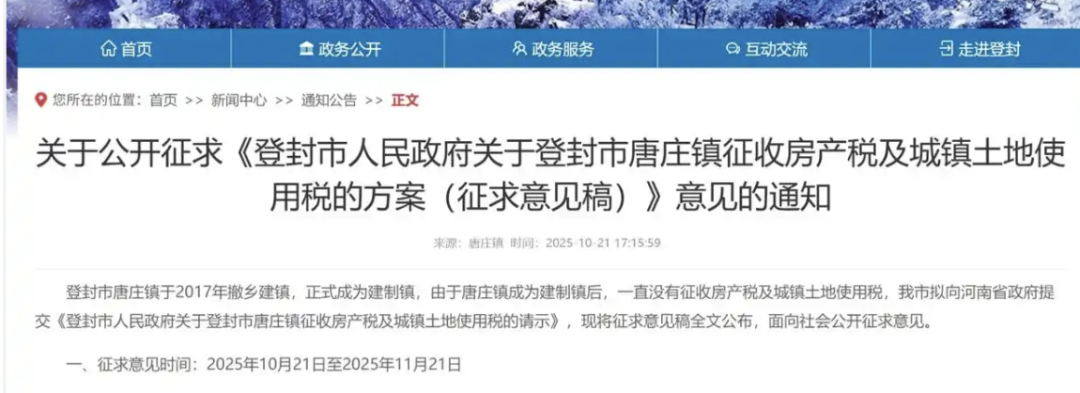
“小镇房产税”引争议
Mei Ri Jing Ji Xin Wen· 2025-10-25 12:36
Core Viewpoint - The news regarding the proposed property tax in Dengfeng's Tangzhuang Town has circulated online, but the official announcement was deleted shortly after its release, indicating potential confusion or miscommunication regarding the tax implementation [1][3]. Summary by Relevant Sections Property Tax Proposal - Dengfeng City released a draft proposal on October 21, suggesting the collection of property tax and urban land use tax in Tangzhuang Town, covering an area of 118 square kilometers and 27 villages/communities [3]. - The proposed tax rate for land is set at 3 yuan per square meter annually, while property tax is calculated at 1.2% of the property value or 12% of rental income [3][9]. Exemptions and Current Tax Status - The property tax is specifically aimed at commercial properties and factories, with residential properties being exempt from this tax [3][7]. - Since Tangzhuang Town's establishment as an administrative town in 2017, there has been no property tax or urban land use tax collected until this proposal [3]. Government Communication and Public Response - Attempts to contact the publicity department of Dengfeng's tax bureau for clarification on the property tax proposal were unsuccessful, indicating a lack of clear communication from local authorities [3]. - Local residents confirmed that their personal residential properties are not subject to property tax, aligning with the exemption for non-commercial properties [8]. Legal Framework - The legal basis for property tax collection is outlined in the "Interim Regulations on Property Tax" and the "Interim Regulations on Urban Land Use Tax," which provide guidelines for tax assessment and collection [4][10]. - Current property tax trials in China are primarily limited to Shanghai and Chongqing, which have been in place since 2011, with recent adjustments to their policies [11][12][15].
上半年房产税逆势增长12%
第一财经· 2025-08-08 03:07
Core Viewpoint - Despite a sluggish real estate market, property tax revenue has seen a counter-trend growth, with a 12% increase in the first half of 2025 compared to the previous year, significantly outpacing the overall tax revenue decline of 1.2% [3][7]. Group 1: Property Tax Revenue Growth - In the first half of 2025, national property tax revenue reached 261.8 billion yuan, marking a 12% year-on-year increase, which is higher than the declines in related taxes such as deed tax (-14.8%) and land value increment tax (-17.6%) [3][7]. - Local finance departments attribute this growth to enhanced tax collection efforts, with specific regions like Fujian and Xinjiang reporting increases of 13.7% and 17.9% respectively due to intensified tax enforcement [3][6]. Group 2: Tax Management Improvements - Some regions have utilized big data and digital management techniques to improve property tax collection, addressing issues like inaccurate tax source information [5][6]. - The Zhengzhou Airport Economic Comprehensive Experimental Zone has reported a 36.42% increase in property-related tax revenue, with significant contributions from online data comparisons and risk audits [6]. Group 3: Local Fiscal Challenges - Despite the growth in property tax revenue, local governments face ongoing fiscal challenges due to declining revenues from land value increment tax and deed tax, which have seen a combined drop of approximately 30% since their peak in 2021 [7][8]. - In the first half of 2025, the combined revenue from deed tax and land value increment tax was 490.3 billion yuan, down about 16% from the same period in 2024 [7]. Group 4: Overall Local Fiscal Situation - Nationally, local government general public budget revenue grew by 1.6% to 669.77 billion yuan in the first half of 2025, while expenditures increased by 2.6% to 1.21357 trillion yuan [8]. - Local government fund budget revenue decreased by 3.2%, indicating ongoing fiscal pressures despite some areas of revenue growth [8].

电子税务局丨房土两税税源采集及申报指南
蓝色柳林财税室· 2025-07-28 01:31
Core Viewpoint - The article provides a detailed guide on the procedures for tax source collection and declaration for property tax and urban land use tax in Xiamen, emphasizing the importance of timely submission during the designated period [1]. Tax Source Collection - For first-time filers who have not registered their tax sources, they must first complete tax source collection by logging into the electronic tax bureau and navigating to the appropriate section [3]. - After entering the declaration interface, users can add tax types by selecting either "urban land use tax" or "property tax" [4]. - The electronic tax bureau has automated the pre-filling of tax source information based on deed tax declaration data, simplifying the process for taxpayers [9]. Urban Land Use Tax Source Information Collection - Users should select "urban land use tax source information" and click "add" to input basic land information before submitting [7]. Property Tax Source Information Collection - Users should select "property tax source information" and click "add" to input basic property information before submitting [8]. Pre-filled Tax Source Information - The system generates "pending confirmation tax sources" based on deed tax payment information, allowing taxpayers to confirm and complete the necessary details [9]. Reporting Requirements - Taxpayers with rental properties must accurately report the original value and rental area of the properties in the designated sections [11]. - Each piece of land must be reported on a separate form, and properties without ownership certificates must be reported based on their location [12]. Tax Declaration - After completing tax source collection, there are two declaration methods: "confirmation declaration" and "form declaration" [17]. Confirmation Declaration - Taxpayers can select the relevant tax types directly from the tax source collection interface and submit their declaration [19]. Form Declaration - Users can select the tax types and proceed to the tax declaration form, which automatically populates the current tax data [22]. - After confirming the accuracy of the data, users can submit the declaration and proceed to pay any due taxes [23].
热点问答丨房产税和城镇土地使用税申报问题
蓝色柳林财税室· 2025-07-25 00:52
Core Viewpoint - The article provides detailed information on the tax declaration process for property tax and urban land use tax in Xiamen, including deadlines, procedures, and options for corrections and terminations of tax obligations [1][3][4][6][10]. Tax Declaration Deadlines - Property tax and urban land use tax are declared semi-annually, with the first half of the year’s declaration period from July 1 to July 31, and the second half from January 1 to January 31 of the following year [3][4]. Electronic Tax Bureau Procedures - To declare property tax and urban land use tax, enterprises must log into the electronic tax bureau and navigate to the relevant sections for tax source information collection and combined declaration [4][8]. - There are two declaration methods available: "confirmation declaration" and "form declaration" [4]. Correction of Tax Source Information - If there is a need to correct past data, enterprises can log into the electronic tax bureau, find the relevant tax declaration form, and either modify the information or void the previous declaration if conditions are met [5][9]. Termination of Tax Obligations - For property tax, the tax obligation can be terminated by entering the property transfer date in the electronic tax bureau [6]. - Similarly, for urban land use tax, the termination process involves entering the land transfer date [7]. Importing Tax Source Information - Enterprises can import tax source information by downloading the relevant templates from the electronic tax bureau, filling them out, and then uploading the completed files [8]. Deleting Incorrect Tax Source Information - If tax source information is incorrect and has not been declared, it can be deleted directly through the electronic tax bureau [9]. Tax Reduction Policies - Taxpayers eligible for the "six taxes and two fees" reduction policy will have the system automatically determine their eligibility during the declaration process, without needing to select reduction codes manually [10].