
手部康复机器人

Search documents
社区养老暖意浓!智慧康养设备加速融入银发生活
Yang Shi Xin Wen· 2025-11-22 05:36
Core Insights - The article emphasizes the proactive measures taken to address the aging population in China, particularly through the development of community-based elderly care services and the integration of new technologies in these services [2][3]. Group 1: Policy and Infrastructure Development - The "14th Five-Year Plan" aims to establish a national basic elderly care service system and accelerate the construction of a three-tier elderly care service system covering urban and rural areas [2]. - By the end of the "14th Five-Year Plan" period, 2,990 elderly-friendly communities and 500 community-based elderly care service networks have been established, with a total of 40,600 elderly care institutions and facilities [2]. - 224,000 households of elderly individuals with special difficulties have completed home modifications for aging in place, and 86,000 meal service points serve over 3 million elderly individuals daily [2]. Group 2: Community Initiatives and Technological Integration - In Lianyungang's Kuihua Community, a resource integration effort led to the establishment of an 800 square meter intergenerational care center, which includes a community canteen, rehabilitation therapy, and cultural activities [2]. - The community has equipped homes of elderly individuals with wheelchairs, nursing beds, smoke detectors, and fall alert devices, showcasing the integration of smart home technology [2]. - New technologies such as smart calling systems and elderly care robots are increasingly entering households, with a growing number of professionals engaging in the silver economy [3]. Group 3: Resident Experiences and Expectations - Residents of Kuihua Community report significant improvements in their quality of life, with affordable smart home installations enhancing their living conditions [3]. - The availability of various interest classes and advanced sports facilities has greatly satisfied the physical and mental needs of the elderly [3]. - There is a strong anticipation for the future of elderly care, with expectations for more information technology and high-tech solutions to be implemented in the community [3][4].

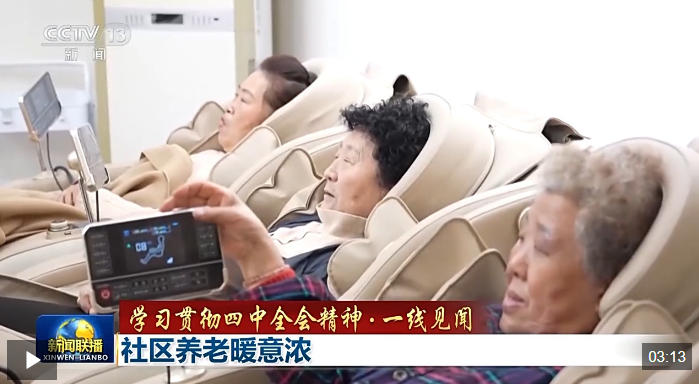
【学习贯彻四中全会精神·一线见闻】社区养老暖意浓
Yang Shi Wang· 2025-11-21 12:02
Core Insights - The article emphasizes the need to actively address population aging and optimize basic elderly care services as outlined in the "14th Five-Year Plan" [1] - The integration of new technologies and services in elderly care is highlighted, showcasing advancements in community-based care [1][2] Group 1: Policy and Infrastructure Development - The "14th Five-Year Plan" aims to establish a national basic elderly care service system and accelerate the construction of a three-tier elderly care service system covering urban and rural areas [1] - By the end of the "14th Five-Year Plan" period, 2,990 elderly-friendly communities and 500 community-based elderly care service networks have been established nationwide [1] - The number of elderly care institutions and facilities has reached 406,000, with 224,000 households of special needs elderly receiving home modifications [1] Group 2: Community Initiatives - In Lianyungang's Kuaihua Community, over one-third of residents are aged 60 and above, indicating a strong demand for home-based elderly care [1] - The community has developed an 800-square-meter intergenerational care center that includes a community canteen, rehabilitation therapy, and cultural activities [1] - Smart home devices such as smoke detectors and fall alarms have been installed in the homes of elderly individuals with disabilities [1] Group 3: Technological Advancements - New technologies like smart call systems and elderly care robots are increasingly being integrated into daily life, attracting more professionals to the silver economy [2]