外骨骼机器人

Search documents
3/13 上海 |中科院:智能科技时代的企业创新政策与战略的视角
CINNO Research· 2026-03-07 13:07
Core Viewpoint - The article emphasizes the profound adjustment in the global industrial landscape, driven by de-globalization and complex geopolitical relationships, presenting both challenges and strategic transformation opportunities for Chinese enterprises in the smart terminal industry [2]. Group 1: Event Overview - AWE2026, a significant event in the global home appliance and consumer electronics sector, will be held in Shanghai, adopting a "one exhibition, two zones" model to enhance its influence and scale [3]. - The event will focus on cutting-edge fields such as AI technology, computing chips, 6G communication, and embodied intelligence, aiming to accelerate the implementation of new productive forces [3]. Group 2: Summit Focus Areas - The summit will cover the entire smart terminal industry chain, focusing on key topics such as: - Macro Guidance: Analyzing national industrial development policies and the latest trends in capital markets to grasp strategic directions [4]. - Technology Drive: Discussing how frontier technologies like AI are reshaping the consumer electronics industry, along with the associated opportunities and challenges [5]. - Market Outlook: Gaining insights into the evolution trends of new technologies and markets globally, exploring new growth opportunities [6]. Group 3: Forum Details - The forum is scheduled for March 13, 2026, at the Oriental Hub Conference Center, E1 Meeting Hall 3F, Banquet Hall 2, organized by the Shanghai Communication Manufacturing Industry Association and hosted by CINNO Research [7][11]. Group 4: Keynote Speakers - Notable speakers include Yu Jiang, Executive Director of the Industrial Technology Center at the Chinese Academy of Sciences, who will discuss enterprise innovation policies and strategies in the era of intelligent technology [9][10]. Group 5: Agenda Highlights - The agenda includes discussions on various topics such as: - The evolution of next-generation display technologies and the industry path of MicroLED [21]. - Strategies for building autonomous and controllable wireless connection bases for smart terminals [21]. - The impact of de-globalization on the strategic elevation paths of Chinese smart terminal enterprises [21]. Group 6: Registration Information - Participants are required to register through the official channel to ensure entry, with a review process taking approximately 48 hours [28].


从医疗到登山,外骨骼进入“万元时代”前夜
机器人大讲堂· 2026-03-05 09:14
Core Viewpoint - The exoskeleton industry is experiencing significant growth, highlighted by the recent B+ round financing of Cheng Tian Technology, which indicates a shift towards consumer-grade applications and market expansion [1][2]. Group 1: Financing and Market Trends - Cheng Tian Technology completed a significant financing round of over 100 million yuan, marking its second round of funding within a year [1]. - The funding will be directed towards expanding the consumer-grade exoskeleton market, developing embodied intelligent exoskeleton technology, and registering new brain-machine interface products [2]. - The exoskeleton industry is entering a phase of accelerated commercialization, driven by advancements in technology, payment models, and diversified applications [2][4]. Group 2: Supply Chain and Cost Dynamics - The supply chain for exoskeletons is maturing, with previously hesitant suppliers now entering the market due to increased demand [4]. - If the exoskeleton market reaches a scale of 10 million units, the corresponding market space for components like motors and sensors could reach 32 billion yuan, 120 billion yuan, and 40 billion yuan respectively [4]. - The transition from high-cost medical devices to more affordable consumer electronics is being facilitated by economies of scale [4]. Group 3: Application Scenarios and Market Demand - Exoskeletons are expanding their application scenarios beyond medical rehabilitation to include industrial and consumer markets, with significant demand growth expected [6]. - The demand for exoskeleton robots in China is projected to grow by 31.6% year-on-year in 2026, with the market size expected to increase by 28.7% [6]. Group 4: Technical Challenges - The industry faces several technical challenges, including the need for improved user experience, better human-machine collaboration, battery life, and the transition from passive to active assistance [8][10]. - Current exoskeletons struggle with user comfort, adaptability to individual movement patterns, and battery performance, which are critical for user acceptance [10]. Group 5: Standardization and Regulation - The lack of a standardized framework for consumer-grade exoskeletons is a significant barrier to large-scale development [11]. - A national standard for exoskeletons is in the process of being established, which aims to create a comprehensive safety risk assessment framework for human-machine interaction [11]. Group 6: Competitive Landscape - The exoskeleton market features a diverse competitive landscape, with companies focusing on either medical or consumer applications [12][14]. - Cheng Tian Technology has a dual strategy, maintaining a strong presence in the medical sector while also exploring consumer markets, which may provide a stable cash flow and growth potential [14]. Group 7: Future Outlook - The recent financing of Cheng Tian Technology is seen as a preparatory move for scaling in the consumer market, but achieving widespread adoption will require addressing key challenges in technology and user experience [16]. - The exoskeleton industry is expected to undergo a competitive shakeout as companies strive to meet the evolving needs of consumers and the market [16].

一家想让外骨骼成为「人体器官」的公司,再获亿元级融资
36氪· 2026-03-05 00:26
Core Viewpoint - The exoskeleton industry is expected to evolve into an independent sector comparable to smartphones, addressing human mobility limitations and enhancing physical capabilities [2]. Group 1: Company Developments - Cheng Tian Technology secured a significant B+ round financing led by Agricultural Bank Capital, marking its second funding round in a year [2]. - The company plans to launch consumer-grade exoskeleton products in 2025, with an estimated shipment of 60,000 to 100,000 units in 2026 [3][9]. - The initial consumer product, a passive exoskeleton, sold out quickly, indicating strong market demand [7]. Group 2: Product Features and User Feedback - The passive exoskeleton targets individuals with walking disabilities, receiving positive feedback for improving stability and gait, although it has limitations in high-load scenarios like climbing [7]. - Active exoskeletons are being developed to assist with joint pain and fatigue during physical activities, with applications in scenic areas [8]. - The company emphasizes the importance of user-specific needs, suggesting that different demographics require tailored exoskeleton solutions [14][15]. Group 3: Market Trends and Future Outlook - The exoskeleton market is still in its infancy, with significant growth potential driven by aging populations and increasing consumer interest [10][18]. - The company aims to differentiate its products through precise user profiling and targeted functionalities rather than creating a one-size-fits-all solution [12][14]. - AI applications in exoskeletons focus on enhancing human-machine interaction and personalizing user experiences through data-driven insights [24][25]. Group 4: Supply Chain and Production Challenges - The supply chain for exoskeleton components has improved, allowing for better cost control and scalability, which was previously a major barrier [11]. - The company has opted for in-house manufacturing to address the rapid product iteration demands and ensure quality standards [11][12]. - The core indicators for consumer-grade exoskeletons include weight, battery life, and stability, which are influenced by supply chain capabilities [12]. Group 5: Integration of AI and Advanced Technologies - AI is being utilized for personalized adaptations of exoskeletons, enhancing user experience through real-time data analysis [24][25]. - The company is also developing brain-machine interfaces to further integrate exoskeletons with human physiology, aiming to improve rehabilitation outcomes [31][32]. - Continuous data collection from clinical applications is crucial for refining product designs and enhancing user adaptability [30].

新潮“年货”科技感拉满
Ren Min Ri Bao· 2026-02-26 13:33
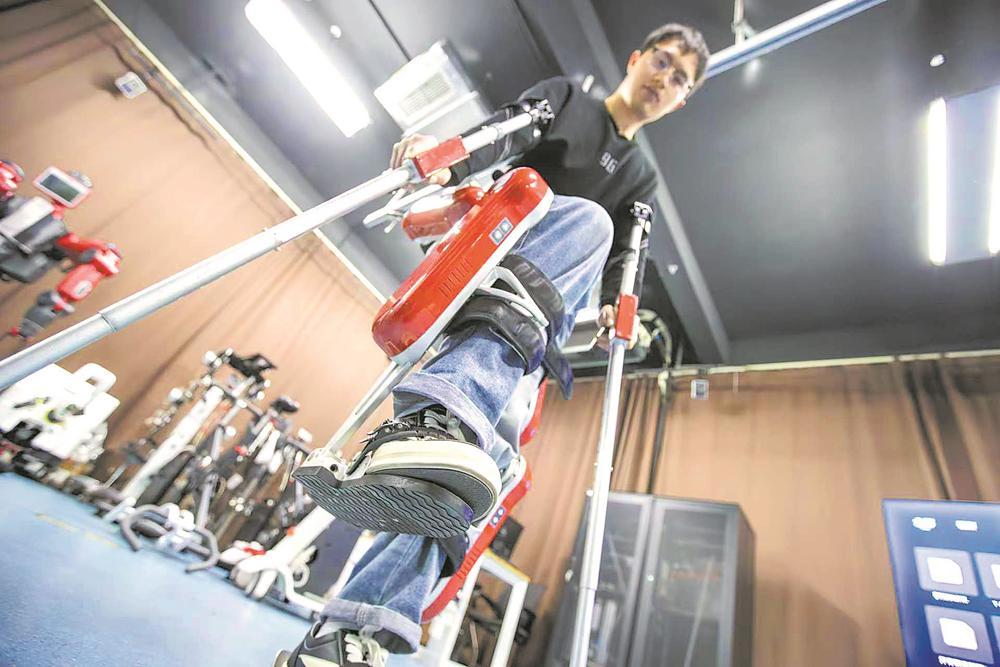
Group 1 - The article highlights the increasing interest in technology among the elderly, particularly in the use of exoskeleton robots to assist with mobility [1] - The exoskeleton robot showcased at the event in Hangzhou allows users to ascend and descend stairs with ease, demonstrating significant practical benefits for older adults [1] - The company, Cheng Tian Technology, has collaborated with various tourist attractions to provide rental services for exoskeleton robots, indicating a strategic move towards expanding their market presence [1] Group 2 - Cheng Tian Technology's co-founder emphasizes the importance of feedback from elderly users in improving product design and functionality [1] - The company is actively exploring opportunities in overseas markets, suggesting a growth strategy beyond domestic boundaries [1] - The overall sentiment expressed is a belief in the potential for more diverse technological products to enhance daily life in the future [2]
振江股份:外骨骼机器人可辅助老人行走、增强稳定性、降低摔倒风险
Zheng Quan Ri Bao Zhi Sheng· 2026-02-26 10:16
Core Viewpoint - The company, Zhenjiang Co., emphasizes the development of exoskeleton robots aimed at assisting the elderly in walking, enhancing stability, reducing fall risks, and improving mobility for those with joint aging and weakness [1] Group 1: Product Features - The exoskeleton robots are designed to be lightweight and compact, with civilian models weighing under 2.5 kg, making them more convenient to wear [1] - The company is focused on continuous product improvement through lightweight and miniaturization efforts [1] Group 2: Market Strategy - The company plans to make its products more affordable by implementing cost-reduction technologies, large-scale production, and product segmentation [1] - Additionally, the company is exploring rental and subsidy models to enhance product accessibility for a broader audience [1]

新春走基层丨-15℃,在雪山之巅为“机器人”炼筋骨
Yang Guang Wang· 2026-02-26 01:08
Core Insights - The article discusses the performance testing of exoskeleton robots in extreme cold conditions, highlighting their applications in various fields such as healthcare, petrochemicals, and firefighting [1][3]. Group 1: Exoskeleton Robot Testing - The testing took place in Harbin, Heilongjiang, where temperatures dropped to -15 degrees Celsius, providing a unique environment for performance evaluation [1]. - The team focused on two main aspects: the impact of low temperatures on battery life and core components, and the robot's ability to maintain balance on slippery snow-covered terrain [1][3]. Group 2: Product Development and Market Potential - The team has evolved from developing 20-pound full-joint wearable devices to lighter 2-3 pound single-joint assistive devices, catering to a broader audience [3]. - The exoskeleton market is expected to grow, with plans to focus on creating age-friendly exoskeletons to assist the elderly in mobility starting from March 2025 [3][4]. - The team has expanded from a small group to over 70 members, reflecting confidence in the growing robot market [4][5].

新潮“年货”科技感拉满(新春走基层)
Ren Min Ri Bao· 2026-02-25 22:18
Group 1 - The article highlights the increasing interest and adoption of technology among the elderly, particularly through the use of exoskeleton robots that assist with mobility [1][2] - The exoskeleton robots showcased at the event in Hangzhou are a product of "Zhejiang manufacturing," emphasizing local innovation and development [1] - The company has partnered with various tourist attractions to provide rental services for exoskeleton robots, indicating a strategic move towards expanding their market presence, including international markets [1] Group 2 - The co-founder of the company expresses optimism about the future, believing that more diverse products will emerge to enhance daily life through technology [2]
在蓉高校上演“机器人总动员”
Xin Lang Cai Jing· 2026-02-25 18:57
Group 1 - The article highlights the establishment of artificial intelligence and robotics programs in universities in Chengdu, aiming to accelerate the application of research outcomes in the robotics field [1][3] - University of Electronic Science and Technology of China (UESTC) has developed various robots, including exoskeleton robots and cognitive interaction robots, and ranks 17th in the national robotics engineering program [3][4] - UESTC's "industry-university-research-application" model has successfully led to the deployment of exoskeleton robots in over 100 hospitals across China, aiding paraplegic patients [4] Group 2 - Sichuan University has officially launched its Artificial Intelligence College, focusing on cultivating high-quality AI professionals and promoting interdisciplinary collaboration [4] - The college aims to establish a comprehensive training system and enhance cooperation with leading enterprises and research institutions to facilitate the transformation of research results into practical applications [4] - Other universities in Chengdu, such as Southwest Petroleum University and Chengdu University, are also offering robotics engineering programs to train talent for energy and manufacturing sectors [4]
科技新年货,让春节更有“智”感(纵横)
Ren Min Ri Bao· 2026-02-24 22:35
Group 1 - The core viewpoint of the articles highlights the rising popularity of technology-driven products as new year gifts during the Spring Festival, indicating a shift in consumer preferences towards experience and care-oriented purchases rather than just practical or bulk buying [1][2]. - The emergence of "smart new year gifts" is attributed to the convergence of mature technology, policy guidance, and consumer upgrades, creating a broad market for diverse consumer demands, from drones to AI interactive products [2]. - The integration of technology into traditional celebrations is seen as a way to enrich the cultural significance of the Spring Festival, demonstrating that technological innovation can enhance emotional connections and health care needs while maintaining the essence of the holiday [2][3]. Group 2 - The articles emphasize the importance of addressing the "digital divide" to ensure that high-tech gifts are usable for all age groups, particularly the elderly, to prevent them from becoming mere decorative items [3]. - There is a call for creative transformation of holiday cultural connotations, suggesting that technology should act as a catalyst to invigorate traditional cultural practices [3]. - The fusion of technology with traditional festivities is portrayed as a unique characteristic of the digital age, revitalizing the Spring Festival with a sense of modernity and style, while also highlighting the enduring importance of genuine emotional connections and shared experiences [3].
从春晚到景区科技buff叠满!这届中国年太会了
3 6 Ke· 2026-02-24 11:28
Group 1 - The 2026 Spring Festival Gala prominently featured AI and robotics, marking a significant integration of technology into cultural events [2][4] - The event showcased advanced technologies such as Seedance 2.0 and Seedream, enhancing the performance and interaction of robots on stage [2][4] - Major tech companies, including Alibaba, Tencent, and ByteDance, invested over 4.5 billion yuan in red envelopes and subsidies to promote AI experiences during the festival [4] Group 2 - The performance of humanoid robots demonstrated China's advancements in servo motors and AI algorithms, reflecting the country's long-term investment in technology [7] - The integration of technology into tourism was highlighted by the introduction of exoskeleton robots in scenic areas, enhancing accessibility for elderly and less mobile visitors [8] - The "AI Guilin" model provided personalized travel experiences, showcasing the application of AI in cultural tourism [12] Group 3 - The fusion of technology and culture aims to enhance cultural experiences without overshadowing traditional elements, ensuring that technology serves as a medium for cultural expression [13][15] - Technology is breaking down barriers to cultural participation, making experiences more inclusive for diverse audiences, including those with disabilities [14] - The ultimate goal of integrating technology in cultural contexts is to improve quality of life and ensure that innovations cater to all demographics [14][15] Group 4 - The 2026 Spring Festival Gala serves as a window into the future of China's technological and cultural integration, showcasing the potential for robots and AI to enhance traditional celebrations [16][18] - The theme of the year, "The galloping steed, unstoppable force," reflects national aspirations and aligns with advancements in China's tech sector [17]