
拓扑量子比特

Search documents
“量子电容”成功读取拓扑量子比特信息
Huan Qiu Wang Zi Xun· 2026-02-12 01:45
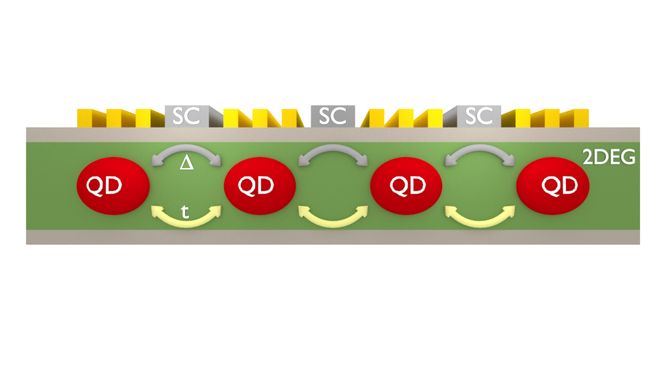
来源:科技日报 量子计算的核心挑战之一在于量子比特的稳定性。与超导、离子阱等技术路径不同,拓扑量子比特常被 形容为量子信息的"保险箱"。也就是说,其信息并非存储在某一具体位置,而是以非局域方式分布在一 对被称为"马约拉纳零模"的特殊量子态中。这种分布式编码使系统对局部噪声具有天然鲁棒性,因为只 有影响整个系统的扰动才可能破坏信息。因此,拓扑量子比特被认为是实现容错量子计算的重要方向。 然而,这种优势也带来了实验挑战。如果信息不对应任何单一点位,科学家该如何对其进行读取,一直 是该领域的关键难题。 科技日报记者 张佳欣 由西班牙国家研究委员会马德里材料科学研究所与荷兰代尔夫特理工大学组成的国际联合研究团队,在 拓扑量子计算领域取得重要进展。他们首次利用一种被称为"量子电容"的新技术,成功读取基于马约拉 纳模式的拓扑量子比特中的信息,向实现更稳定的量子计算迈出关键一步。相关成果发表于最新一期 《自然》杂志。 为解决这一问题,研究团队构建了被称为"最小Kitaev链"的模块化纳米结构。该结构通过超导体将两个 半导体量子点耦合起来,形成可控的拓扑体系。这种构建方式类似搭乐高积木,通过"自下而上"的设计 避免了以往依赖 ...

每一次突破,都在为未来铺路(院士新语)
Ren Min Ri Bao· 2025-11-09 22:20
Group 1 - The research and development of topological materials are driven by innovative thinking and rigorous empirical methods, emphasizing the importance of collaboration between theoretical research, material preparation, and experimental detection [1][2][3] - The theoretical prediction of Weyl semimetals by the Chinese Academy of Sciences in 2014 laid the groundwork for subsequent research, highlighting the critical challenge of high-quality material preparation for accurate experimental analysis [1][2] - The establishment of advanced experimental platforms, such as the Shanghai Synchrotron "Dream Line," has significantly enhanced the ability to analyze the properties of topological materials [1][3] Group 2 - The focus has shifted towards the promising field of topological quantum computing, particularly in developing topological qubits based on Majorana zero modes, with strong evidence found in iron-based superconductors [2][3] - The integration of multiple disciplines, including materials science and computer science, is becoming increasingly important in the research of topological quantum bits, facilitating advancements in purity, stability, and quantum control algorithms [2][3] - The collaborative approach in scientific research is emphasized, where data from experiments feed back into theoretical calculations, guiding further experimental and material preparation efforts [3] Group 3 - The ongoing development of topological materials and quantum computing aims to enhance China's international standing in the field and contribute to the advancement of related sectors [3] - Breakthroughs in the research of topological qubits are expected to usher in a new phase of quantum computing, with each scientific advancement paving the way for future developments [3]