无碘盐

Search documents
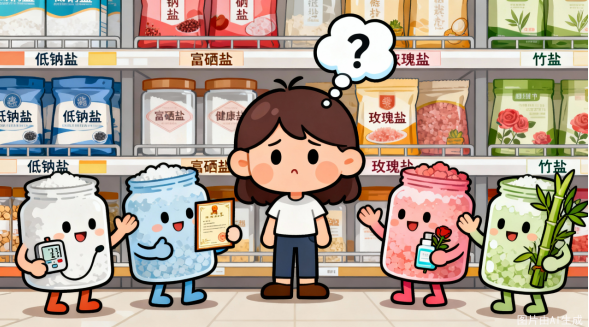
低钠盐、富硒盐、玫瑰盐、竹盐……这么多盐该怎么选?
Xin Hua Wang· 2026-01-31 14:20
Core Viewpoint - The article discusses the various types of salt available in the market, their nutritional values, and how to choose the right salt based on individual health needs, emphasizing that "high-end salts" do not necessarily provide significant health benefits compared to regular iodized salt [1][36]. Group 1: Types of Salt - Common salt types include regular iodized salt, selenium salt, low-sodium salt, and specialty salts like rose salt and bamboo salt, with the primary component being sodium chloride (95%-99%) [3][5][18]. - Regular iodized salt is cost-effective and prevents iodine deficiency diseases, making it suitable for most people [5][20]. - Selenium salt claims to provide selenium but only offers minimal benefits, insufficient to meet daily requirements [8][18]. - Low-sodium salt is beneficial for individuals with high blood pressure, but it is not suitable for everyone due to its potassium content [11][22]. - Specialty salts like rose salt and bamboo salt should be chosen based on specific needs rather than trends, as they do not provide significant health advantages [24][36]. Group 2: Choosing the Right Salt - The selection of salt should align with individual health conditions and dietary environments rather than blindly opting for expensive or trendy options [18][20]. - Regular iodized salt is recommended for the general population, while non-iodized salt is only for specific medical conditions [20][21]. - Low-sodium salt is ideal for those with hypertension but should be avoided by individuals with certain health issues [22][23]. - Specialty salts should be used judiciously, as they do not replace the need for a balanced diet [24][36]. Group 3: Salt Consumption Tips - It is crucial to control salt intake, with a recommended daily limit of 5 grams, and to be aware of hidden sources of salt in processed foods [32][30]. - Cooking techniques such as adding salt at the end of cooking and using natural flavor enhancers can help reduce overall salt consumption [33][34]. - Proper storage of salt is important to maintain its quality and nutritional value, particularly for iodized salt [34][36].

几块和几十块的盐,区别大吗?
Huan Qiu Wang· 2025-12-17 13:25
Group 1 - The core point of the article discusses the importance of salt in human health, emphasizing that sodium ions in salt play a crucial role in regulating bodily functions such as fluid balance, blood pressure, and energy metabolism [1][3] - The recommended daily intake of sodium is 1500 mg, and insufficient sodium can lead to health issues like hyponatremia, which can cause symptoms ranging from lethargy to severe complications like shock [3] Group 2 - Different types of salt available in the market include rock salt, lake salt, and sea salt, which are all essentially sodium chloride but differ in their sources and processing methods [5][9] - Rock salt is derived from ancient sea beds and is known for its high purity and low impurity levels, often sold at lower prices [6] - Lake salt is harvested from salt lakes and has larger granules that do not clump easily, while sea salt is produced through evaporation of seawater and may have lower sodium chloride purity [7][9] Group 3 - Specialty salts like bamboo salt and Himalayan pink salt are marketed as premium products, but they primarily serve the same purpose of sodium supplementation, with variations in flavor and appearance [10][11] - Nutritional salts, such as calcium and selenium salts, are available but provide minimal nutritional benefits compared to the recommended daily intake levels [12] Group 4 - When purchasing salt, consumers should focus on sodium and iodine content rather than price, with low-sodium salt being beneficial for individuals with hypertension [15] - Iodized salt is essential in iodine-deficient regions to prevent thyroid-related health issues, while some individuals may require non-iodized salt based on specific health conditions [17] Group 5 - The article stresses the importance of limiting salt intake to no more than 5 grams per day to avoid health risks associated with high salt consumption, such as hypertension and cognitive decline [18] - It also highlights the presence of hidden salts in various condiments and encourages a balanced diet with controlled salt intake [18]

雪天盐业:用高品质诠释“盐匠”精神
Zhong Guo Zhi Liang Xin Wen Wang· 2025-11-16 14:22
Core Viewpoint - Xue Tian Salt Industry Group has been awarded the Hunan Provincial Governor Quality Award, showcasing its commitment to quality amidst industry challenges such as overcapacity and intense competition [1][3]. Group 1: Historical Development - The quality foundation of Xue Tian Salt Industry is rooted in the historical context of salt production in Hunan and Jiangxi provinces, which were once considered "salt-less" regions [3]. - The discovery of the "Red Well" in 1969 marked the beginning of salt production in Hunan, fulfilling the local need for quality salt [5]. - In 1970, the identification of a 1.9 billion-ton salt rock deposit in Jiangxi ended its status as a "salt-less" province, further motivating the company to focus on quality [6]. Group 2: Quality Assurance and Production - Xue Tian Salt Industry has established a strategic goal to provide excellent quality assurance for becoming a leading salt chemical group in China, with a focus on high-quality development [6]. - The company’s salt products have a sodium chloride content of 99.7%, setting a new industry record, and have received the first national "Ecological Well Salt" certification [6][9]. - A comprehensive quality control system is in place, including a full lifecycle traceability system for salt products, ensuring transparency from production to consumption [9]. Group 3: Technological Innovation - The company is undergoing a digital transformation to enhance quality, with plans for a smart factory to be operational by August 2024, focusing on automation and energy optimization [10]. - Research and development expenditures have been increasing, with 4.58% of revenue allocated to R&D in 2024, positioning the company at an advanced level within the industry [10]. - Xue Tian Salt Industry has developed over 500 patents and has been involved in the formulation of 35 industry standards, reflecting its commitment to innovation [10]. Group 4: Market Position and Future Outlook - Xue Tian Salt Industry has established a robust production and sales network across China, with over 200,000 retail outlets in Hunan and more than 18,000 distributors outside the province [11]. - The brand value of "Xue Tian" is projected to reach 18.499 billion yuan by 2025, indicating strong market presence and growth potential [11]. - The company is also expanding into new industries, such as smart fiber materials, in collaboration with research institutions, aiming to enhance its production capabilities and innovation [12].