无线物联网芯片

Search documents
行业报告 | 全球与中国无线物联网芯片市场现状及未来发展趋势
QYResearch· 2026-02-03 09:51
Core Insights - The global wireless IoT chip market is projected to reach $13.13 billion in 2024 and $32.81 billion by 2031, with a CAGR of 14.34% from 2025 to 2031 [3] - The Chinese market is a key variable influencing global trends, expected to grow from $4.77 billion in 2024 to $12.74 billion by 2031, increasing its global share from 36.3% to 38.8% [8] - Major players in the wireless IoT chip market include Qualcomm, Texas Instruments, Semtech Corporation, and Nordic Semiconductor, with the top ten companies holding approximately 71% market share in 2024 [7] Market Size and Growth - The wireless IoT chip market is expected to grow significantly, with sales reaching $13.13 billion in 2024 and projected to hit $32.81 billion by 2031, indicating a robust growth trajectory [3] - The CAGR of 14.34% from 2025 to 2031 highlights the increasing demand for wireless IoT solutions [3] Competitive Landscape - The market is characterized by high concentration, with the top ten manufacturers accounting for about 71% of the market share in 2024 [7] - Key manufacturers include Qualcomm, Texas Instruments, and Nordic Semiconductor, among others, indicating a competitive environment where leading firms are likely to strengthen their market positions [7] Regional Analysis - The Chinese market is crucial for global trends, with a projected market size of $4.77 billion in 2024, expected to grow to $12.74 billion by 2031, thus increasing its global market share [8] - The rapid growth in the Chinese market is anticipated to accelerate local supply chain collaboration and domestic substitution, making it one of the most competitive regions in the coming years [8] Product Types and Technology Trends - Bluetooth and Bluetooth Low Energy (BLE) are expected to remain the largest technology routes, with a market share of approximately 57.3% in 2024, declining to 52.5% by 2031 [10] - Wi-Fi IoT is projected to increase its share from 21.7% in 2024 to 23.6% in 2031, driven by the demand for direct connectivity and higher bandwidth [10] - Smart home applications are expected to remain the core scalable deployment scenario, with a market share of about 34.1% in 2024 and a projected CAGR of 14.2% from 2025 to 2031 [10] Industry Chain Analysis - The wireless IoT chip industry encompasses the research, design, and sales of wireless communication chips, along with custom chip services and semiconductor IP licensing [11] - The health of upstream raw material supply directly impacts the stability and sustainability of the entire industry chain [13] Upstream Supply Analysis - The supply of raw materials for wireless IoT chips is characterized by global concentration and reliance on imports, with a notable acceleration in domestic substitution [13] - Silicon wafers, essential for chip manufacturing, are primarily supplied by companies in Taiwan, Japan, and South Korea, highlighting the importance of these regions in the global supply chain [13] Policy Analysis - Various policies are being implemented to support the development of the wireless IoT chip industry, including initiatives to enhance digital infrastructure and promote the integration of AI and IoT technologies [15]


2025年中国物联网芯片代表性企业分析 泰凌微:无线物联网芯片引领者
Qian Zhan Wang· 2025-07-24 08:28
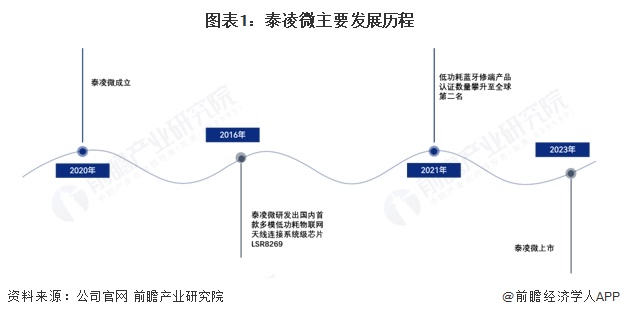
Core Insights - The article highlights that 泰凌微 (TaiLing Micro) is one of the most comprehensive companies in the global wireless IoT chip market, focusing on the research, design, and sales of low-power wireless IoT chips [1][2]. Company Overview - 泰凌微 was established in June 2010 and specializes in integrated circuit design, particularly in wireless IoT system-level chips [1]. - The company has a diverse product range supporting various applications, including smart retail, consumer electronics, smart home, smart healthcare, logistics, and audio entertainment [1]. Business Focus - The primary business of 泰凌微 is the development, design, and sales of low-power wireless IoT chips, focusing on technologies such as low-power Bluetooth, dual-mode Bluetooth, Zigbee, Matter, and WiFi [2]. - The company plans to embrace AI trends in 2024 by integrating edge AI with low-power wireless IoT chips, launching multiple series of chips and software development tools [2]. Product Adoption - 泰凌微's products are adopted by numerous leading domestic and international brands, including Google, Amazon, Xiaomi, Logitech, Lenovo, and Sony [5]. Production and Sales Data - In 2024, 泰凌微's IoT chip production is expected to reach 442 million units, a year-on-year increase of 51.84%, while sales are projected to be 425 million units, up 36.85% [7]. Technological Advancements - 泰凌微 has achieved several domestic firsts in technology, including the launch of a multi-mode low-power IoT chip with a peak current of 1mA and the first company to pass Bluetooth 6.0 high-precision positioning standard certification [10]. - The company is a leading supplier of Zigbee chips in China and has a strong competitive position in both local and international markets [8]. Core Technologies - The company has developed a comprehensive technology and product series for Zigbee communication protocols, supporting various standards [11]. - 泰凌微's latest generation of RF transceivers can support multiple communication modes, which is significant for the coexistence of Zigbee and Thread networks [11]. Future Directions - 泰凌微 is set to launch a machine learning and AI development platform, TLEdgeAI-DK, which will support mainstream local AI models, paving the way for future AI edge applications [11].