旷湖数据云底座

Search documents
18亿跨界并购背后:AI独角兽探迹科技入主“世界毯王”的产业重构逻辑
Xin Lang Cai Jing· 2026-02-11 03:16
Core Insights - The acquisition of a 44.99% stake in Zhenai Meijia by Tanjitech for approximately 1.8 billion yuan marks a significant shift in control, making Zhenai Meijia the first manufacturing company in the A-share market to be controlled by an AI model platform [1][10] - The transaction is structured as a combination of "agreement transfer + partial tender offer," showcasing complexity in its design [2][11] Transaction Details - Tanjitech will acquire 29.99% of Zhenai Meijia's shares at a price of 27.74 yuan per share, totaling around 1.198 billion yuan [2][11] - The original controlling shareholder, Zhenai Group, will retain 21.61% of the shares and has agreed to waive voting rights on the transferred shares [2][11] - The founder of Tanjitech, Li Zhan, will become the new actual controller of Zhenai Meijia [2][11] Industry Collaboration - Zhenai Meijia, established in 2010 and known as the "World Blanket King," has faced revenue pressures, with revenues of 953 million yuan and 879 million yuan in 2023 and 2024, respectively [3][12] - The company has a high dependency on overseas markets, with over 80% of its revenue coming from abroad [3][12] - In the first half of 2025, Zhenai Meijia reported a revenue of 390 million yuan, a year-on-year increase of 21.82%, and a net profit of 197 million yuan, a staggering increase of 484.48% [3][12] - Zhenai Meijia is undergoing an intelligent transformation, developing an industrial internet platform covering the entire process of the blanket industry [3][12] Business Logic - The acquisition aligns with the trend of "AI+" empowering the real economy, as highlighted by the Chinese government's push for deep integration of AI across industries [5][15] - A McKinsey survey indicates that 78% of Chinese companies have deployed AI in at least one business function, with generative AI usage rising from 55% in 2023 to 75% in 2024 [5][15] - The transaction is expected to break Zhenai Meijia's growth bottleneck, facilitating deep collaboration across the entire process from R&D to sales [5][15] Challenges and Responses - The integration of AI into manufacturing faces challenges, with only 9% of companies successfully achieving significant improvements in efficiency and profitability [7][17] - The introduction of AI agents necessitates a transformation in organizational structure and workflow, requiring middle management to adapt to managing digital employees [8][18] - Zhenai Meijia is also under pressure from shifting textile production to Southeast Asia and North Africa, facing competition from lower-cost regions [8][18]
AI Agent重构客服生态 消费企业生命力如何再赋能?
2 1 Shi Ji Jing Ji Bao Dao· 2026-01-23 10:53
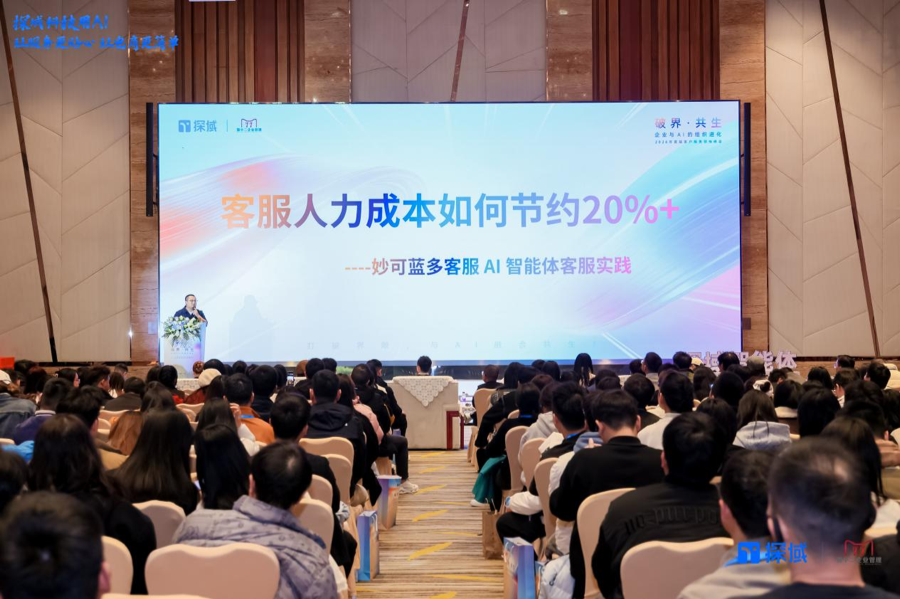
Core Insights - AI has deeply integrated into the e-commerce and retail sectors, functioning as "digital employees" to effectively address business challenges and enhance the quality and efficiency of the real economy [1][7] - The demand from consumers is rapidly evolving, requiring more professional responses and emotional resonance, making service quality crucial for customer retention and conversion [1] - Traditional customer service chatbots are becoming obsolete, and the need for "smarter services" that combine precision and warmth is emerging [1] Group 1: AI in Customer Service - The "Breaking Boundaries and Coexistence" concept emphasizes the collaboration between AI and human agents, where AI handles routine tasks, allowing human agents to focus on complex issues and create higher value [1] - The "Tianyu Intelligent Agent" from Tanjie Technology aims to provide comprehensive AI Agent services for e-commerce and retail, covering customer service, marketing, operations, and private domain scenarios [3] - The annual token consumption of the Tianyu Intelligent Agent has surpassed 10 trillion, indicating its significant role in driving core business and serving a large user base [4] Group 2: Business Impact and Efficiency - The implementation of the Tianyu Intelligent Agent has led to a 25% reduction in customer service labor costs for Miaokela, achieving the goals of quality improvement, efficiency enhancement, and cost reduction [6] - AI is transforming customer service from a "cost center" to a "growth engine," with the potential to enhance conversion rates, user value, and organizational efficiency [6][7] - Tanjie Technology has received substantial investments from top-tier capital firms, positioning itself as a global unicorn and indicating strong market confidence in its AI capabilities [7] Group 3: Future Trends - The year 2026 is anticipated to be a pivotal year for the application of AI Agents, marking a shift from merely answering questions to solving problems in complex business scenarios [7] - The evolution of AI Agents is moving from being external tools for efficiency to becoming internal engines for value creation [7]