昆仑芯M系列

Search documents
不再只会聊天,2026年AI变局前瞻
Xin Hua She· 2026-01-29 18:03
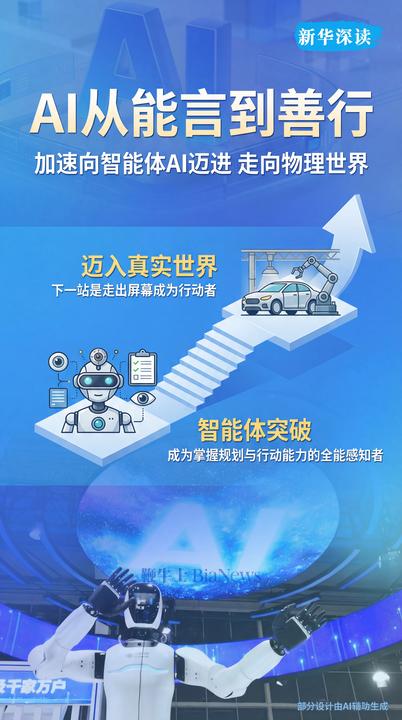
Group 1 - The number of AI companies in China has exceeded 6,000, with the core AI industry scale expected to surpass 1.2 trillion yuan, reflecting a nearly 30% year-on-year growth [2] - China has become the largest holder of AI patents globally, accounting for 60% of the total [2] - The trend indicates a shift from a "chat" paradigm to an "intelligent agent" era, focusing on practical applications of AI [2][4] Group 2 - The AI development in China is characterized by a dual approach: technological advancements and practical applications addressing real-world issues [4][5] - The concept of "density law" is emerging, emphasizing efficiency and effectiveness in AI model training rather than merely scaling up [5][6] - The industry is moving towards high-quality, specialized data sets, with a focus on vertical industry applications [20][23] Group 3 - AI is increasingly being integrated into traditional industries, driving transformation and modernization [27][32] - The AI application landscape is diversifying, with significant growth in sectors like manufacturing, healthcare, and finance [28][30] - The government is actively promoting AI integration across various sectors, aiming for a comprehensive application of AI technologies [32][34] Group 4 - AI is reshaping governance and public service delivery, enhancing efficiency and responsiveness in urban management [36][37] - The consumer experience is being transformed through AI, with personalized recommendations and smart interactions becoming commonplace [38][39] - The focus on ethical AI development is growing, with initiatives aimed at establishing safety and regulatory frameworks [41][46]

中国AI 最新趋势来了!
Shang Hai Zheng Quan Bao· 2026-01-28 16:25
Core Insights - The article outlines the rapid development of artificial intelligence (AI) in China, highlighting over 6,000 AI companies and a core industry scale expected to exceed 1.2 trillion yuan, with a year-on-year growth of nearly 30% [2] - China has become the largest holder of AI patents globally, accounting for 60% of the total [2] - The shift in AI technology is moving from a "chat" paradigm to a more functional "intelligent agent" era, focusing on practical applications [2][4] Industry Trends - The number of AI companies in China has surpassed 6,000, with significant growth in the core AI industry expected to reach 1.2 trillion yuan [2] - The cumulative download of domestic open-source large models has exceeded 10 billion [2] - The AI industry is witnessing a transition from a focus on scale to a focus on efficiency and intelligence density, with companies like DeepSeek leading the way in addressing memory and stability challenges in large model training [4][5] Technological Advancements - The concept of "density law" is emerging, emphasizing the need for AI models to evolve in both capability and cost efficiency, moving from a scale-based approach to a density-based approach [5][6] - Innovations in algorithm architecture, such as sparse attention mechanisms, are becoming crucial for enhancing model inference efficiency [5] - The development of intelligent agents is accelerating, with these agents expected to possess autonomy, long-term memory, and the ability to understand complex tasks [10][11] Data Utilization - The focus is shifting from quantity to quality in data collection, with high-quality industry-specific datasets becoming essential for training AI models [21][24] - The data annotation industry is evolving from labor-intensive to knowledge-intensive, requiring specialized expertise to create high-quality datasets [20][21] - China's data production accounts for over a quarter of the global total, providing a rich resource for AI development [22][27] Application in Manufacturing - AI is increasingly being integrated into traditional industries, driving transformation and efficiency improvements [28][30] - The application of AI in manufacturing is expanding across research and development, production, and operational management, with significant growth expected in the coming years [31][33] - The Chinese government is actively promoting AI integration in manufacturing through various initiatives and policies [33][34] Social Impact - AI is transforming governance and public services, enhancing efficiency and responsiveness in urban management [37][38] - The integration of AI into consumer services is reshaping how businesses interact with customers, moving towards more personalized experiences [39][40] - The potential of AI to redefine human value and capabilities is being recognized, with a focus on fostering innovation and creativity [41]
中国AI,最新趋势来了!
Xin Hua She· 2026-01-28 05:55
Core Insights - The number of AI companies in China has exceeded 6,000, with the core AI industry expected to surpass 1.2 trillion yuan, reflecting a nearly 30% year-on-year growth [1] - China has become the largest holder of AI patents globally, accounting for 60% of the total [1] - The trend indicates a shift from a "chat" paradigm to an "intelligent agent" era, focusing on practical applications of AI [1][3] Industry Development - In January, several domestic AI companies, including Zhipu, Tianshu Zhixin, and MiniMax, have gone public, indicating a surge in AI enterprise listings [1] - The "15th Five-Year Plan" suggests that China will integrate AI with various sectors, enhancing productivity across industries [1] Technological Paradigms - AI is transitioning from a focus on "chatting" to "doing," emphasizing the development of intelligent agents capable of task execution [3][10] - The concept of "density law" is emerging, where AI models will evolve to enhance efficiency and reduce costs, moving away from merely increasing scale [6][24] Application and Market Trends - Major companies like Tencent and Baidu are accelerating the deployment of AI in real-world scenarios, with Tencent integrating its self-developed models into over 900 applications [7][34] - The AI market is witnessing a consolidation of foundational models, with a focus on high-quality data and application effectiveness in various sectors [7][27] Data Utilization - The data annotation industry is shifting from labor-intensive to knowledge-intensive, requiring high-quality industry-specific datasets for AI training [22][25] - China's data production accounts for over a quarter of the global total, providing a rich resource for AI development [26] Manufacturing Transformation - AI is becoming a crucial driver for the transformation of traditional industries, with applications in R&D, production, and operational management [31][34] - The integration of AI in manufacturing is expected to enhance efficiency and product quality, with significant growth anticipated in sectors like automotive and robotics [34][38] Social Impact - AI is reshaping governance and public services, enabling smarter and more efficient urban management [39][42] - The technology is also transforming consumer experiences, with AI-driven recommendations becoming more prevalent in retail and service sectors [43][44]