春节旅游

Search documents
春节游4大新趋势 你赶上了哪一拨?
Zhong Guo Jing Ji Wang· 2026-02-25 08:00
Group 1 - The travel patterns during the recent long Spring Festival holiday have shifted significantly, with a notable increase in reverse family gatherings where young people invite their parents to their cities instead of returning home [1] - There is a growing trend towards less popular destinations and intangible cultural heritage experiences, with a 117% year-on-year increase in consumption related to non-material cultural performances during the holiday [1] - Family travel has become mainstream, with family trips accounting for 68% of travel, indicating a shift towards shared experiences and deeper connections during travel [1] Group 2 - The inbound tourism market has seen a significant surge, with a 312% year-on-year increase in inbound flight bookings during the first five days of the Spring Festival holiday [2] - The average daily number of people entering and exiting the country is expected to exceed 2.05 million, reflecting a 14.1% year-on-year growth [2] - The Chinese Spring Festival is evolving into a global cultural phenomenon, moving from quantity to quality in tourism experiences, emphasizing warmth, culture, family, and openness [2]
这个春节,多少单身族出国旅游躲清静?
3 6 Ke· 2026-02-10 13:16
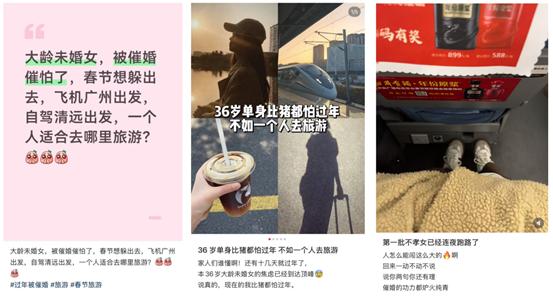
Core Insights - The article discusses the growing trend among young people in China to travel during the Spring Festival instead of returning home, primarily to avoid familial pressure regarding marriage [3][19] - This shift reflects a broader societal change where individual preferences and lifestyles are increasingly prioritized over traditional expectations [20] Group 1: Travel Trends - There has been a significant increase in outbound travel during the Spring Festival, with long-haul outbound travel rising by 60% and short-haul destinations seeing a 160% increase compared to the previous year [9] - Turkey has become a popular destination, with hotel bookings increasing by 1.5 times during the Spring Festival, ranking second among all outbound destinations [10] - The proportion of solo travelers among Chinese tourists has surged from approximately 10% to 26.7% between 2011 and 2023, indicating a notable shift in travel preferences [10][11] Group 2: Societal Changes - The decline in marriage rates in China is contributing to the rise of solo travel, with marriage registrations dropping from 13.46 million in 2013 to 6.1 million in 2024 [11] - The trend of solo travel is not unique to China; globally, discussions around solo travel have increased significantly on social media platforms, with Google searches for "solo travel" doubling from 2018 to 2023 [12] - The article draws parallels between the current situation in China and Japan's past experiences with declining marriage rates and the acceptance of single lifestyles [15][16] Group 3: Industry Implications - The tourism industry has an opportunity to cater to the growing demand for solo travel and to acknowledge the changing dynamics of social interactions among young people [20] - There is a cautious perspective within the industry regarding the role of travel in addressing marriage anxiety, emphasizing that travel should not become a mechanism for enforcing marriage expectations [18] - The emergence of solo travel as a mainstream option presents a potential market for tourism companies to develop experiences that align with the preferences of this demographic [20]

中国人过年方式多样化,现在流行先回家再出游
第一财经· 2026-02-07 04:40
Core Viewpoint - The article discusses the evolving ways in which Chinese people celebrate the Spring Festival, highlighting a trend towards a segmented approach that combines traditional family visits with travel experiences [3][5]. Group 1: Changes in Celebration Patterns - More individuals are adopting a "return home, then travel" approach during the Spring Festival, reflecting a shift in consumer behavior and lifestyle choices [5][8]. - The trend of "reverse Spring Festival," where parents visit their children's homes, is becoming increasingly common [5][8]. - The integration of travel into the Spring Festival celebrations indicates a blend of traditional values with modern consumer experiences [6][9]. Group 2: Economic and Demographic Insights - The number of rural residents participating in domestic travel and their spending has seen rapid growth, with rural travel expenditures increasing by 21.4% year-on-year in 2025 [6]. - In 2025, domestic travel expenditures reached 6.30 trillion yuan, with rural residents contributing 1.00 trillion yuan, showcasing a significant increase in their travel spending [6]. - The changing consumption mindset among older rural residents, many of whom are financially stable, is driving this growth in travel during the Spring Festival [6][7]. Group 3: Transportation and Market Implications - The improvement of transportation infrastructure and services has facilitated the trend of returning home before traveling, particularly with the rise of car ownership [7]. - Car rental services are expected to experience dual peak demand during the Spring Festival, with significant rental activity anticipated on both the last working day and the second day of the new year [7]. - The trend towards segmented travel during the holiday period is expected to unlock substantial consumer spending potential in the travel and rental markets [7].