智能仿生假肢

Search documents
杭州重磅布局“类脑智能”未来赛道
Mei Ri Shang Bao· 2025-12-30 22:20
Core Viewpoint - Hangzhou is accelerating the development of brain-like intelligence as a key future industry, supported by substantial policy measures aimed at fostering innovation and investment in this field [1][2]. Group 1: Policy Support - The "Measures" outline financial support for brain-like intelligence projects, including a 25% subsidy on actual funding for projects not requiring local matching funds, with a maximum of 5 million yuan per project [2]. - For small and medium-sized technology enterprises with R&D increases over 2 million yuan, a 5% subsidy on the increase is available, capped at 200,000 yuan [2]. - Larger enterprises with R&D expenditures exceeding 500 million yuan can receive a direct subsidy of 300,000 yuan [2]. Group 2: Application Focus - The policy emphasizes application-oriented support, targeting key areas such as personalized medical treatment, intelligent diagnostic assistance, and rehabilitation in healthcare [2]. - In smart applications, priority scenarios include smart homes and security, intelligent transportation and autonomous driving, and robotics [2]. Group 3: Encouragement for Innovation - The policy encourages enterprises to trial new brain-like intelligence products, offering a subsidy of up to 300,000 yuan for the first product sold to non-affiliated parties, based on 10% of sales [3]. - Companies transitioning through various growth stages can receive financial rewards, including 20,000 yuan for first-time registration and additional support for maintaining status over three years [3]. - Recognition as a national or provincial "specialized and innovative" enterprise can yield rewards of up to 1 million yuan and 200,000 yuan, respectively [3]. Group 4: Spatial Layout - The policy outlines a spatial layout for the brain-like intelligence industry, supporting the establishment of a pilot area in Yuhang District and encouraging development in Binjiang and Xiaoshan Districts to create a dual-driven growth model [3].
杭州市科技助残工作方案发布
Mei Ri Shang Bao· 2025-12-03 23:20
Group 1 - The core event was the celebration of the 34th "International Day of Persons with Disabilities," showcasing technological innovations that significantly enhance the lives, rehabilitation, and social participation of people with disabilities [1] - The "Hangzhou Smart Bionic Prosthesis Adaptation Service Base" was inaugurated, which will provide tailored services for individuals with limb disabilities, focusing on personalized prosthesis adaptation and rehabilitation training [1] - The "Hangzhou Technology Assistance for the Disabled Work Plan" was officially released, outlining key tasks, support policies, and pathways for promoting technology assistance for the disabled in the city [1] Group 2 - By 2030, Hangzhou aims to establish a comprehensive policy system and collaborative working mechanism for technology assistance to the disabled, enhancing research and application capabilities in assistive technology [1] - By 2035, the city plans to significantly improve its assistive technology capabilities, aligning them with economic development, research levels, and the well-being of disabled individuals [1] - The Hangzhou Technology Assistance for the Disabled Alliance was formed, consisting of 10 member units specializing in artificial intelligence, brain-machine interfaces, and exoskeleton rehabilitation technology, which will play a crucial role in advancing technology assistance for the disabled [2]
脑机接口产业趋势解读
2025-10-19 15:58
Summary of Brain-Computer Interface Industry Trends Industry Overview - The brain-computer interface (BCI) industry in China is experiencing significant advancements, particularly in clinical applications, with the National Healthcare Security Administration including relevant neurological projects in medical insurance [1][3][12] - Major cities like Zhejiang, Shanghai, and Jiangsu have begun implementing these policies, encouraging researchers to explore innovative applications [1][4] Key Technological Advancements - China has made breakthroughs in BCI technology, achieving 1,024 electrical probe channels, a signal-to-noise ratio (SNR) exceeding 20 dB, and reducing chip power consumption to 3.8 milliwatts per channel, with single-channel costs around 800 yuan [1][4][25] - Research institutions such as Fudan University Huashan Hospital and Tsinghua University have made significant contributions, particularly in areas like deep brain stimulation and high-resolution signal acquisition [5][19] Future Development Directions - Future directions for BCI technology include increasing the number of channels to 30-50, improving SNR to 30-50 dB, reducing chip power consumption to below 2 milliwatts, and lowering single-channel costs to below 500 yuan [6][7] - The development of adaptive transfer recognition algorithms for various signals (EEG, MEG, fMRI) is also a critical area, especially for early intervention in Alzheimer's disease [7] Market Potential and Demand - The market demand for BCI technology is substantial, particularly for restoring limb function in paralyzed patients and non-invasive BCI products [1][13][23] - The clinical application market is vast, with approximately 30 million stroke patients annually in China, indicating a market space of at least 50 billion yuan [23] Policy Support and Government Initiatives - The year 2025 is anticipated to be a pivotal year for the BCI industry in China, with various government policies aimed at promoting innovation and development in this field [2][12] - Policies focus on medical applications but are expected to expand into areas like silicon and carbon integration, brain simulation, and military applications [2] Competitive Landscape - Internationally, institutions like Stanford University and MIT are leading in BCI research, focusing on areas such as neural signal decoding and flexible electronic materials [8] - Despite the competitive landscape, China's focus on medical applications provides a unique advantage, particularly in treating conditions like Parkinson's and Alzheimer's diseases [8][13] Commercial Models and Applications - BCI companies are exploring various business models, including direct-to-consumer (B2C) applications for conditions like Alzheimer's and children's attention issues, as well as business-to-business (B2B) models targeting hospitals [17] - Non-invasive BCI technology is expected to see significant breakthroughs in the next 1-2 years, with applications in monitoring mental states and cognitive functions [22] Challenges and Bottlenecks - The primary bottlenecks in the BCI industry include the stability and reliability of biocompatible materials and the need for breakthroughs in chip technology [14] - The market's vast potential is countered by the challenges of achieving long-term usability and effective signal processing [14] Conclusion - The BCI industry in China is poised for rapid growth, driven by technological advancements, strong market demand, and supportive government policies. The focus on both clinical and consumer applications presents a unique opportunity for innovation and investment in the coming years [1][10][21]
科技+体育 门头沟区举办首届“智谷潮铁” 铁人三项赛
Xin Jing Bao· 2025-08-09 15:06
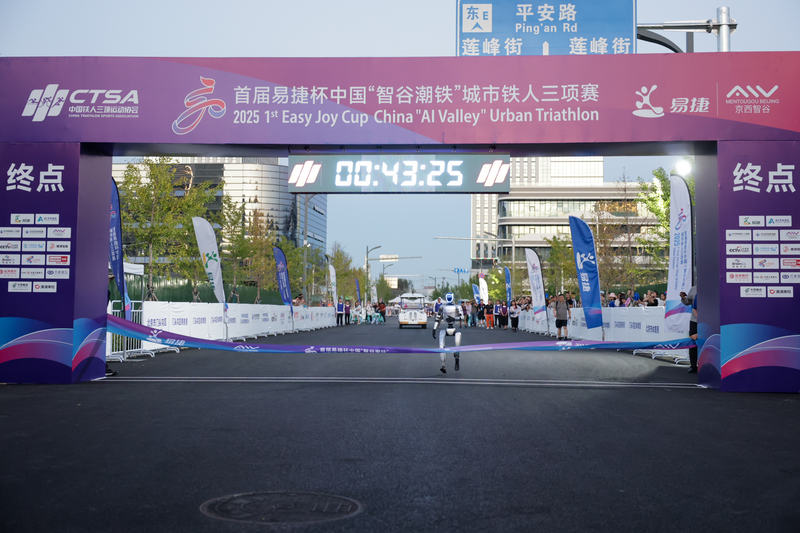
Group 1 - The first "Zhigu Chao Tie" triathlon event was held in the Mentougou District of Beijing, showcasing a combination of technology and traditional culture [1][3] - The event featured robots and robotic dogs competing alongside athletes, marking the first time such technology has been integrated into a domestic triathlon [3] - The venue, Jingxi Zhigu, is the first national public open innovation platform for the new generation of artificial intelligence in North China, providing computing power support to over 200 companies and incubating more than 250 solutions [3] Group 2 - The Mentougou District has been promoting its "three land" brand by hosting various events that align with regional characteristics, using sports as a catalyst for local development [4] - The triathlon event included a carnival with traditional cultural performances and modern entertainment elements, creating a vibrant atmosphere [4] - Surrounding the event, various functional areas were developed, including camping zones, markets, and dining services, enhancing the overall experience for participants and visitors [4]