智能反欺诈系统

Search documents
省呗科普升级:揭秘“职业背债”骗术,全方位守护金融安全
Cai Fu Zai Xian· 2026-01-27 02:34
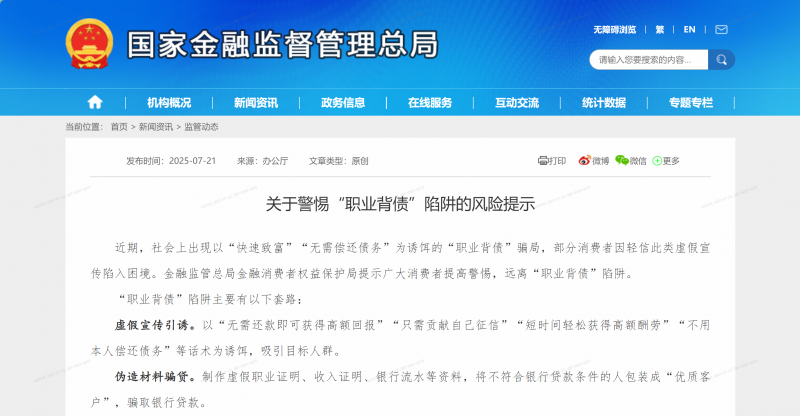
Core Viewpoint - The rise of "professional debt" scams, which lure consumers with promises of easy money and no repayment obligations, highlights the need for increased financial literacy and protection measures in the digital finance landscape [1][10]. Group 1: Scam Mechanisms - Scammers use false advertising to attract victims, promoting slogans like "no debt responsibility, earn commissions" and "the worse your credit, the more you earn," targeting those in financial distress or lacking financial knowledge [3]. - To secure loans fraudulently, scammers prepare forged documents such as fake income statements and bank statements, misrepresenting unqualified applicants as "high-quality" candidates [4]. - Once loans are disbursed, scammers take a significant portion of the funds as "fees," leaving victims with minimal compensation while all legal and financial responsibilities fall on them [5]. Group 2: Risks of Becoming a "Professional Debtor" - Individuals who become "professional debtors" face the burden of massive debts, as they are legally responsible for the full amount of the loans they signed for, leading to severe financial consequences if they fail to repay [6]. - Their credit scores suffer significantly due to missed payments, affecting future borrowing, credit card applications, and even employment opportunities, with long-lasting repercussions [7]. - Engaging in loan fraud, even unknowingly, can lead to criminal charges, including fraud and money laundering, resulting in severe legal consequences and irreversible damage to their lives [8]. Group 3: Company Actions - The company, as a financial technology platform, prioritizes user protection through a multi-layered anti-fraud strategy, employing AI and big data to monitor suspicious activities and ensure loans are granted only to legitimate users [9]. - It emphasizes financial education by collaborating with communities to conduct outreach programs, enhancing public awareness of financial literacy and fraud prevention [9]. - The company implements robust privacy protection measures, including dynamic encryption and multi-layer security systems, and has received various certifications, underscoring its commitment to user data security [9].

如何抓住人工智能的第二序红利?
伍治坚证据主义· 2025-07-28 02:11
Core Viewpoint - The article emphasizes that the true beneficiaries of the AI revolution are not only the companies creating AI technologies but also those that effectively integrate AI into their operations to enhance efficiency and profitability, referred to as "second-order winners" [1][2][9]. Group 1: Historical Context and Examples - Historical examples illustrate that during technological revolutions, the greatest returns often come from companies that leverage new technologies rather than those that create them. For instance, the automotive industry saw more significant gains from downstream service providers than from car manufacturers [1][2]. - Gulf Refining's establishment of self-service gas stations exemplifies how companies can capitalize on technological advancements without being the creators of the technology [2]. Group 2: AI Integration in Companies - Companies like Shake Shack have successfully integrated AI and automation to enhance operational efficiency, reducing the time to prepare meals and lowering labor costs while increasing employee wages and profit margins [3]. - Ecolab's modeling indicates that it can automate approximately 50% of high-probability automation roles, leading to significant cost savings and improved profit margins without altering revenue [4]. Group 3: Chinese Companies Leveraging AI - JD Logistics has implemented the "Zhi Lang" system, which has tripled picking efficiency and significantly improved sorting accuracy, contributing to its profit growth [6]. - Ping An has effectively utilized AI in insurance processes, achieving rapid underwriting and claims processing, which has led to substantial cost reductions and enhanced customer experience [6]. Group 4: Investment Perspective - Investors are encouraged to focus on companies that have embedded AI into their operations, as these firms are likely to provide more stable returns compared to high-valuation AI technology creators [7]. - The characteristics of promising companies include labor-intensive operations that can benefit from AI cost reductions, clear and repetitive business processes, and the ability to scale AI applications effectively [7]. Group 5: Macro Economic Impact - The integration of AI is expected to reshape overall productivity in China, with projections indicating a potential GDP increase of about 8% by 2030 due to AI applications across various sectors [8]. - Companies that can quickly adapt and utilize AI to enhance efficiency are likely to continue benefiting from the efficiency dividends in the coming years [8]. Group 6: Conclusion - The article concludes that AI represents a revolution in efficiency, and investors should focus on companies that effectively integrate AI into their business models, as these "downstream" enterprises may yield better returns than those merely creating AI technologies [9].