
智能有序充电桩

Search documents
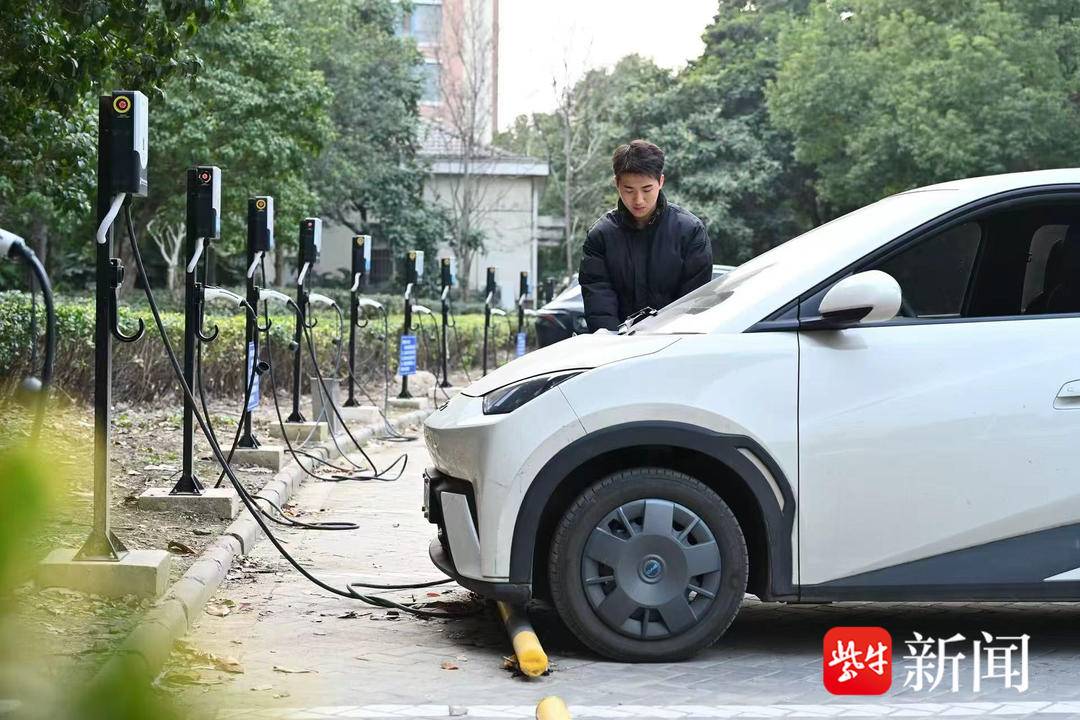
江苏建成首批 智能有序充电试点社区
Zhong Guo Dian Li Bao· 2025-12-24 05:43
Core Insights - The article highlights the advancements in smart and orderly charging modes for electric vehicles in China, emphasizing cost savings and efficiency for users [1][2] - The Chinese government is actively promoting the integration of electric vehicles with the power grid, aiming for significant growth in charging infrastructure and service capabilities by 2027 [1][2] Group 1: Smart Charging Developments - Users can set specific charging times, leading to cost savings; for example, a user saved 7.2 yuan on a 30 kWh charge, estimating an annual saving of 800 yuan [1] - Jiangsu province has implemented smart charging pilot communities, with 146 smart charging piles installed, providing a total adjustable load of 1,022 kW [1] Group 2: Government Initiatives - The National Development and Reform Commission and other departments have issued guidelines to encourage the smart and orderly development of charging infrastructure [1] - The "Three-Year Doubling Action Plan" aims to double the charging service capacity by the end of 2027, with a focus on enhancing the synergy between electric vehicles and the new power system [2] Group 3: Future Projections - The number of electric vehicles in Jiangsu is expected to reach 9 million by 2030, with peak charging loads projected to exceed 10 million kW [2] - The pilot communities are intended to serve as practical examples for the large-scale promotion of smart charging solutions, facilitating the growth of electric vehicles and the new power system [2]
惠及近万名车主 车网互动“常州样本”落地见效
Yang Zi Wan Bao Wang· 2025-12-12 11:50
Core Insights - The article highlights the successful implementation of Vehicle-to-Grid (V2G) technology in Changzhou, where electric vehicles not only charge but also discharge energy back to the grid, generating income for vehicle owners [1][3][4]. Group 1: Policy and Regulatory Framework - Changzhou has established itself as a pilot city for V2G applications, collaborating with the State Grid Changzhou Power Supply Company since March 2025 to create a comprehensive system focusing on reverse discharge, orderly community charging, and market-driven initiatives [1][3]. - The introduction of the "Changzhou New Energy Industry Promotion Regulations" in April 2024 provides a policy framework for the long-term promotion of reverse discharge, including a dual mechanism of electricity pricing and subsidies [3][4]. Group 2: Implementation and Results - As of now, Changzhou has conducted five rounds of large-scale reverse discharge activities, achieving a total discharge volume exceeding 30.4 million kWh and distributing over 1.2 million yuan in subsidies to vehicle owners [4][6]. - The city has built a demonstration system covering various charging scenarios, including public charging stations and residential areas, with a total of 45 stations and 176 V2G charging piles established [3][4]. Group 3: Community Engagement and Benefits - The "residential grid backup" model allows homeowners to participate in low-cost charging during off-peak hours and discharge during peak hours, with potential earnings of over 3,000 yuan annually for participants [5][6]. - The implementation of smart orderly charging stations in communities optimizes charging based on overall electricity load, enhancing user experience and reducing costs [7]. Group 4: Technological Advancements - Changzhou has successfully tested the conversion of standard charging piles to V2G charging piles, reducing the modification cost to under 1,000 yuan, which supports the future scalability of V2G technology [5][6]. - The establishment of a resource management platform by the State Grid Changzhou Power Supply Company integrates various charging resources, enhancing data support for government policies and market activities [8][9]. Group 5: Future Directions - The company plans to further enhance the resource management platform's capabilities and expand the aggregation of charging resources, aiming for a transition from pilot demonstrations to large-scale commercial operations [9].

广州V2G方案明确三年目标任务
Zhong Guo Dian Li Bao· 2025-09-19 07:18
Group 1 - The core objective of the plan is to establish Guangzhou as a pilot city for large-scale vehicle-to-grid (V2G) applications by 2025, with specific targets for charging stations and energy resources [1][2] - By the end of 2025, the plan aims to have 600 smart orderly charging stations, 130 smart battery swap stations, and 28,000 smart charging piles connected to the government regulatory platform [1] - The V2G discharge capacity is expected to reach at least 1.5 million kilowatt-hours by the end of 2025, increasing to 2 million kilowatt-hours in 2026 and 2.5 million kilowatt-hours in 2027 [1] Group 2 - The plan supports the regular participation of V2G pilot projects in peak shaving and valley filling to secure stable revenue [2] - Electric grid companies are encouraged to enhance the service guarantee system for V2G facilities, including connection applications, metering, and billing [2] - Guidelines for low-voltage connection applications for residential V2G pilot users will be published, detailing the specific application process [2]