智能金融服务

Search documents
香蜜湖金融年会凝聚行业共识 擘画智能金融高质量发展新蓝图
Zheng Quan Shi Bao· 2025-12-21 18:23
Group 1 - The Shenzhen Xiangmi Lake Financial Annual Conference focused on promoting a virtuous cycle of technology, industry, and finance in the Guangdong-Hong Kong-Macao Greater Bay Area, emphasizing the theme of making finance smarter and more humane [1] - The "Xiangmi Lake Intelligent Finance Development Report (2025)" was released, highlighting the development trajectory of intelligent finance in China and featuring a new "Hong Kong and Macao" section to reflect regional collaboration [1][2] - The report was compiled by over 30 experts, led by former China Securities Regulatory Commission Chairman Xiao Gang, and aims to provide important references for the region's financial development [1] Group 2 - Xiao Gang emphasized the significance of technology finance in promoting self-reliance and strength in technology, noting the challenges posed by rapid advancements in AI and the need for tailored financial support measures [2] - Five new trends in intelligent finance were identified, including the expansion of complex business scenarios and the enhancement of service efficiency through AI models [2] - The transition from traditional data governance to intelligent governance in the financial sector was highlighted, with a focus on the need for a new governance framework to address the challenges posed by AI-generated data [3] Group 3 - The Hong Kong Securities and Futures Commission's former chairman, Liang Dingbang, discussed the importance of consumer protection in innovation, particularly in the context of AI and blockchain technology [3] - The need for a lightweight governance system for small and medium-sized financial institutions was emphasized, addressing their strategic and resource limitations [3] - The conference underscored the role of intelligent finance as a core link for high-quality development in the Greater Bay Area, aiming to propel China from a "financial power" to a "financial strong power" [4]
新开发银行副行长:开发性银行必须具备智能化,确保智能金融益处惠及每一个社区
Xin Lang Cai Jing· 2025-12-19 10:24
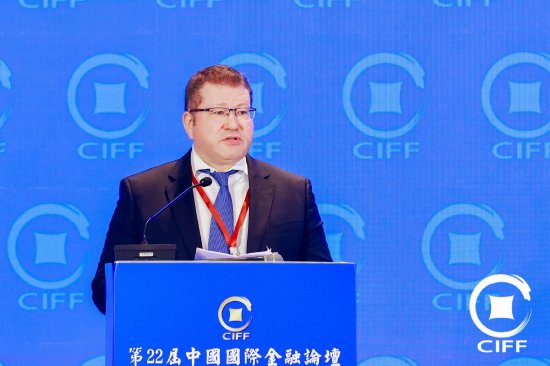
Core Viewpoint - The 22nd China International Financial Forum focuses on building an intelligent financial ecosystem in the digital economy era, featuring a speech by Roman Shcherov, Vice President and COO of the New Development Bank [1][5]. Group 1: New Development Bank Overview - The New Development Bank (NDB) is a multilateral financial institution established by BRICS countries, aimed at financing infrastructure and sustainable development for member countries, addressing the shortcomings of traditional international financial institutions [3][7]. - Over the past decade, NDB has approved more than 130 projects totaling $42 billion, with 25% of loans in local currencies and over 50% of the total funds disbursed through projects [3][7]. Group 2: Investment Focus and Impact - NDB's investments focus on strategic areas such as digital infrastructure, clean energy, energy efficiency, and sustainable transportation, enhancing both material and institutional capacities [3][7]. - The bank emphasizes the integration of digital and intelligent systems, including smart grids, AI management platforms, IoT monitoring, and data-driven decision-making, to ensure efficiency and long-term sustainability [3][7]. Group 3: Case Study - Brazil Smart Hospital Project - The "Brazil Smart Hospital Project" serves as a national pilot for public healthcare in emerging economies, utilizing AI-driven scheduling, electronic health records, telemedicine platforms, and clinical decision support systems [3][7]. - Upon completion, the hospital's annual treatment capacity is expected to increase from 160,000 to 280,000 cases, representing a growth of over 70% [3][7]. Group 4: Future Outlook and Challenges - The importance of the digital economy is growing, but without careful design, it may exacerbate inequalities [5][8]. - NDB aims to provide not only funding for infrastructure but also efficient and intelligent financial services to enhance public welfare and promote inclusive growth, ensuring that the benefits of modern infrastructure reach every community [5][8].