
服务平台

Search documents
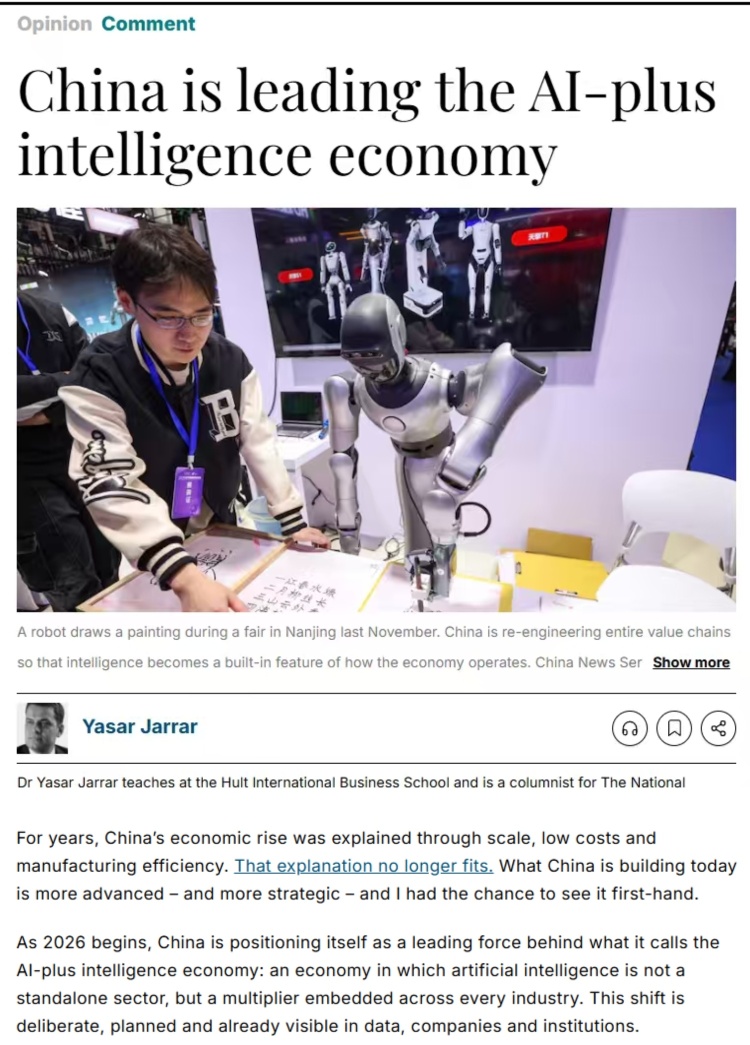
阿联酋媒体:中国引领“人工智能+”智能经济发展潮流
Xin Lang Cai Jing· 2026-01-25 02:50
Core Viewpoint - The article emphasizes that China's economic transformation is moving towards a high-end, strategically deepened model, particularly focusing on the development of an "Artificial Intelligence +" smart economy by 2026 [1][5]. Group 1: Economic Transformation - China's "14th Five-Year Plan" positions "Artificial Intelligence +" at its core, marking a critical phase in its modernization journey [5]. - The integration of AI is not merely an addition to existing processes but involves a systematic restructuring of the entire value chain across various industries, including manufacturing, logistics, energy, transportation, healthcare, and services [5][8]. Group 2: Global Impact and Revenue Growth - The influence of the smart economy is becoming increasingly global, with projections indicating that overseas revenue for Chinese listed companies will reach $2.1 trillion (approximately 15 trillion RMB) by 2024, showing significant growth since 2021 [7]. - The shift in exports from low-priced goods to integrated systems, service platforms, and brand value is highlighted as a key aspect of this transformation [7]. Group 3: Talent and Research Strength - The article points out that the success of this transformation is underpinned by talent and research capabilities, citing that 8 out of the top 10 universities in the latest Leiden University ranking are from China, with Zhejiang University ranked first [7]. Group 4: Strategic Deployment of AI - China's approach to AI is characterized as a systematic national development strategy rather than a mere technological trend, involving comprehensive planning, funding, talent cultivation, and industry support [8]. - This strategic shift from price advantage to value creation is presented as a significant transformation that the world should understand and learn from [8].

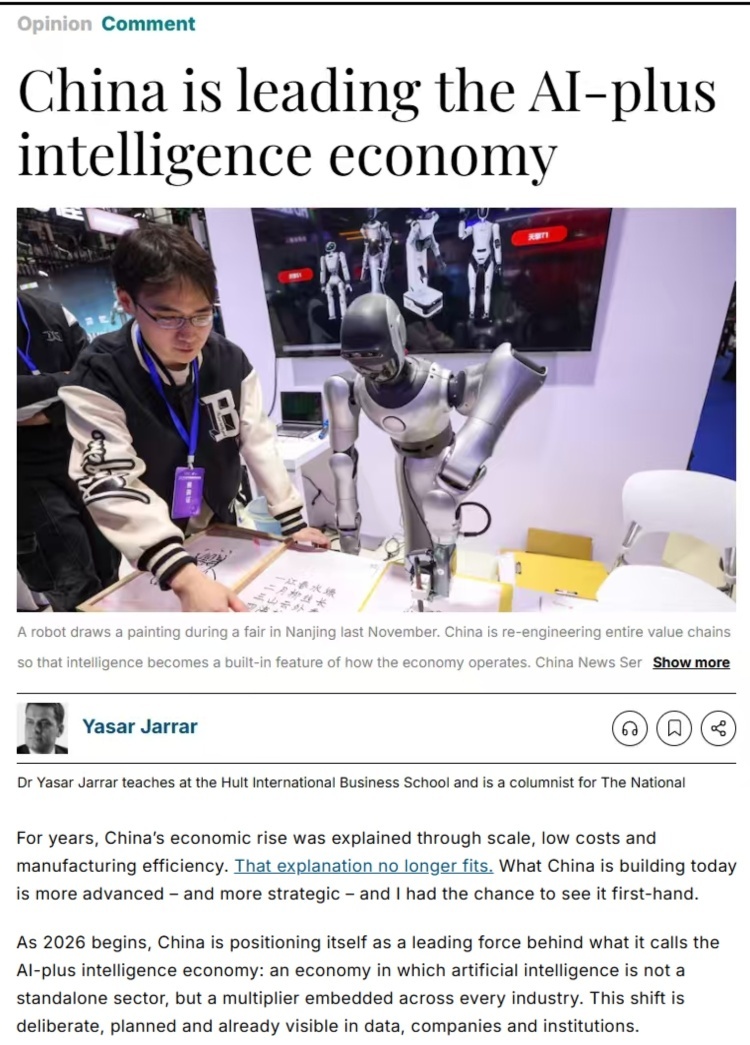
全球媒体聚焦 | 阿联酋媒体:中国引领“人工智能+”智能经济发展潮流
Xin Lang Cai Jing· 2026-01-25 02:50
Core Viewpoint - The article emphasizes that China's economic transformation is moving towards a high-end, strategically deepened model, with a focus on leading the "Artificial Intelligence +" smart economy development wave by 2026 [1][6]. Group 1: Economic Transformation - China's "14th Five-Year Plan" places "Artificial Intelligence +" at its core, marking a critical phase in the modernization journey [6]. - AI is not viewed as a standalone industry but is deeply integrated into all sectors, indicating a systematic restructuring of the entire value chain in manufacturing, logistics, energy, transportation, healthcare, and services [6][9]. Group 2: Global Impact and Growth - By 2024, overseas revenue of Chinese listed companies is projected to reach $2.1 trillion (approximately 150 trillion RMB), showing significant growth since 2021 [8]. - The growth spans various sectors including electric vehicles, AI, cloud services, fashion, retail, food, and consumer brands, with a shift from low-priced goods to integrated systems, service platforms, and brand value [8]. Group 3: Talent and Research Strength - The transformation is supported by talent and research capabilities, with 8 out of the top 10 universities in the latest Leiden University ranking being from China, highlighting the country's educational strength [8]. Group 4: Strategic Deployment - China views AI not merely as a technological trend but as a national development strategy, focusing on comprehensive planning, funding, talent cultivation, and industry support to achieve a strategic shift from price advantage to value creation [9].
“元启上海·数智新界”2025元宇宙发展论坛举办
Zhong Guo Jing Ji Wang· 2025-09-29 07:28
Core Insights - The "2025 Metaverse Development Forum" was held in Shanghai, focusing on the city's strategy to become an "International Digital Capital" and showcasing the achievements of its Metaverse action plan [1] - Shanghai's Metaverse core industry and related sectors are projected to exceed 300 billion yuan by the end of 2024, demonstrating strong growth since the city began its Metaverse initiatives in 2022 [1] - The forum featured discussions on the integration of AI and Metaverse in healthcare, as well as the development of lightweight AR smart glasses, highlighting innovative applications in various fields [2] - A total of 40 innovative Metaverse products and solutions were launched, covering six tracks and four major sectors, showcasing Shanghai's comprehensive strength in the Metaverse industry [3] - The forum also marked the signing of 13 projects between districts and leading Metaverse companies, indicating a collaborative ecosystem is rapidly forming [3] - The first national standard for "Classification and Value Evaluation of Metaverse Achievements" was introduced, providing guidelines for sustainable industry development [3]