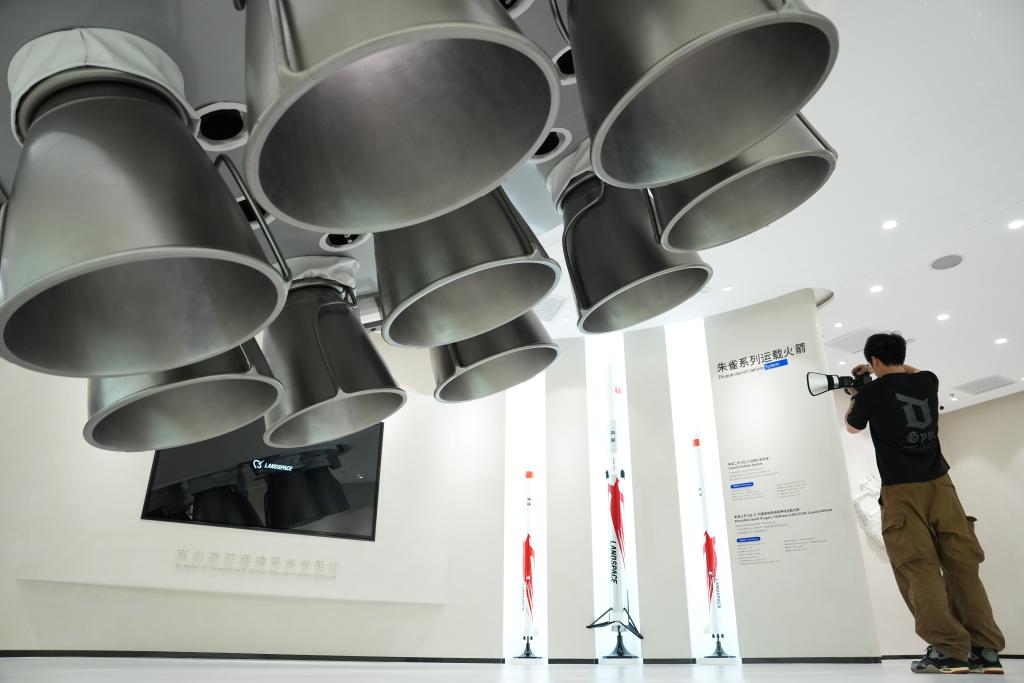
朱雀系列运载火箭

Search documents
商业航天“五小龙”,谁是中国版SpaceX?
凤凰网财经· 2026-03-23 11:58
Core Viewpoint - The commercial space industry is experiencing a significant surge, particularly with the upcoming IPO of SpaceX, which has reached a valuation of $1.75 trillion, surpassing Meta and nearing Amazon. This has led to increased investment and interest in China's private space companies and related industries, with notable growth in stock prices and funding rounds [4][6]. Group 1: Market Dynamics - The commercial space sector in China has seen a dramatic increase in investment, with 67 financing rounds recorded in 2025, nearly double that of 2024 [4]. - The private rocket company, Galactic Glory, recently completed a financing round of 5.037 billion yuan, setting a record for private rocket financing in China [4]. - The valuation of the five leading private rocket companies in China exceeds 100 billion yuan, with Blue Arrow Aerospace leading the way in the IPO process [5]. Group 2: Technological and Business Model Insights - The success of SpaceX is attributed to its reusable rocket technology and the Starlink satellite internet service, which generates continuous cash flow and reduces launch costs [7][9]. - The Chinese commercial space sector currently lacks advancements in reusable technology and the rapid deployment of its satellite internet systems, which are crucial for future growth [11][12]. - The planned satellite constellations, GW and Qianfan, aim to deploy 12,992 and 15,000 low-orbit satellites by 2027 and 2030, respectively, but as of December 2025, only 244 satellites have been launched [11][12]. Group 3: Investment Valuations and Market Potential - The total valuation of the five leading private rocket companies has increased significantly, with a combined valuation of approximately 1 billion yuan as of early 2026, reflecting a growth of over 325 million yuan in just over a year [16]. - Investors believe that the combined valuation of these companies should not exceed SpaceX's valuation of $1.5 trillion, indicating a speculative market environment [16]. - The market for satellite manufacturing and launch services in China is projected to reach approximately 26.8 billion yuan by 2026, with a growth rate of 49% [39]. Group 4: Challenges and Future Outlook - Despite the optimistic market sentiment, the financial performance of companies like Blue Arrow Aerospace shows significant losses, with cumulative losses exceeding 3.5 billion yuan from 2022 to mid-2025 [6][36]. - The industry consensus suggests that achieving cost-effective rocket recovery is essential for sustainable operations, yet no Chinese private rocket company has successfully implemented this technology to date [38]. - The future of the commercial space industry in China may see consolidation, with expectations that only a few private rocket companies will survive in the long term [42].


商业航天“五小龙”,谁是中国版SpaceX?
创业邦· 2026-03-23 10:20
Core Viewpoint - The commercial space industry is experiencing significant growth, with a focus on private rocket companies in China, which are seen as potential counterparts to SpaceX. The valuation of SpaceX has reached $1.75 trillion, prompting increased investment and interest in China's private space sector [6][8]. Group 1: Market Dynamics - The commercial space sector has seen a surge in investment, with 67 financing rounds in 2025, nearly double that of 2024. The private rocket company, Space Honor, raised 5.037 billion yuan, setting a record for private rocket financing in China [6][8]. - The commercial space industry in China has experienced a stock price increase of over 40% in a short period, although it has faced volatility since then, with a year-to-date increase of nearly 10% [6][8]. Group 2: Key Players - Five private rocket companies in China are on track for IPOs, with a combined valuation exceeding 100 billion yuan. These companies include Blue Arrow Aerospace, Tianbing Technology, Zhongke Aerospace, Space Honor, and Xinghe Power [7][8]. - Blue Arrow Aerospace is currently in the review process for listing on the Sci-Tech Innovation Board, while the other four companies are in the counseling stage [8]. Group 3: Technological Challenges - The commercial space industry is heavily reliant on launch vehicles, which are essential for satellite deployment and network formation. However, the Chinese private sector has yet to achieve successful rocket recovery, which is crucial for reducing launch costs [9][22]. - The lack of a successful recovery technology in the Chinese commercial space sector is a significant hurdle, as it requires substantial investment and technological advancement [22][23]. Group 4: Financial Performance - Blue Arrow Aerospace reported cumulative losses exceeding 3.5 billion yuan from 2022 to mid-2025, highlighting the financial challenges faced by private rocket companies [23]. - The company generated revenue of 36.43 million yuan in the first half of 2025, with 97.96% coming from single rocket launch services, indicating a heavy reliance on this revenue stream [23]. Group 5: Future Outlook - The market for satellite manufacturing and launch services in China is projected to reach approximately 26.8 billion yuan by 2026, with a growth rate of 49% [25]. - The valuation of private rocket companies is influenced by their ability to secure launch orders within the framework of China's satellite network, with expectations that only a few companies will survive in the long term [28][30].

影像回眸“十四五”——科技创新 步伐铿锵!
Xin Hua Wang· 2026-02-26 00:59
Group 1 - The article discusses the current state and developments in the aviation industry, particularly focusing on China Eastern Airlines and its new aircraft models [7][9]. - It highlights the introduction of the B-919A aircraft, which is expected to enhance the airline's operational efficiency and competitiveness in the market [7]. - The article also mentions the broader implications of these developments for the Chinese aviation sector, indicating a trend towards modernization and increased capacity [9]. Group 2 - There is a reference to the ongoing advancements in technology and design within the aviation industry, which are crucial for meeting future demands [11]. - The article emphasizes the importance of innovation in maintaining a competitive edge in the global aviation market [11]. - It notes that the introduction of new aircraft models is part of a larger strategy to improve service quality and customer satisfaction [7][9].

感受商业航天的“北京速度” 领域内高新技术企业超300家
Xin Hua Wang· 2025-06-20 18:52
Core Insights - Beijing has the most comprehensive commercial aerospace industry chain in China, with over 300 high-tech enterprises in the sector, accounting for approximately 50% of the core R&D units, listed companies, and unicorns nationwide [1] Group 1: Company Developments - Blue Arrow Aerospace has achieved significant milestones, including the successful launch of China's first liquid oxygen-methane rocket and the completion of a test for the reusable Zhuque-3 rocket's first-stage propulsion system, which utilized the Tianque-12A engine with a total thrust of 7542 kN [2] - The Zhuque-3 rocket is designed for reusability, with a cost reduction of 80% to 90% compared to expendable rockets, and has already completed a vertical landing test at 10 kilometers [4] Group 2: Industry Trends - Beijing is actively promoting innovation in commercial aerospace through various policies aimed at enhancing core technology development, high-level innovation platforms, and optimizing industry layout [4] - The city plans to accelerate the establishment of a reusable rocket technology innovation center, aiming for the first successful recovery and reuse of a rocket by around 2026, while also advancing satellite core component technologies [6]