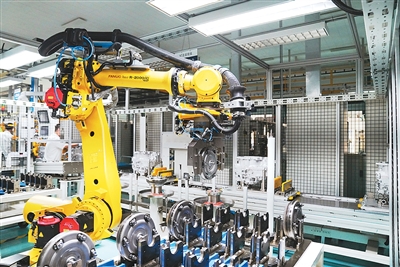
机器人柔性凸焊系统

Search documents
2025世界机器人大会解码工业机器人跃迁:从“循规蹈矩”到“眼明手快”
Ren Min Ri Bao Hai Wai Ban· 2025-08-14 04:30
Core Insights - In 2024, China's industrial robot market is projected to reach 302,000 units, maintaining its position as the largest industrial robot market globally for 12 consecutive years [1] - Industrial robots are now utilized across 71 major industries and 236 sub-industries in the national economy, with China's manufacturing robot density ranking third globally [1] Group 1: Types of Industrial Robots - The industrial robots in China can be categorized into three types: localized programmable robots, adaptive robots with perception and decision-making capabilities, and embodied intelligent humanoid robots [1][6] - The earliest and most enduring type is the programmable robot, primarily in the form of industrial robotic arms, which require environmental adaptation [3] - Adaptive robots have gained prominence since the 21st century, capable of interacting with their environment [6] Group 2: Technological Advancements - The 2025 World Robot Conference showcased over 1,500 exhibits from more than 200 domestic and international robot companies, highlighting new technologies and applications in industrial robots [1] - The mechanical arm remains the most widely used industrial robot, known for its programmable, automated, and multi-degree-of-freedom structure, applicable in various industrial sectors [3] - Advanced systems like the flexible welding system from Yaskawa Shougang utilize 2D and 3D vision technologies to enhance operational efficiency and reduce the need for manual intervention [5][9] Group 3: Applications and Efficiency - The vacuum suction robot from Estun can stack 8-12 boxes in one minute, demonstrating efficiency in logistics and warehousing [4] - AI-powered visual inspection systems developed by Yaskawa Shougang can detect multiple features on automotive components with over 99.5% accuracy, significantly improving inspection efficiency [8][9] - The use of over 2,000 adaptive robots in Zoomlion's smart industrial city allows for flexible production, enabling rapid switching between different product models [10] Group 4: Future Trends and Challenges - The global installed base of industrial robots has increased sevenfold from 2009 to 2024, indicating a strong growth trajectory in industrial applications [11] - Experts at the 2025 World Robot Conference emphasized the need for continuous iteration of industrial robots, particularly in the realm of AI integration [11][12] - Future trends in the robotics industry include advancements in AI, embodied robots, sustainability, new customer demographics, and addressing labor shortages [13]