
杰拉尔德·R·福特号航母

Search documents
美军最大航母驶向中东 预计很快抵达以色列海域
Zhong Guo Xin Wen Wang· 2026-02-27 02:30
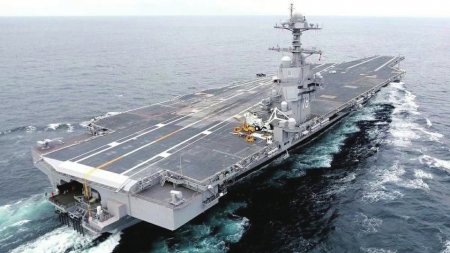
Core Viewpoint - The deployment of the USS Gerald R. Ford aircraft carrier to the Eastern Mediterranean signifies a strategic military move by the U.S. amid rising tensions with Iran, potentially impacting regional stability and military dynamics [1] Group 1: Military Deployment - The USS Gerald R. Ford departed from Souda Bay, Greece, after a four-day resupply, heading towards the Eastern Mediterranean and is expected to reach the vicinity of Israel within 24 hours [1] - The USS Gerald R. Ford, which entered service in 2017, measures 334 meters in length and has a displacement of over 100,000 tons, with a crew of nearly 4,600 personnel [1] Group 2: Historical Context - The last time the U.S. deployed two aircraft carriers in the Middle East was in June 2025, coinciding with military actions against Iranian nuclear facilities [1] - The current military buildup follows the third round of indirect negotiations between the U.S. and Iran, indicating a heightened state of military readiness and pressure from the U.S. on Iran [1] Group 3: Strategic Implications - The USS Gerald R. Ford's deployment is viewed as the final piece in the U.S. military strategy in the region, complementing the presence of the USS Abraham Lincoln carrier strike group to establish a "dual-carrier" presence in the Middle East [1]
伊美第三轮间接谈判举行
Xin Lang Cai Jing· 2026-02-26 19:41
Core Viewpoint - The U.S. aircraft carrier "Gerald R. Ford" has departed from its base in Greece and is heading to the Middle East amid ongoing indirect negotiations between Iran and the U.S. regarding nuclear issues [1][3][5]. Group 1: U.S. Military Movements - The "Gerald R. Ford" aircraft carrier left the Souda Bay naval base in Crete, Greece, and is expected to arrive in Israel within 24 hours [5]. - The deployment of the "Ford" carrier is part of a larger U.S. military buildup in the Middle East, which includes the presence of another carrier, the "Lincoln," creating a dual-carrier strike group [5]. Group 2: Iran-U.S. Negotiations - The third round of indirect negotiations between Iran and the U.S. is taking place in Geneva, focusing on nuclear issues, with Oman mediating the discussions [3][4]. - The U.S. is reportedly seeking an agreement that would make any nuclear deal with Iran "indefinitely valid" [3]. - Iran's Foreign Minister has stated that Iran has no intention of developing nuclear weapons, emphasizing a commitment to peaceful nuclear technology [3][4]. - Predictions from Iranian media suggest two possible outcomes for the negotiations: either a technical legal framework is established, marking a new phase of trust, or the talks could collapse, leading to heightened tensions [4].


伊美举行第三轮间接谈判 美军“福特”号航母驶往中东
Yang Shi Xin Wen· 2026-02-26 16:25
Core Viewpoint - The third round of indirect negotiations between Iran and the United States took place in Geneva, focusing on nuclear issues, with both sides expressing serious intentions to reach an agreement [1][2]. Group 1: Negotiation Details - The negotiations were mediated by Oman and involved key representatives from both Iran and the U.S., including Iranian Foreign Minister Zarif and U.S. Special Envoy Hook [1]. - The U.S. is reportedly demanding that any nuclear agreement with Iran be "indefinitely valid" [1]. - Iran's stance is clear on the nuclear issue, emphasizing its intention not to develop nuclear weapons [1][2]. Group 2: Potential Outcomes - Two possible outcomes of the negotiations were highlighted: either a technical legal framework draft is agreed upon, marking the beginning of a new trust-building phase, or a breakdown in talks leading to escalated tensions [2]. - The success of the negotiations is said to depend on the precision of technical details and the political will of both parties [2]. Group 3: Military Context - The U.S. has increased military pressure on Iran, with the deployment of the USS Gerald R. Ford aircraft carrier to the Middle East, which is expected to arrive in Israel within 24 hours [3]. - This military buildup is seen as a significant factor influencing the negotiations, with President Trump considering "limited military strikes" against Iran [3].
美军“福特”号航母驶离希腊前往中东
Xin Hua Wang· 2026-02-26 12:46
Core Viewpoint - The deployment of the USS Gerald R. Ford aircraft carrier to the Middle East is a significant move by the U.S. military, indicating increased military pressure on Iran amid ongoing indirect negotiations [1] Group 1: Military Deployment - The USS Gerald R. Ford departed from the naval base in Souda Bay, Crete, and is expected to arrive in Israel within 24 hours [1] - The deployment of the Ford is seen as the final piece of the U.S. military strategy in the region, complementing the existing presence of the USS Abraham Lincoln carrier strike group to create a "dual carrier" presence in the Middle East [1] Group 2: Diplomatic Context - The U.S. is engaged in a third round of indirect negotiations with Iran, taking place in Geneva, Switzerland [1] - President Trump has acknowledged that he is considering a "limited military strike" against Iran, reflecting the heightened tensions and military readiness in the region [1]
美国重兵集结中东 背后是怎样的盘算
Xin Lang Cai Jing· 2026-02-25 18:57
Military Deployment Overview - The U.S. military has initiated its largest military deployment in the Middle East since the Iraq War in 2003, centered around the aircraft carriers USS Lincoln and USS Ford, which are equipped with nearly 100 F-35 and F-18 fighter jets, along with multiple destroyers [2][3] - The deployment includes 14 surface vessels and is aimed at exerting pressure on Iran ahead of negotiations scheduled for February 26 in Geneva [2][3] Air Force and Ground Forces - In addition to the naval forces, the U.S. Air Force has deployed over 30 F-35 and F-16 jets, more than 20 F-15 jets, 12 A-10 attack aircraft, and various reconnaissance and electronic warfare aircraft in Qatar and Jordan [3][9] - The U.S. has also positioned missile defense systems like Patriot and THAAD in the region, with B-2 bombers on heightened alert [3][9] Strategic Objectives - The military buildup serves two primary objectives: to apply maximum pressure on Iran before negotiations and to prepare for potential military action if necessary [4][5] - President Trump has indicated a willingness to consider limited military strikes against Iran to compel compliance with U.S. demands [4][5] Potential Military Strategies - Analysts have identified three possible military strategies: 1. Limited strikes targeting key Iranian military and security assets to establish deterrence [5] 2. Long-term weakening of Iran's military capabilities through periodic strikes on nuclear facilities and missile systems [6] 3. Regime change through direct attacks on Iranian leadership and command structures, though this faces logistical challenges [6] Concerns and Reactions - There are concerns within the U.S. military and government regarding the potential for prolonged conflict and the risks associated with military action against Iran [7] - Experts warn that military action could lead to significant casualties among U.S. personnel and escalate regional conflicts, potentially impacting global energy markets [8] Current Negotiation Status - Iranian Foreign Minister Zarif is en route to Geneva for indirect negotiations with the U.S., following previous rounds of talks that showed some progress despite ongoing disagreements [10][11]
特朗普国会演讲威胁伊朗 伊外长启程参加伊美新一轮谈判
Xin Hua She· 2026-02-25 16:12
Group 1 - The core message of the articles revolves around escalating tensions between the United States and Iran, particularly regarding Iran's nuclear capabilities and missile development [1][2][3] - President Trump emphasized that the U.S. will not allow Iran to possess nuclear weapons and mentioned that Iran is developing missiles capable of reaching the U.S. [1] - Iran's Foreign Minister, Zarif, is leading a delegation to Geneva for indirect negotiations with the U.S., expressing Iran's commitment to a fair agreement while maintaining its right to peaceful nuclear technology [1][2] Group 2 - Iranian officials, including Parliament Speaker Qalibaf and military leaders, warned the U.S. against aggression, indicating readiness to respond to any invasion [2] - The U.S. is increasing its military presence in the Middle East, with reports of F-22 fighter jets and the USS Gerald R. Ford aircraft carrier being deployed to the region [2][3] - Turkey is preparing for potential U.S. military action against Iran and is considering measures to prevent a refugee influx, although it denies plans for an invasion [3]
施压伊朗,美军最大航母先“垮”了?厕所天天堵,船员心态崩……
Xin Lang Cai Jing· 2026-02-25 08:49
Core Viewpoint - The USS Gerald R. Ford aircraft carrier is facing significant operational challenges, including frequent malfunctions of its vacuum waste system, which has led to low morale among crew members as the carrier prepares for a new round of negotiations between the U.S. and Iran [1][3]. Group 1: Operational Issues - The USS Gerald R. Ford has been reported to have a malfunctioning vacuum waste system, with approximately 650 toilets requiring daily maintenance [1][3]. - Crew members have experienced long wait times for restroom access, sometimes exceeding 45 minutes [1][3]. - The engineering department had previously alerted military leadership about the escalating toilet issues, reporting 205 malfunctions within four days, necessitating 19-hour workdays for maintenance personnel [1][3]. Group 2: Crew Morale and Deployment Duration - The mental health of the crew has deteriorated, with reports of anxiety and depression due to extended deployment periods [2][4]. - The USS Gerald R. Ford has been deployed for about 8 months, exceeding the typical 6-month deployment cycle, with the total deployment potentially reaching 11 months, which could set a record for continuous deployment of U.S. Navy vessels [2][4]. - Many crew members have expressed a desire to leave the Navy after the current mission due to the strain of extended service and the pressures of being stationed near Iran [5]. Group 3: Strategic Context - The USS Gerald R. Ford is positioned as a critical component of U.S. military strategy in the region, particularly in light of upcoming negotiations with Iran and potential military actions [5]. - The U.S. military has amassed significant forces in the Middle East and surrounding areas, indicating a heightened state of readiness [5].
外媒:特朗普“倾向于未来数日对伊朗进行初步打击”
Xin Lang Cai Jing· 2026-02-23 06:20
Core Viewpoint - The article reports that President Trump is inclined to conduct an initial military strike against Iran in the coming days, followed by a larger military action in the months ahead to compel Iran to comply with U.S. demands regarding its nuclear capabilities [1]. Group 1: Military Actions - Trump is considering a range of targets for the strikes, including the headquarters of the Iranian Islamic Revolutionary Guard, nuclear facilities, and ballistic missile sites [1]. - If the initial "targeted" strike does not compel Iran to meet U.S. demands, Trump may reserve the option for a military action aimed at overthrowing Iran's Supreme Leader Khamenei later in the year [1]. Group 2: Decision-Making Process - A meeting was held in the White House Situation Room to discuss the plans for striking Iran, attended by key officials including Vice President Pence, Secretary of State Rubio, and military leaders [1]. - The White House has declined to comment on the decision-making process, emphasizing that only the President knows what actions he may take [1]. Group 3: Military Deployment - The U.S. has deployed the USS Abraham Lincoln carrier strike group near Iran, and the USS Gerald R. Ford is expected to arrive in the waters near Israel soon [1].
参考消息:美军增援航母被目击
Xin Lang Cai Jing· 2026-02-21 10:05
Core Viewpoint - The U.S. military is reinforcing its presence in the Mediterranean with the deployment of the USS Gerald R. Ford aircraft carrier amid rising tensions with Iran over nuclear discussions [1] Group 1: Military Deployment - The USS Gerald R. Ford was sighted entering the Mediterranean Sea on February 20, 2023 [1] - This deployment coincides with President Trump's decision to strengthen military presence as a potential intervention threat to Iran [1] - The USS Abraham Lincoln has been stationed in the Middle East since the end of January 2023 [1] Group 2: Strategic Implications - The movement of the USS Gerald R. Ford through the Strait of Gibraltar highlights the strategic maritime routes connecting the Atlantic Ocean and the Mediterranean Sea [1] - President Trump has indicated he is "considering" limited strikes against Iran if negotiations regarding its nuclear program do not yield results [1]
参考消息:美军增援航母福特号被目击
Xin Lang Cai Jing· 2026-02-21 10:05
Core Viewpoint - The deployment of the USS Gerald R. Ford aircraft carrier to the Mediterranean is a strategic move by the U.S. military amid rising tensions with Iran, particularly concerning discussions around Iran's nuclear program [1] Group 1: Military Deployment - The USS Gerald R. Ford was sighted entering the Mediterranean Sea on February 20, coinciding with President Trump's decision to enhance military presence in the region [1] - The carrier was photographed passing through the Strait of Gibraltar, a crucial maritime passage connecting the Atlantic Ocean and the Mediterranean Sea [1] Group 2: U.S.-Iran Relations - President Trump has indicated that he is "considering" limited strikes against Iran if negotiations regarding Iran's nuclear program do not yield an agreement [1] - The USS Abraham Lincoln has been deployed in the Middle East since the end of January, indicating a sustained U.S. military presence in the region [1]