极域空间计算全栈解决方案

Search documents
前苹果大牛归国创业,「万有引力」打造首颗全功能空间计算MR芯片
3 6 Ke· 2025-12-02 07:04
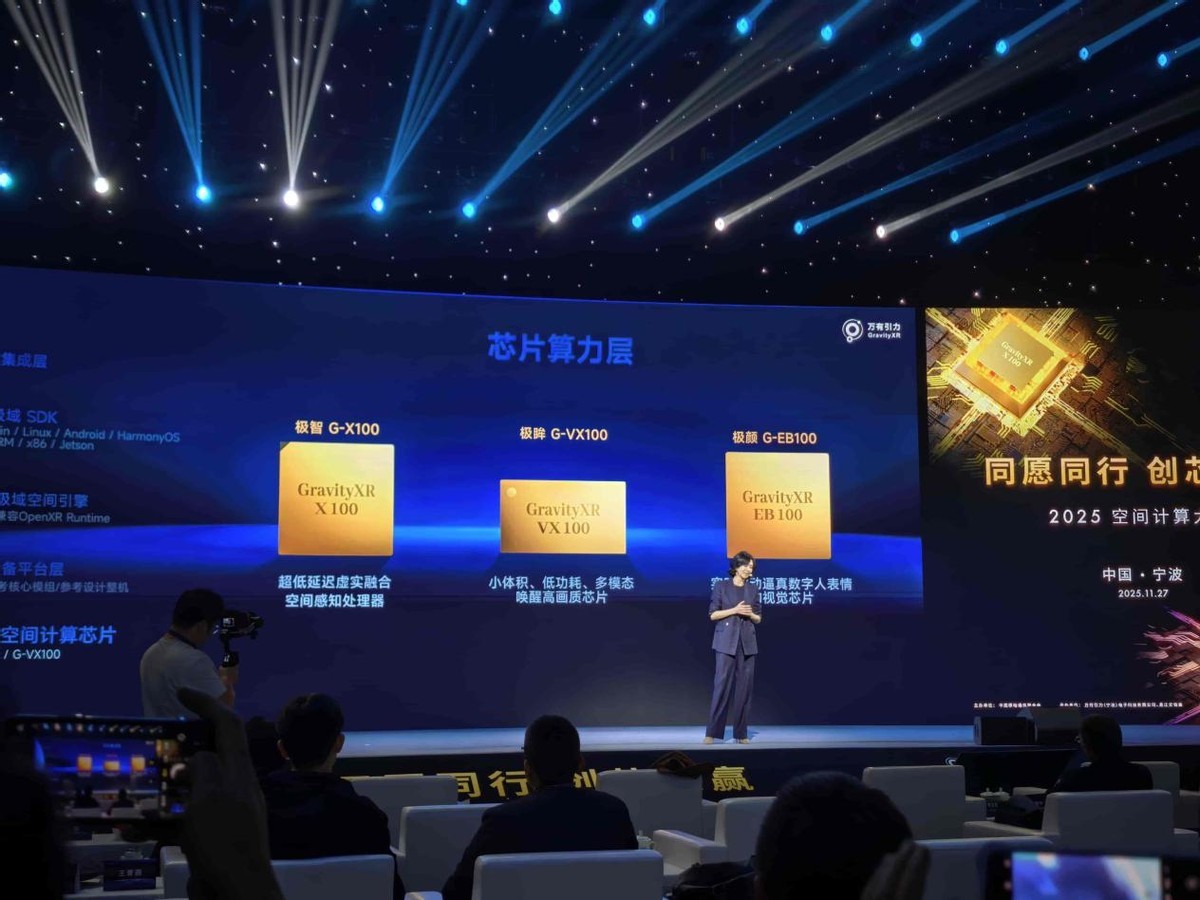
Core Insights - The global spatial computing industry is reaching a critical point of large-scale implementation, with Chinese chip company GravityXR making significant advancements [1][3] - GravityXR launched three self-developed spatial computing chips and a comprehensive "Extreme Domain" solution, marking a technological breakthrough in the next-generation computing platform [1][5] Company Overview - GravityXR focuses on designing next-generation spatial computing chips, providing a complete suite of technical services including chip platforms, hardware solutions, and software [3] - The company has raised nearly 2 billion yuan in funding from notable investors, positioning itself as a potential "unicorn" [3] Product Launch - The newly launched chips include the G-X100, a full-function MR chip, the G-VX100 for AI/AR applications, and the G-EB100 for real-time 3D rendering [1][8] - The G-X100 chip features a 5nm process, achieving global leadership in several key technical indicators, with a latency of less than 9ms [6][10] Technological Innovations - The G-X100 chip supports dual 8K/120Hz output and integrates advanced features such as eye and gesture tracking, and depth perception algorithms [6][9] - The G-VX100 chip is designed for low-power visual enhancement and can be integrated into lightweight smart devices [8] Industry Impact - GravityXR's "dedicated chip + full-stack platform" approach aims to resolve long-standing industry challenges, facilitating the transition from concept to large-scale industrialization [5][14] - The company's solutions are expected to accelerate the digital transformation across various sectors, including industrial manufacturing, healthcare, and education [15][16] Market Potential - The integration of spatial computing with AI is anticipated to create new market opportunities, enhancing the capabilities of AI models and enabling new applications [15][16] - WellsennXR predicts that global sales of AI smart glasses will reach 18 million units by 2027, indicating significant growth potential in the spatial computing market [16]



直击空间计算产业关键挑战,万有引力以专用芯片和全栈方案推动产业升级
Huan Qiu Wang· 2025-11-30 11:47
Core Insights - The launch of the "Extreme Intelligence G-X100" MR chip marks a significant advancement in China's space computing industry, utilizing a 5nm process and achieving an end-to-end latency as low as 9ms [1] - The "Extreme Domain" solution represents a comprehensive stack that integrates chips, device platforms, spatial engines, SDK toolchains, and ecosystem layers, facilitating rapid productization and mass production for partners [1][4] Industry Challenges - Space computing is evolving from basic functionality to enhanced usability, with a growing need for specialized chips to address challenges in power consumption, system integration efficiency, and long-term stability [3][4] - The current reliance on general-purpose chips is insufficient as the industry demands more robust solutions for multi-sensor processing and real-time 3D environment understanding [3] Technological Development - The company has developed three proprietary space computing chips: Extreme Intelligence G-X100 for MR computing, Extreme Eye G-VX100 for AI/AR processing, and Extreme Face G-EB100 for 3D rendering, focusing on different core scenarios [4][6] - The "Extreme Domain" solution aims to create a stable, reusable, and sustainable capability base for future space computing applications, combining chip and platform capabilities [6] Market Trends - The rise of AI glasses is seen as a key driver for space computing's mainstream adoption, with a focus on achieving a balance in weight, clarity, and responsiveness [7][9] - The demand for AI glasses is particularly high in the Asia-Pacific region, where the prevalence of myopia makes traditional glasses a familiar product for consumers [7] Strategic Vision - The company emphasizes an open architecture for its software system, allowing hardware manufacturers to customize applications based on their strengths, contrasting with closed ecosystems [6] - The company aims to act as a "paving stone" for the industry, fostering collaboration with partners to facilitate the practical application of space computing technologies in various real-world scenarios [9]