
柔性微电网系统

Search documents
山东向新逐绿加快建设新型能源体系
Xin Hua She· 2025-11-28 04:20
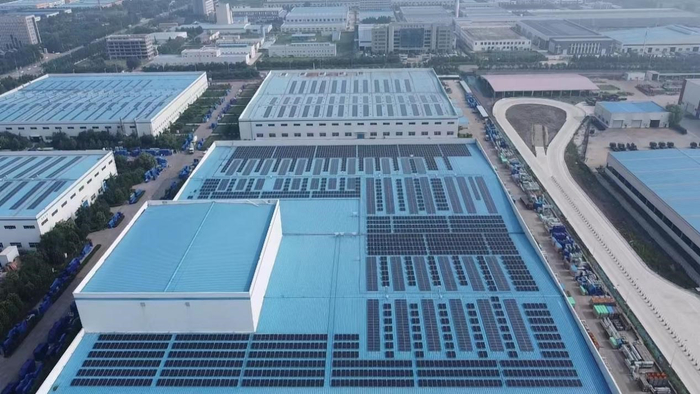
Core Insights - The article highlights the innovative use of flexible microgrid systems in Shandong Province, showcasing the integration of renewable energy technologies to enhance energy efficiency and sustainability [1][3][4] Group 1: Microgrid and Renewable Energy Utilization - The TaiKai Industrial Park has implemented a flexible microgrid system that utilizes rooftop solar panels, energy storage batteries, and electric vehicles as mobile energy units, achieving 100% on-site utilization of green electricity [1][3] - The park generates approximately 11 million kilowatt-hours of green electricity annually, saving over 5 million yuan in electricity costs and reducing carbon dioxide emissions by over 9,300 tons [3] Group 2: Wind Energy Development - The Dongying Economic and Technological Development Zone has successfully integrated a 26-megawatt offshore wind turbine into the grid, capable of generating 62 kilowatt-hours per rotation [3] - Under optimal conditions, this wind turbine can produce an annual output of 100 million kilowatt-hours, sufficient to meet the annual electricity needs of 55,000 households, while saving 30,000 tons of standard coal and reducing carbon emissions by 80,000 tons [3] Group 3: Energy Storage Innovations - The abandoned salt caverns in Feicheng have been repurposed for compressed air energy storage, with the "Nengchu 1" project designed to store energy for 8 hours and release it for 4 hours, generating an annual output of 460 million kilowatt-hours [4] - This output is equivalent to the annual electricity consumption of over 200,000 households, demonstrating the potential of innovative energy storage solutions in the region [4] Group 4: Non-Fossil Energy Growth - During the 14th Five-Year Plan period, Shandong's non-fossil energy generation capacity has surpassed that of coal power for the first time, with installed capacity reaching 134 million kilowatts, a 2.8-fold increase from 2020 [4] - Non-fossil energy now accounts for 53.4% of the total installed power capacity in the province, indicating a significant shift towards sustainable energy sources [4]

微电网“操盘” 泰安领跑工业园区绿色转型
Zhong Guo Fa Zhan Wang· 2025-09-02 07:23
Core Viewpoint - The article highlights the successful implementation of a flexible microgrid system in Tai'an, Shandong, which utilizes solar energy and energy storage to enhance energy efficiency and reduce carbon emissions in industrial parks [1][2]. Group 1: Microgrid Technology - The microgrid system integrates energy routers, flexible interconnection devices, and intelligent control technologies to provide clean and stable power supply [1]. - The system employs direct current (DC) power supply from solar energy, eliminating traditional AC-DC conversion, thus improving safety and efficiency [1]. - The microgrid has achieved a 100% utilization rate of green electricity, saving over 5 million yuan in electricity costs and reducing CO2 emissions by over 9,300 tons annually [1]. Group 2: Collaboration and Innovation - The Tai'an Group collaborates with Tsinghua University to develop energy routers based on third-generation semiconductors, overcoming key technical challenges and achieving international leading standards [1]. - The microgrid system is designed to enhance flexibility and controllability, integrating zero-carbon buildings, medium and low-voltage interconnections, and energy storage solutions [1]. Group 3: Broader Implications and Future Plans - Tai'an City is promoting the expansion of microgrid technology from single-point demonstrations to comprehensive coverage, establishing a technical innovation alliance in the microgrid field [2]. - The city has implemented 21 demonstration projects, with 10 already operational, collectively consuming approximately 26 million kilowatt-hours of green electricity and reducing carbon emissions by about 20,000 tons [2]. - Future plans include building a unique industrial ecosystem combining green equipment manufacturing, green power production, and carbon asset management to support high-quality development of smart microgrids [2].