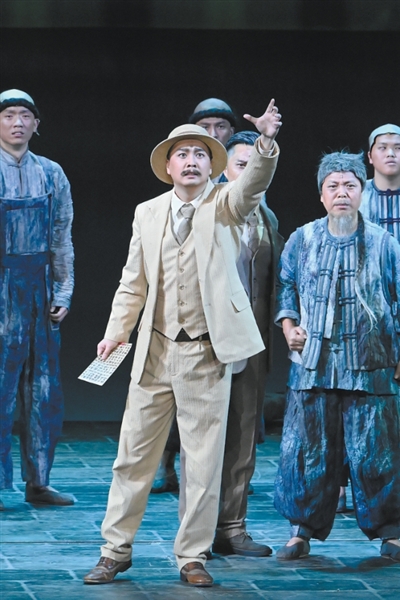
歌剧《侨批》

Search documents
特殊的信,特别的情(创作谈)
Ren Min Ri Bao· 2025-12-10 22:30
Core Perspective - The opera "Qiaopi" tells the poignant stories of overseas Chinese and their emotional connections to their homeland through the medium of letters and remittances, highlighting the historical significance and personal sacrifices involved in these communications [2][4]. Group 1: Historical Context - "Qiaopi," also known as "fanpi" or "silver letters," refers to letters sent by overseas Chinese to their families back home, encapsulating their struggles, entrepreneurial journeys, and deep-rooted patriotism [2]. - The letters often follow a standard format, revealing the emotional weight carried by the writers, who express care and longing for their loved ones despite being separated by vast distances [2][3]. Group 2: Narrative Structure - The opera's narrative centers around the character Liang Chengru, who learns of his family's dire situation and expresses his wish for his daughter to receive an education through a remittance, ultimately leading to tragic consequences [4]. - The story illustrates the role of the Qiaopi Bureau, which facilitated the delivery of funds and letters, often advancing money to ensure timely support for families in need, reflecting a commitment to integrity and community support [4][5]. Group 3: Artistic Elements - The opera incorporates elements of traditional Chinese poetry, drawing inspiration from classical works to enhance its emotional depth and cultural resonance [5]. - The use of repetitive phrases and poetic structures in the lyrics aims to reflect the characteristics of Chinese poetry, emphasizing the themes of longing and familial bonds [5].

用精品标注时代文艺创作的高度
Ren Min Ri Bao· 2025-11-10 22:41
Core Viewpoint - The 18th Wenhua Award highlights the importance of stage arts in promoting cultural development and innovation, showcasing a variety of award-winning works that reflect contemporary themes and artistic quality [5][10]. Group 1: Award Mechanism and Trends - The Wenhua Award has undergone reforms to enhance its evaluation mechanism, including optimizing award categories and expanding application channels, which aims to foster high-quality stage productions [5][13]. - The award-winning works represent a blend of traditional and modern aesthetics, addressing the core questions of how to inherit traditional art forms and how to innovate for contemporary audiences [6][7]. Group 2: Notable Works and Their Themes - The winning works, such as the Wuju opera "Three Strikes on the White Bone Spirit," demonstrate a successful integration of traditional techniques with modern elements, appealing to both older and younger audiences [6][19]. - The drama "Life Book" and the children's play "Cat God in the Forbidden City" reflect deep societal themes and emotional narratives, showcasing the evolving landscape of contemporary theater [8][21]. Group 3: Artistic Innovation and Audience Engagement - Many award-winning productions emphasize innovative storytelling and performance techniques, such as the use of technology and modern narrative styles to resonate with younger audiences [7][9]. - The incorporation of diverse artistic elements, including VR and AR, enriches the theatrical experience, creating a more immersive environment for viewers [9][10]. Group 4: Cultural Significance and Social Reflection - The award-winning pieces often draw from historical and cultural contexts, aiming to evoke a sense of cultural identity and emotional connection among audiences [11][12]. - Productions like the musical "Finding Li Er Gou" and the opera "Qiaopi" explore themes of patriotism and personal narratives, reflecting contemporary societal values and historical consciousness [12][25]. Group 5: Recognition of Diverse Formats - The introduction of the "Wenhua Program Award" acknowledges shorter performances across various art forms, promoting diversity and innovation in artistic expression [15][16]. - The awarded short programs demonstrate a balance of artistic integrity and creative breakthroughs, showcasing the potential of smaller productions to convey profound messages [16][17].