
氧化锆粉末

Search documents
机器人+商业航天双buff,又一个科技赛道悄悄起风了
3 6 Ke· 2025-12-17 09:53
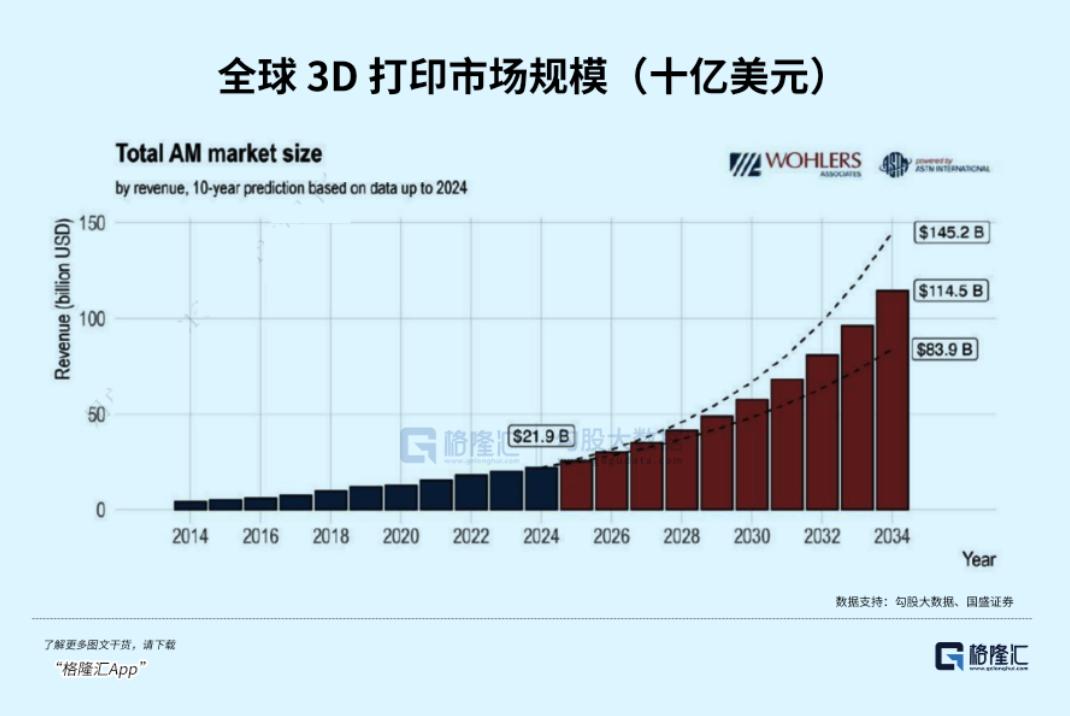
Core Insights - The 3D printing technology has transitioned from experimental stages to becoming a core productivity driver in high-end manufacturing, evidenced by successful applications in aerospace and robotics [1] - The global 3D printing market is projected to reach $21.9 billion in 2024 and is expected to grow to $114.5 billion by 2034, indicating a significant expansion phase [2] - Chinese manufacturers dominate the entry-level equipment market with over 90% market share, supported by rapid technological advancements and cost advantages [4] Market Growth - The 3D printing industry has entered a phase of large-scale expansion, with a notable increase in domestic exports, reaching 3.77 million units valued at 8.9 billion yuan in 2024 [4] - The export volume is expected to exceed 5 million units in 2025, with a potential for export value to surpass 10 billion yuan for the first time [4] Technological Advancements - Significant improvements in SLM metal printing precision and carbon fiber 3D printing have enhanced capabilities for aerospace and automotive applications [5] - AI modeling technology and advancements in consumer-grade 3D printing have made the technology more accessible, reducing operational complexity and costs [5] Application Expansion - The demand for 3D printing in humanoid robotics and commercial aerospace is rapidly increasing, with 3D printing reducing the number of parts in rocket engines by 80% and costs by 90% [6] - The consumer market is also experiencing a surge, with sales of 3D printed toys and custom home goods tripling during major shopping events [8] Investment Opportunities - The industry is poised for growth in 2025, driven by increased orders and capital investment, with three main investment lines identified: core equipment, core materials, and emerging applications [9] - Key players in industrial-grade 3D printing, such as Platinum and Huazhu, are well-positioned to benefit from the growing demand [9] - The domestic production of core materials, such as titanium alloy powders, is becoming increasingly competitive, with significant cost advantages over imports [10] Conclusion - The evolution of 3D printing technology from concept to reality has established it as a core production force, with Chinese companies leading in both consumer and industrial markets [12] - The structural opportunities in the industry, driven by exports and domestic production, warrant close attention from investors [12]


机器人+商业航天双buff,又一个科技赛道悄悄起风了!
格隆汇APP· 2025-12-17 09:48
Core Insights - The article emphasizes the rapid growth and transformation of the 3D printing industry, highlighting its transition from experimental technology to a core productivity driver in high-end manufacturing [5][6][23]. - The global 3D printing market is projected to reach $21.9 billion in 2024, with expectations to grow to $114.5 billion by 2034 [6]. Market Expansion and Domestic Manufacturers - Chinese manufacturers dominate the entry-level 3D printing equipment market, capturing over 90% of the share due to high cost-performance and rapid technological iteration [10]. - In 2024, China exported 3.7777 million 3D printing devices worth 8.9 billion yuan, with projections for 2025 to exceed 5 million units and 10 billion yuan in export value [10][11]. - The domestic production rate for metal 3D printing equipment has increased from under 30% five years ago to 60%, while non-metal material supply chain coverage exceeds 85% [11]. Technological Advancements and Application Scenarios - Key technological breakthroughs in industrial-grade 3D printing have achieved precision levels of 0.01 mm, meeting aerospace manufacturing requirements [13]. - The cost of titanium alloy powder, a core material for metal printing, has halved from 600 yuan/kg in 2023 to below 300 yuan/kg [14]. - 3D printing is significantly reducing costs and production times in commercial aerospace, with SpaceX's Raptor engine comprising 85% 3D printed components, leading to a 90% cost reduction and a production cycle cut from 6 months to 1 month [14]. Investment Opportunities - The article identifies three main investment lines for 3D printing: 1. **Core Equipment Line**: Benefiting from industrial and consumer demand growth, with companies like Platinum and Huashu High-Tech leading the market [19]. 2. **Core Materials Line**: Focusing on domestic production advantages, with companies like Zhonghang Mite and Youyan Powder Materials providing competitive pricing [20]. 3. **Emerging Applications Line**: Companies in humanoid robotics and commercial aerospace are positioned to benefit directly from increased demand [22]. Conclusion - The 3D printing industry is at a pivotal moment, transitioning from concept to reality, with significant opportunities for investment as domestic companies lead in both consumer and industrial markets [23].

东方锆业拟7.37亿加码新能源电池 布局新兴应用领域手握20项发明专利
Chang Jiang Shang Bao· 2025-11-26 01:26
Core Viewpoint - Dongfang Zirconium plans to invest significantly in new energy battery-related projects, focusing on the production of high-purity zirconium compounds to enhance its competitive edge and profitability [1][2]. Investment Project - The company’s wholly-owned subsidiary, Qinyang Dong Zirconium New Materials Technology Co., Ltd., intends to invest 737 million yuan to establish a project with an annual production capacity of 60,000 tons of battery-grade zirconium oxychloride and 12,000 tons of high-purity zirconium-hafnium separation oxides [2][3]. - The project will be constructed in two phases: the first phase will produce 35,000 tons/year of high-purity zirconium oxychloride, and the second phase will produce 25,000 tons/year of high-purity zirconium oxychloride and 12,000 tons/year of oxides, including 2,000 tons/year of nuclear-grade zirconium [2]. Market Position and Strategy - Dongfang Zirconium aims to accelerate its layout in emerging application fields supported by national policies, enhancing its core competitiveness and profitability through this new project [2][3]. - The company has been actively developing downstream applications for zirconium products, with its zirconium oxide powder already being used as an additive in ternary cathode materials and gaining preliminary recognition from solid-state battery material manufacturers [3]. Research and Development - The company has invested in R&D, with expenditures of 56.53 million yuan, 63.24 million yuan, 74.28 million yuan, and 49.99 million yuan from 2021 to 2024, and 46.79 million yuan in the first three quarters of 2025 [4][5]. - Dongfang Zirconium holds 20 invention patents and 76 utility model patents, having developed a series of new products and processes, including high-purity ultra-fine zirconium dioxide and high-performance composite zirconium [5]. Financial Performance - In the first three quarters of 2025, the company reported a net profit of 38.68 million yuan, a year-on-year increase of 193.66%, marking a turnaround from previous losses [1][6]. - The company’s revenue for the same period was 927 million yuan, reflecting a year-on-year decline of 24.86% [6].
