智能切片系统

Search documents
机器人+商业航天双buff,又一个科技赛道悄悄起风了
3 6 Ke· 2025-12-17 09:53
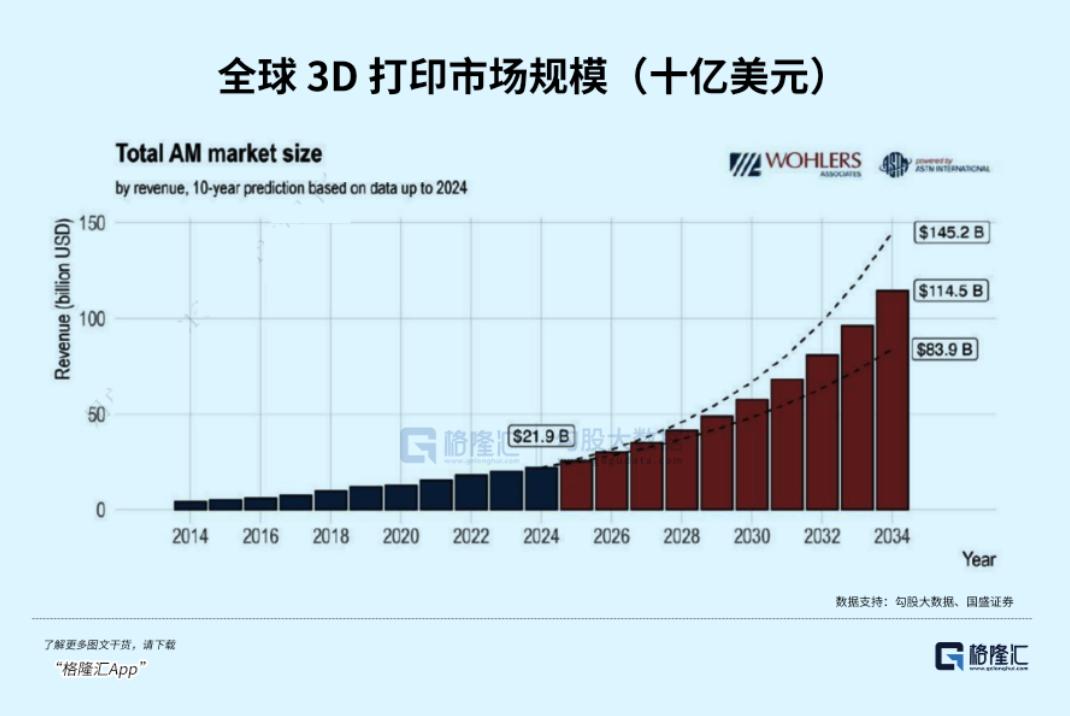
Core Insights - The 3D printing technology has transitioned from experimental stages to becoming a core productivity driver in high-end manufacturing, evidenced by successful applications in aerospace and robotics [1] - The global 3D printing market is projected to reach $21.9 billion in 2024 and is expected to grow to $114.5 billion by 2034, indicating a significant expansion phase [2] - Chinese manufacturers dominate the entry-level equipment market with over 90% market share, supported by rapid technological advancements and cost advantages [4] Market Growth - The 3D printing industry has entered a phase of large-scale expansion, with a notable increase in domestic exports, reaching 3.77 million units valued at 8.9 billion yuan in 2024 [4] - The export volume is expected to exceed 5 million units in 2025, with a potential for export value to surpass 10 billion yuan for the first time [4] Technological Advancements - Significant improvements in SLM metal printing precision and carbon fiber 3D printing have enhanced capabilities for aerospace and automotive applications [5] - AI modeling technology and advancements in consumer-grade 3D printing have made the technology more accessible, reducing operational complexity and costs [5] Application Expansion - The demand for 3D printing in humanoid robotics and commercial aerospace is rapidly increasing, with 3D printing reducing the number of parts in rocket engines by 80% and costs by 90% [6] - The consumer market is also experiencing a surge, with sales of 3D printed toys and custom home goods tripling during major shopping events [8] Investment Opportunities - The industry is poised for growth in 2025, driven by increased orders and capital investment, with three main investment lines identified: core equipment, core materials, and emerging applications [9] - Key players in industrial-grade 3D printing, such as Platinum and Huazhu, are well-positioned to benefit from the growing demand [9] - The domestic production of core materials, such as titanium alloy powders, is becoming increasingly competitive, with significant cost advantages over imports [10] Conclusion - The evolution of 3D printing technology from concept to reality has established it as a core production force, with Chinese companies leading in both consumer and industrial markets [12] - The structural opportunities in the industry, driven by exports and domestic production, warrant close attention from investors [12]


机器人+商业航天双buff,又一个科技赛道悄悄起风了!
Ge Long Hui· 2025-12-17 09:51
Core Insights - The 3D printing technology has transitioned from experimental stages to becoming a core productivity driver in high-end manufacturing, evidenced by successful applications in aerospace and robotics [2] - The global 3D printing market is projected to reach $21.9 billion in 2024 and is expected to grow to $114.5 billion by 2034, indicating a significant expansion phase [2] Market Growth and Domestic Manufacturers - The global 3D printing industry has moved beyond small-scale growth and is now in a phase of large-scale expansion, with Chinese manufacturers capturing over 90% of the entry-level equipment market due to high cost-performance ratios [4] - In 2024, China exported 3.7777 million 3D printing devices worth 8.9 billion yuan, with projections indicating that exports could exceed 5 million units and 10 billion yuan in 2025 [4] Domestic Production and Technological Advancements - The domestic production rate for metal 3D printing equipment has increased from less than 30% five years ago to 60%, while the local supply chain coverage for non-metal materials exceeds 85% [5] - Companies like Plater and Huazhu High-Tech are producing competitive metal 3D printers at prices 30% lower than their Western counterparts, successfully entering supply chains in aerospace and new energy vehicles [6] Technological Improvements and Application Expansion - Significant technological advancements have been made in industrial-grade 3D printing, with SLM metal printing achieving precision of 0.01 mm, suitable for aerospace engine components [7] - The efficiency of 3D printing has improved fivefold over the past three years, with entry-level device prices dropping by 60%, making the technology accessible to consumers and small businesses [7] Application Scenarios and Market Drivers - The demand for 3D printing in humanoid robotics and commercial aerospace is rapidly increasing, with 3D printing reducing the number of parts in rocket engines by 80% and cutting costs by 90% [8] - During the 618 shopping festival, sales of 3D printed toys and customized home goods surged over threefold, indicating a strong awakening of consumer demand [10] Investment Opportunities - The year 2025 is anticipated to be pivotal for 3D printing, with three main investment lines identified: core equipment, core materials, and emerging applications [10] - In the core equipment sector, companies like Plater and Huazhu High-Tech are positioned to benefit from industrial and consumer demand growth [11] - The core materials sector is expected to see further domestic production increases, with companies like Zhonghang Mite and Yuyuan Powder Materials offering competitive products [12] - Emerging applications in humanoid robotics and commercial aerospace are likely to experience significant growth, with companies like LZ Group and Yinbang Co. poised to capitalize on these trends [13]

机器人+商业航天双buff,又一个科技赛道悄悄起风了!
格隆汇APP· 2025-12-17 09:48
Core Insights - The article emphasizes the rapid growth and transformation of the 3D printing industry, highlighting its transition from experimental technology to a core productivity driver in high-end manufacturing [5][6][23]. - The global 3D printing market is projected to reach $21.9 billion in 2024, with expectations to grow to $114.5 billion by 2034 [6]. Market Expansion and Domestic Manufacturers - Chinese manufacturers dominate the entry-level 3D printing equipment market, capturing over 90% of the share due to high cost-performance and rapid technological iteration [10]. - In 2024, China exported 3.7777 million 3D printing devices worth 8.9 billion yuan, with projections for 2025 to exceed 5 million units and 10 billion yuan in export value [10][11]. - The domestic production rate for metal 3D printing equipment has increased from under 30% five years ago to 60%, while non-metal material supply chain coverage exceeds 85% [11]. Technological Advancements and Application Scenarios - Key technological breakthroughs in industrial-grade 3D printing have achieved precision levels of 0.01 mm, meeting aerospace manufacturing requirements [13]. - The cost of titanium alloy powder, a core material for metal printing, has halved from 600 yuan/kg in 2023 to below 300 yuan/kg [14]. - 3D printing is significantly reducing costs and production times in commercial aerospace, with SpaceX's Raptor engine comprising 85% 3D printed components, leading to a 90% cost reduction and a production cycle cut from 6 months to 1 month [14]. Investment Opportunities - The article identifies three main investment lines for 3D printing: 1. **Core Equipment Line**: Benefiting from industrial and consumer demand growth, with companies like Platinum and Huashu High-Tech leading the market [19]. 2. **Core Materials Line**: Focusing on domestic production advantages, with companies like Zhonghang Mite and Youyan Powder Materials providing competitive pricing [20]. 3. **Emerging Applications Line**: Companies in humanoid robotics and commercial aerospace are positioned to benefit directly from increased demand [22]. Conclusion - The 3D printing industry is at a pivotal moment, transitioning from concept to reality, with significant opportunities for investment as domestic companies lead in both consumer and industrial markets [23].