永赢鑫欣A

Search documents
低利率时代的收益突围:永赢基金详解固收增强解决方案
中国基金报· 2025-12-05 07:35
Core Viewpoint - In a continuously declining interest rate environment, traditional fixed-income assets are providing diminishing coupon yields, making it increasingly difficult for investors to achieve returns. The core proposition of wealth management has shifted towards achieving stable asset appreciation, which is addressed by Yongying Fund through systematic multi-asset and multi-strategy layouts, particularly in the "fixed income enhancement" direction [1]. Group 1: Response to Low Interest Rate Environment - Yongying Fund's absolute return investment department general manager Liu Xingyu emphasizes that when interest rates remain low for an extended period, relying solely on bond assets to meet return targets is inadequate. Expanding into multi-asset and multi-strategy approaches is a necessary choice [3]. - Liu proposes a "multi-asset, multi-strategy" core solution, which involves diversifying asset classes (such as bonds, stocks, convertible bonds, gold, and overseas equities) to effectively broaden the investment portfolio's efficient frontier and optimize the risk-return ratio [3]. - Liu outlines seven specific paths to pursue absolute returns, highlighting the importance of identifying and enhancing long-term high Sharpe ratio assets, actively managing to achieve returns that exceed benchmarks [3]. Group 2: Deep Collaboration Between Stocks and Bonds - Yongying Fund's fixed income investment department general manager Wu Wei notes that the scale of fixed income enhancement products has returned to historical highs, with low to medium volatility being the core variety. Data shows that low to medium volatility strategies often better reflect the "synergistic effect of stocks and bonds" [5]. - The innovative "deep collaboration between stocks and bonds" operational model allows fixed income to play three core roles: liquidity management, providing basic coupon income, and assisting equity in enhancing returns and controlling drawdowns [5]. - Wu believes that under this model, fixed income managers will elevate their perspective from a single bond market to the overall product, focusing on comprehensive evaluations of the relationship between stocks and bonds to manage overall drawdown [5]. Group 3: Product Matrix and Performance - Yongying Fund has established a clear product matrix for fixed income enhancement, with a full range of low, medium, and high volatility layouts. For instance, the Yongying Xinxin A product achieved a return of 21.61% over the past two years, significantly outperforming the peer average of 11.93% [6]. - The Yongying Multi-Asset and Multi-Strategy product has a maximum drawdown of only -0.71%, better than the peer average of -1.39% [6]. Group 4: Systematic Research and Support - Effective execution of strategies relies on a robust systematic research and investment platform. Yongying Fund has developed five systems that span front, middle, and back offices, aiming to scientifically identify market cycle positions and capture various asset return opportunities [10]. - The Qianxing fixed income research system utilizes big data and AI technologies to construct intelligent rating, risk warning, and bond strategy modules, enhancing bond investment capabilities [10]. Group 5: Market Outlook - Looking ahead, Liu anticipates that global liquidity easing and fiscal expansion will likely continue, with U.S. tech stocks, U.S. Treasuries, and gold being noteworthy assets. The A-share market is expected to shift from valuation-driven to profit-driven, with improving corporate earnings as a key support [12]. - Wu provides a practical perspective on the bond market, suggesting that the monetary policy is likely to remain accommodative, with interest rate bonds expected to oscillate within a "low interest rate + high volatility" range, presenting trading opportunities [12].


固收+规模两连涨破1.9万亿元!低波策略引爆市场
2 1 Shi Ji Jing Ji Bao Dao· 2025-08-06 05:37
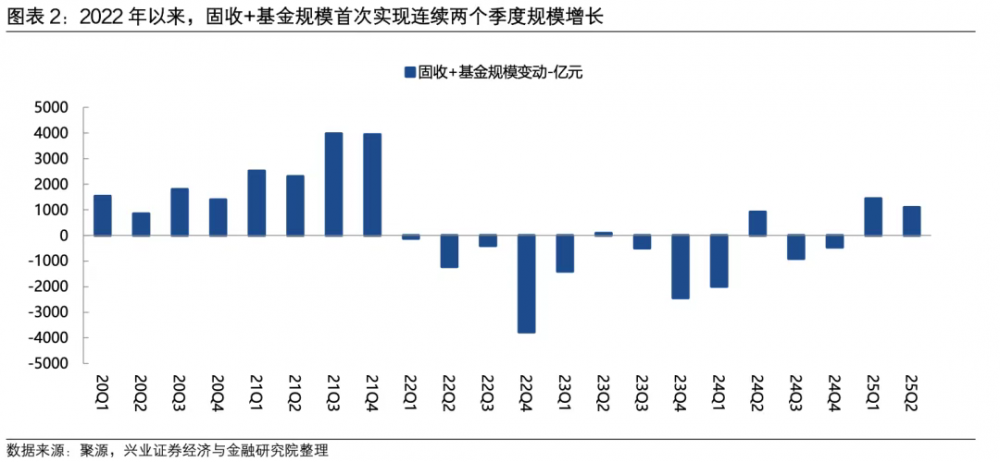
Core Viewpoint - The low-interest-rate environment has led to a significant increase in the popularity and growth of "fixed income plus" (固收+) funds, supported by regulatory guidance and market demand for stable investment options [1][24]. Group 1: Market Growth and Trends - As of June 30, 2025, the total market size of fixed income plus funds reached 1.93 trillion yuan, with a notable increase of 111.22 billion yuan in the second quarter of 2025, marking the first consecutive positive growth since 2022 [1][24]. - The growth rate for primary bond funds in Q2 2025 was approximately 25%, while secondary bond funds saw a 4% increase, and mixed bond funds experienced a 2% decrease [4][24]. - High-performing fixed income plus funds have attracted significant net subscriptions, with several funds exceeding 5 billion units in net purchases [3][24]. Group 2: Fund Performance and Characteristics - Many fixed income plus funds achieved positive returns in the first half of 2025, with 72 funds reporting returns over 6% [7][9]. - Three mixed bond funds reported annual returns exceeding 30%, while nearly 90 funds had returns between 10% and 30% [8][9]. - The performance of secondary bond funds was also strong, with over 50 funds achieving returns above 10% [9]. Group 3: Key Players and Strategies - Major fund companies like Yongying Fund, E Fund, and Invesco Great Wall have seen substantial growth in their fixed income plus fund offerings, with Yongying Fund's products ranking among the top in terms of scale increase [5][6][28]. - Yongying Fund employs a multi-strategy approach, integrating risk control and asset allocation to meet client needs, resulting in significant growth in their fixed income plus products [11][20]. - E Fund remains the largest player in the fixed income plus market, with a total scale exceeding 2 trillion yuan and a growth of over 172 billion yuan in the first half of 2025 [6][26]. Group 4: Regulatory Support and Future Outlook - The China Securities Regulatory Commission's action plan for promoting high-quality development of public funds has provided strong support for the growth of fixed income plus funds [1][24]. - The current market conditions, characterized by high volatility in the bond market and structural trends in the stock market, present an excellent opportunity to validate the effectiveness of fixed income plus strategies [7][24].