
固收+策略

Search documents
——固收+基金2025年Q4季报分析:25Q4绩优固收+基金有什么特征?
Hua Yuan Zheng Quan· 2026-03-13 02:57
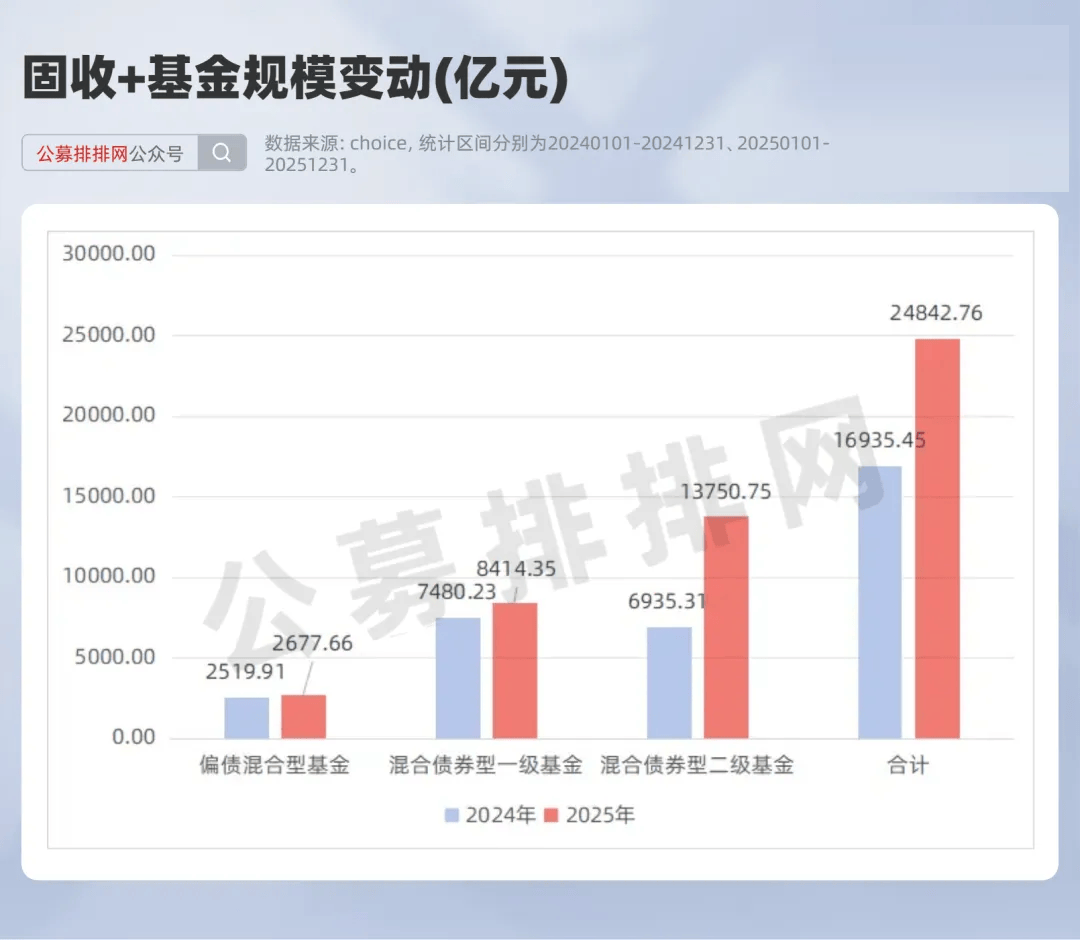
1. Report Industry Investment Rating - The report does not mention the industry investment rating. 2. Core Viewpoints of the Report - Since 2025, in a low - interest - rate environment, the scale of fixed - income plus funds has expanded significantly. In Q4 2025, the total scale reached about 2.83 trillion yuan, with the growth mainly coming from secondary bond funds. The industry shows a trend of increasing concentration [7]. - There is a significant performance differentiation among fixed - income plus funds. The report analyzes the performance causes of high - performing fixed - income plus funds in Q4 2025 and long - term high - performing funds, providing references for investors [14]. - High - performing fixed - income plus funds in Q4 2025 generally use higher stock and convertible bond positions, have a relatively short average bond duration, and show characteristics such as heavy positions in high - growth cyclical sectors and low positions in falling sectors [27][46]. - Long - term high - performing fixed - income plus funds have high return - risk matching, stable equity positions, and a multi - strategy synergy model to enhance returns [76][81]. 3. Summary by Relevant Catalogs 3.1 Industry Overview - **Scale and Growth**: In a low - interest - rate environment, the scale of fixed - income plus funds has expanded. By the end of Q4 2025, the total scale was about 2.83 trillion yuan, a 3.2% increase from Q3 2025. The scale growth mainly came from secondary bond funds, while the scale of primary bond funds continued to decline [7]. - **Industry Concentration**: The industry shows a trend of increasing concentration. The proportion of the top ten fund companies in the fixed - income plus fund scale increased from 46.0% in Q3 2025 to 48.4% in Q4 2025 [10]. - **Leading Companies and Products**: As of the end of 2025, E Fund and Invesco Great Wall Fund were the only two companies with a "fixed - income plus" scale exceeding 20 billion yuan. Some leading products had large scales and better performance than the average [13]. 3.2 Performance Overview of Fixed - Income Plus Funds - **Overall Performance in Q4 2025**: The arithmetic average quarterly return of fixed - income plus funds was 0.42%. The average returns of partial - debt hybrid funds, primary bond funds, secondary bond funds, and convertible bond funds were 0.28%, 0.59%, 0.43%, and 0.88% respectively. The proportion of products with positive returns was 75.0%, a decrease from Q3 2025 [16]. - **Top - Performing Funds in Q4 2025**: In different types of funds, there were top - performing products. For example, Orient Minfeng Return Ying'an Hybrid led the partial - debt hybrid funds with a 15.95% return in Q4 2025 [18]. - **High - Performing Fixed - Income Plus Funds in Q4 2025**: The high - performing funds met certain conditions, with returns ranging from 0.88% - 7.36%. They had characteristics such as good returns, solid risk control, stable scale, and balanced allocation [21]. 3.3 Allocation Characteristics of High - Performing Fixed - Income Plus Funds - **Leverage and Investor Structure**: In Q4 2025, the average leverage levels of high - performing fixed - income plus funds and the whole market showed differentiation. The leverage of high - performing primary bond funds and partial - debt hybrid funds was slightly higher than the market average, while that of high - performing secondary bond funds and convertible bond funds was lower. The investor structure also showed category differentiation, with institutional funds being the main force in secondary bond funds, primary bond funds, and convertible bond funds, while partial - debt hybrid funds were mainly held by individuals [28][32]. - **Bond Allocation**: The bond allocation structures of fixed - income plus funds and high - performing fixed - income plus funds were similar, with financial bonds as the core holding. High - performing funds had a higher proportion of treasury bonds and convertible bonds and a lower proportion of corporate bonds and medium - term notes. The average duration of high - performing funds was relatively shorter [35][43]. - **Stock Allocation**: High - performing fixed - income plus funds in Q4 2025 had heavy positions in high - growth cyclical sectors and low positions in falling sectors. The top - performing stocks were concentrated in cyclical, technology, and financial blue - chip stocks, with high concentration [46][55]. - **Convertible Bond Allocation**: The convertible bond positions of high - performing fixed - income plus funds were similar to those of the whole market, with bank convertible bonds as the core bottom - position and high - elasticity individual bonds. The performance of individual bonds was significantly differentiated [62]. 3.4 Long - Term High - Performing Fixed - Income Plus Funds - **Selection and Basic Information**: Four fixed - income plus funds with performance ranking in the top 30% of their peers in each full year in the past five years were selected, including primary bond funds, secondary bond funds, and partial - debt hybrid funds. They had different scales and stable returns [65][67]. - **Common Allocation Characteristics**: These funds had high return - risk matching, stable equity positions, and a preference for high - grade bonds. They adopted a "bond as the base + X" multi - strategy synergy model to enhance returns [76][81].
2025年银行理财规模普增,低利率环境下结构调整加速
第一财经· 2026-03-12 15:36
Core Viewpoint - The overall operational pattern of the banking wealth management industry is gradually emerging, with many banks' wealth management subsidiaries reporting positive growth in their 2025 operating data despite downward pressure on bond yields and a trend of "deposit disintermediation" [2][3]. Group 1: Industry Growth - Thirteen wealth management companies have reported their 2025 performance, showing that the industry scale has generally achieved positive growth, with a total management scale reaching 33.29 trillion yuan, an increase of 3.34 trillion yuan year-on-year, representing a growth of 11.15% [5][6]. - Leading the industry, Xingyin Wealth Management has a product scale exceeding 2.43 trillion yuan, followed by Puyin Wealth Management at 1.47 trillion yuan. Several city commercial banks also showed steady growth, with Su Yin Wealth Management and Hang Yin Wealth Management at 826.2 billion yuan and 607.6 billion yuan, respectively [5]. - Nine wealth management companies achieved double-digit growth, with foreign joint venture companies showing particularly strong growth, such as Far East Agricultural Bank Wealth Management, which increased from 48.7 billion yuan to 89.3 billion yuan, a growth of over 80% [5]. Group 2: Product Structure Changes - Despite the continuous expansion of wealth management scale, the structure of products is changing due to declining asset yields. Fixed-income products still dominate but the proportion of mixed products is gradually increasing, with mixed products reaching a scale of 870 billion yuan, accounting for 2.61% of the total [10]. - For instance, Xingyin Wealth Management's fixed-income product scale is 2.26 trillion yuan, accounting for 98.19%, while its mixed product scale has nearly doubled to 34.9 billion yuan, now accounting for 1.52% [10]. - The "fixed income plus" strategy has become a major focus for wealth management companies, with products typically based on stable assets like bonds, supplemented by a small allocation to equity or commodity assets to enhance returns [12]. Group 3: Future Trends - The trend of increasing wealth management scale is expected to continue into 2026, with estimates suggesting an increase of 1.5 trillion to 2.3 trillion yuan in the scale of wealth management products [6][7]. - The competition for funds is intensifying, with insurance products potentially diverting some funds, although the overall impact is expected to be limited [8]. - In the current low-interest-rate environment, wealth management products may further evolve towards multi-asset and multi-strategy configurations to enhance yield flexibility [19].


“固收+”基金规模持续扩张!零售端成申购主力
券商中国· 2026-03-11 23:40
Core Viewpoint - The "fixed income +" funds are becoming increasingly popular among residents for asset allocation amid stock market fluctuations and declining returns on financial products [1] Group 1: Fund Inflows and Growth - Since the beginning of the year, there has been a significant influx of funds into "fixed income +" funds, with ordinary individual investors becoming the main contributors, indicating a clear trend of residents moving their deposits [2][4] - A flagship "fixed income +" fund recently experienced inflows of up to 1 billion yuan in a single day, with weekly inflows reaching around 10 billion yuan [3] - The total issuance scale of newly established "fixed income +" funds has exceeded 30 billion yuan since 2026, with several funds surpassing 2 billion yuan in initial fundraising [4] Group 2: Performance and Returns - Over the past three years, more than 96% of "fixed income +" funds have achieved positive returns, with 59 funds yielding over 30% [6] - Notably, the Huaan Zhilian A fund achieved a remarkable return of 80.02%, despite a maximum drawdown of 17.64% [6] - The performance growth is reflected in the scale of funds, with "track-type fixed income +" funds showing significant growth compared to those with balanced stock allocations [6] Group 3: Market Outlook and Strategy - The fixed income team at CICC suggests that the growth of "fixed income +" funds will be driven by retail investors, as institutional demand may not see significant breakthroughs in 2026 [5] - Fund managers emphasize the importance of equity asset allocation in 2026, with expectations of moderate economic recovery and stable external demand [8] - Investment strategies will focus on structural opportunities in sectors such as AI, military, new energy, and innovative pharmaceuticals, which are expected to be key areas for equity allocation within "fixed income +" strategies [8][9]

银行理财2026年3月月报:规模恢复增长,告别收益“打榜”
Guoxin Securities· 2026-03-07 10:45
Investment Rating - The report maintains an "Outperform" rating for the banking wealth management industry, indicating expected performance exceeding the market benchmark by over 10% [39]. Core Insights - The wealth management scale is gradually recovering, with a slight month-on-month increase in February, reaching a total of 31.7 trillion yuan, indicating a positive growth trend [1][11]. - Regulatory measures have been implemented to address the "ranking" phenomenon in wealth management products, which previously distorted market order by artificially inflating short-term high-yield products. This shift is expected to lead to a more stable and sustainable operating environment in the long term [2][3]. - The downward trend in baseline yields for wealth management products is prompting a shift towards enhanced yield strategies, with recent interest in equity and gold strategies. For instance, a certain wealth management product achieved over 7% annual net value growth through diversified asset allocation [3][10]. Summary by Sections Wealth Management Scale - In February, the wealth management product stock scale slightly increased by 0.1 trillion yuan, with cash management and fixed-income products remaining the dominant categories [11][10]. New Product Issuance - The initial fundraising scale for newly issued products in February was 299.5 billion yuan, primarily consisting of fixed-income products. The average performance benchmark for new products showed a slight rebound to 2.35% [18][10]. Product Performance - Most products that matured in February met their performance benchmarks, with 1,434 closed-end wealth management products reaching expected returns [27][10].
固收-扩容下的资金面分析和择时思路-解码转债超额收益之源
2026-03-01 17:23
Summary of Key Points from the Conference Call Industry Overview - The convertible bond market is dominated by institutional investors, with five main types (public funds, corporate annuities, insurance institutions, private equity funds, and securities firms' asset management) holding over 80% of the market share, while the share of general institutions and individuals continues to decline [1][6][5]. Core Insights and Arguments - **Market Sentiment Impact**: Optimistic market expectations lead to increased institutional holdings in convertible bonds, while pessimistic sentiments result in a decrease. Historical data shows that during periods of market pessimism (early 2022, end of 2023, and mid-2025), institutional holdings in convertible bonds declined [1][7]. - **Investment Strategy Shift**: The trend towards institutionalization and stock-like characteristics in convertible bonds has altered the investment framework, reducing the effectiveness of traditional dual-low strategies and increasing the weight of fundamental-driven individual bond selection [1][9]. - **Structural Market Characteristics**: The market exhibits structural features where the elasticity of underlying stocks and fundamental differences across industries lead to decreased consistency in cross-industry strategies [1][9]. - **Winning vs. Odds Thinking**: In a structured market, the focus on "winning probability" is more critical than "odds thinking." High-premium stock-like convertible bonds can still exhibit strong upward movement due to their close correlation with underlying stocks [1][9]. - **Institutional Composition Changes**: By 2025, the share of public funds, securities firms, and private equity in the convertible bond market is expected to rise, while the direct investment share of annuities and insurance funds is projected to decline [10][5]. Important but Overlooked Content - **Convertible Bond Valuation Drivers**: The core variables affecting convertible bond valuations have narrowed to "fixed income + incremental funds," which are closely tied to stock market expectations. Zero-coupon and near-strong redemption convertible bonds tend to have weaker valuation increases [11][13]. - **Behavior of Insurance Funds**: Insurance funds tend to engage in left-side positioning during stock market declines and convertible bond valuation drops, while they sell off during market upswings or when valuations are high [10][12]. - **Differentiation in Fund Types**: By 2025, a clear differentiation is expected between primary and secondary bond funds, with secondary bond funds showing a higher allocation to convertible bonds due to their greater flexibility in stock allocations [11][12]. - **Risk Variables for High-Valuation Convertible Bonds**: The primary risk variable remains stock market expectations, with historical trends indicating that premium rates tend to rise during positive market sentiment and decline when expectations fall [15][16]. Conclusion - The convertible bond market is undergoing significant changes driven by institutional investment trends and market sentiment. Understanding these dynamics is crucial for identifying potential investment opportunities and risks in the evolving landscape of convertible bonds.
最具爆发潜力的配置方向、行稳致远的配置策略有哪些?
Qi Huo Ri Bao· 2026-02-23 23:04
Core Viewpoint - The article discusses the investment strategies and asset allocation approaches for the year of the Horse, emphasizing the shift towards equity and physical assets in a low-interest-rate environment, while also highlighting the importance of diversification and risk management through various financial instruments [1][7]. Group 1: Macro Trends - The trend of residents moving deposits to capital markets is confirmed, with a significant increase in non-bank institution deposits expected to rise by 6.4 trillion yuan by 2025 [2]. - The scale of bank wealth management products is projected to exceed 33 trillion yuan, increasing by 3.3 trillion yuan compared to the end of 2024, with over 97% being fixed-income products [2]. Group 2: Asset Allocation Strategies - The "fixed income plus" strategy is anticipated to become mainstream, combining stable fixed-income assets with equity investments to enhance overall returns [2]. - The allocation ratio should be dynamically calibrated based on risk-return objectives, ranging from 90:10 for conservative investors to 70:30 for aggressive ones [2]. Group 3: Sector Focus - Investment focus should be on sectors such as non-ferrous metals (copper, aluminum, tin), chlor-alkali industry, and fine chemicals, as these areas are expected to benefit from sustained demand despite limited capital expenditure [3]. - The strategy of "dual expression" allows investors to manage risks within a sector while capitalizing on price movements in commodities [3]. Group 4: Risk Management and Diversification - The concept of diversification is emphasized as a "free lunch" in investing, with a focus on identifying growth opportunities and managing positions dynamically based on market conditions [4]. - Non-linear derivatives, such as deep out-of-the-money put options, are recommended for asymmetric risk protection in volatile markets [6]. Group 5: Investor Guidance - Investors are advised to define their capability circle, focusing on areas of expertise and avoiding unfamiliar investments to achieve sustainable returns [7]. - Specific risk management guidelines include limiting investment to 30% of available capital, avoiding illiquid contracts, and prioritizing strategies with limited risk and returns [7].
2026年有几十万亿存款到期,会流入股市、利好A股吗?|投资小知识
银行螺丝钉· 2026-02-17 13:01
Group 1 - The total scale of fixed-term deposits maturing in 2026 is estimated to be around 50 trillion, with most maturing in the first two quarters of 2026 [2] - Current deposit interest rates are relatively low, mostly around 1% compared to 2021-2022, leading to a low risk appetite for deposit funds [2] - A few hundred billion to a trillion level of funds may flow into the stock market, which is beneficial but not significantly large [3] Group 2 - Investment in financial products or funds is primarily focused on "fixed income +" strategies, with bonds as the main component and stocks as a supplementary part [4] - The stock portion of these strategies tends to focus on low volatility and low dividend stocks, which could benefit dividend indices [4] - The market size for "fixed income +" strategies is expected to grow rapidly in 2026 [4]

如何选出长期绩优的“固收+”基金?关键看这几大点
Sou Hu Cai Jing· 2026-02-10 07:20
Core Viewpoint - The demand for stable income investments is increasing, leading to a significant growth in the scale of fixed income plus (固收+) funds, which reached 2.48 trillion yuan by the end of 2025, reflecting a year-on-year growth rate of 46.69% [1][5]. Group 1: Current Market Environment - In the current low interest rate environment, traditional investment products such as fixed deposits and money market funds have seen declining yields, failing to meet investors' needs for stable asset appreciation [3]. - Pure bond funds are also struggling to achieve investment goals due to reduced coupon rates and increased volatility in the bond market [3]. Group 2: Advantages of Fixed Income Plus Strategy - The 固收+ strategy combines bond assets as a base with selected equity assets to enhance returns, resulting in a more favorable risk-return profile compared to pure bond funds [4]. - This strategy offers higher yield elasticity than pure equity funds while maintaining lower risk and volatility, providing a better holding experience for investors [4]. Group 3: Market Demand and Growth - The rapid growth of 固收+ funds, outpacing equity funds, indicates strong investor demand for assets that balance risk and return in a low interest rate and volatile market environment [5]. - The 46.69% year-on-year growth in 固收+ funds by 2025 is a direct response to the market's need for such investment strategies [5]. Group 4: Types of Fixed Income Plus Funds - 固收+ funds are generally defined as those with a bond base and an equity allocation of 5% to 30%, which includes stocks, convertible bonds, and equity funds [7]. - Some flexible allocation funds that are bond-heavy can also be classified as 固收+ funds [8]. Group 5: Performance Evaluation of Fixed Income Plus Funds - To identify high-performing 固收+ funds, four core indicators should be considered: annualized volatility, maximum drawdown since inception, equity allocation ratio, and the Calmar ratio [13][14][15]. - Low volatility funds typically have an equity allocation ratio of less than 10%, a maximum drawdown of less than 5%, and an annualized volatility of less than 5% [17]. - Medium volatility funds have an equity allocation ratio between 10% and 20%, with similar drawdown and volatility criteria [17]. - High volatility funds have an equity allocation ratio between 20% and 30%, with a maximum drawdown of less than 5% and an annualized volatility of less than 10% [17].
银行理财 2026 年 2 月月报:从财报看理财子如何布局多资产
Guoxin Securities· 2026-02-08 10:45
Investment Rating - The report maintains an "Outperform" rating for the banking sector, indicating expected performance above the market benchmark by more than 10% [4][41]. Core Insights - The banking wealth management sector is experiencing a slight increase in scale, with a focus on loan growth at the beginning of the year, leading to a stable overall scale in January [1]. - The industry is characterized by a significant "Matthew Effect," where leading wealth management companies dominate the market, while smaller firms are still in the early stages of development [1][10]. - The transition from pure fixed income to "fixed income plus" and multi-asset strategies is a gradual but firm trend in the industry, with mixed-asset products becoming the main battlefield for this transformation [1][2]. Summary by Sections Wealth Management Product Layout - As of the end of 2025, there are 191 institutions with active wealth management products, with wealth management companies holding 92.25% of the total market scale [10]. - The mixed-asset and equity products are primarily concentrated among large banks and leading joint-stock banks, reflecting a strategic focus on these areas [10]. Performance Metrics - In January 2026, the weighted average annualized yield of bank wealth management products rose to 3.62%, an increase of 181 basis points from the previous month [11]. - The initial fundraising scale for newly issued products in January was 423.8 billion, with most being fixed-income products [20]. Product Development Strategy - Wealth management subsidiaries are advised to prioritize mixed-asset products to build experience in equity and derivatives management before cautiously introducing pure equity products [2]. - Leading firms like Agricultural Bank Wealth Management and Everbright Wealth Management have established scale advantages in mixed-asset products, leveraging their channel and brand strengths [2]. Market Outlook - The investment strategy for 2026 should shift from focusing on yield elasticity to ensuring yield certainty, emphasizing risk budget management and the use of innovative tools and strategies [3]. - The report suggests increasing the development and application of structured products linked to broad or industry indices to meet the demand for stable returns in a volatile market [3].
银行理财2026年2月月报:从财报看理财子如何布局多资产-20260208
Guoxin Securities· 2026-02-08 08:25
Investment Rating - The report maintains an "Outperform" rating for the banking sector, indicating expected performance above the market benchmark by more than 10% [4][41]. Core Insights - The banking wealth management sector is experiencing a low overall allocation in multi-asset products, with significant individual differences and early-stage development characteristics [1]. - The industry is transitioning from pure fixed income to "fixed income plus" and multi-asset strategies, with mixed products currently being the main battleground for this transformation [2]. - In January 2026, the average annualized yield for bank wealth management products increased to 3.62%, reflecting a recovery of 181 basis points month-on-month [11]. Summary by Sections Market Overview - In January, the wealth management product scale remained stable, with a total scale of 31.6 trillion yuan, showing little month-on-month change [13]. - The mixed product scale reached 6,383.7 billion yuan, significantly higher than the equity product scale of 271.5 billion yuan, indicating a preference for mixed strategies [12]. Product Performance - The newly issued products in January had an initial fundraising scale of 4,238 billion yuan, primarily consisting of fixed income products, with the performance benchmark remaining stable at 2.33% [20]. - Most of the closed-end bank wealth management products that matured in January met their performance benchmarks, demonstrating a strong performance in the sector [29]. Strategic Development - Wealth management subsidiaries are focusing on mixed products first, gradually building a multi-asset allocation framework before introducing pure equity products [2]. - Leading wealth management institutions are leveraging their channel and brand advantages to strengthen mixed products as core tools for wealth management clients [2].